Symposium · Aesthetics · Pl. 2Edmund Burke · 1729–1797
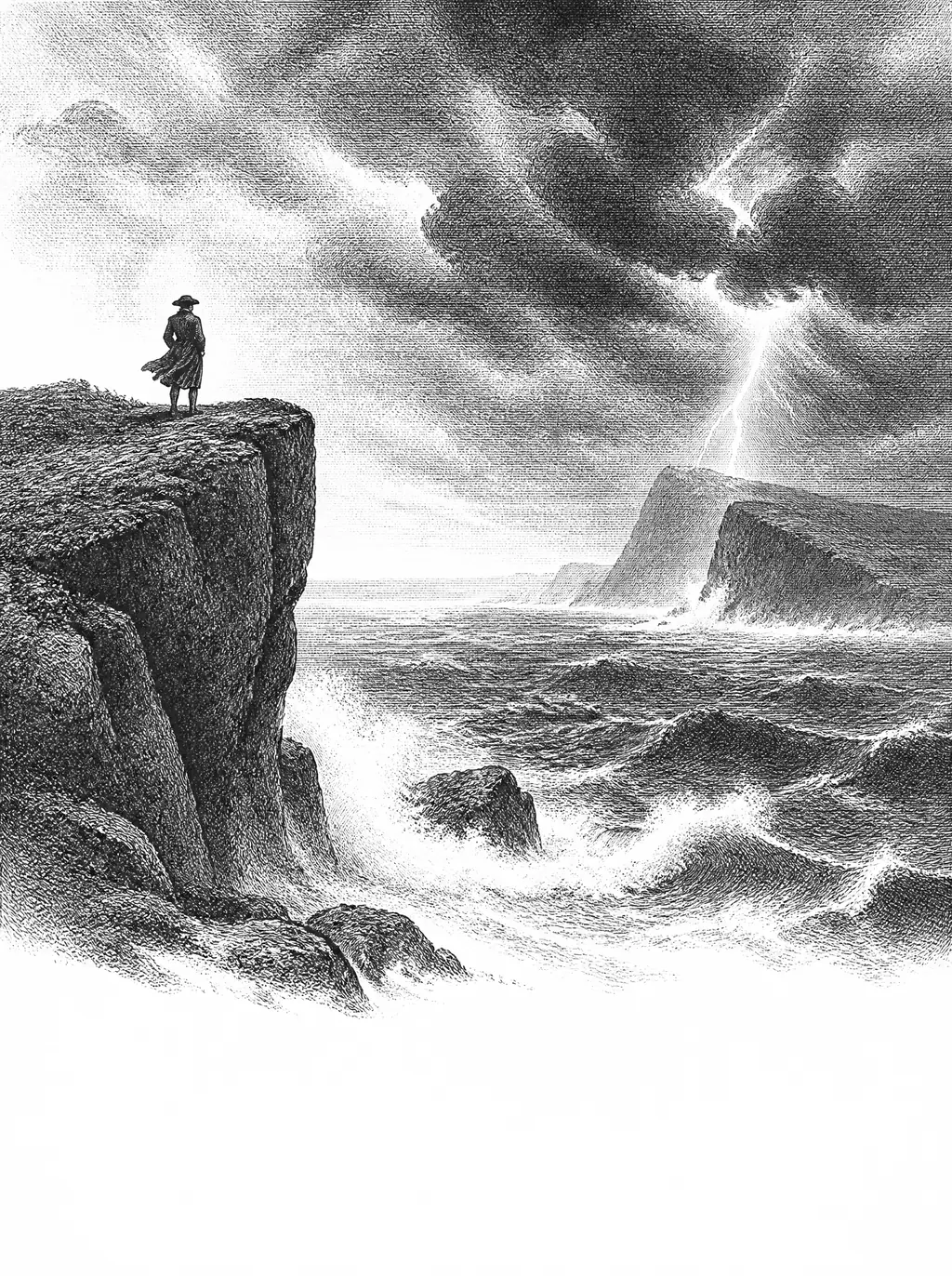
The Strongest Emotion the Mind Can Feel
Two feelings, not one
Before Burke, beauty was treated as the single measure of aesthetic quality, with everything else counted as a lesser or failed version of it. Burke instead separates beauty from a second, rival category entirely, the sublime, built not from pleasant smallness and gentle proportion but from vastness, obscurity, and a controlled brush with real terror. His examples are physical: darkness, silence, the sudden roar, the ocean, a precipice, the ox that is merely useful and the bull that is dangerous. Beauty relaxes the body; the sublime tightens it. Burke wanted an account that explained why a ruin at dusk grips you harder than a garden at noon, and why you go back for more.
The world it came from
Edmund Burke published A Philosophical Enquiry into the Origin of Our Ideas of the Sublime and Beautiful in 1757, at twenty-eight, a young Irishman in London with no political career yet. He had drafted it as a student in Dublin. The word sublime was in the air: Boileau's translation of Longinus had made it fashionable, Addison had written on the pleasures of the imagination, and the Grand Tour had put educated Englishmen in front of the Alps, which they had been taught to find horrid and were starting to find magnificent. Burke's method came from Locke and the empiricists: trace every idea to sensation and every pleasure to the body. His problem was to explain, in physiological terms, why pain kept at a distance could please.
The idea
Whatever is fitted in any sort to excite the ideas of pain and danger... is a source of the sublime; that is, it is productive of the strongest emotion which the mind is capable of feeling. Beauty, by contrast, Burke ties to smallness, smoothness, and gentle pleasure, a genuinely separate aesthetic category rather than a milder version of the same underlying experience. The sublime is rooted in self-preservation, the beautiful in society, the attraction that draws people together. Because self-preservation is the stronger drive, its passions are stronger. The sublime produces not pleasure but what Burke calls delight, the relief that comes when pain or danger is present in idea but removed in fact. Astonishment is its highest degree: the mind is filled and cannot reason.
How the reasoning runs
Burke's argument runs through the body. First, the passions divide by what they serve: those of self-preservation, which concern pain and danger, and those of society, which concern pleasure and company. Second, pain and danger are far more powerful than any pleasure, because the body's stake in survival is higher. Third, when pain or danger is present only in idea, at a safe distance, the nerves are exercised without being harmed, and the result is a distinct emotion, delight, that feels like relief and awe together. Fourth, whatever tends to produce that emotion, vastness, obscurity, power, privation, is a source of the sublime. Since beauty works through the opposite qualities and the opposite bodily state, relaxation, the two cannot be degrees of one thing.
Seen in life
You are in the cinema for a film about the ocean, and there is a shot from inside the wave as it goes over the swimmer, the sound cut to almost nothing, the light green and going dark. You grip the armrest. You are on a padded seat forty miles from the coast, and your body has decided otherwise. Burke would say you are feeling the sublime exactly as he described it: the idea of pain and danger, delivered with obscurity and vastness, at a distance that lets it thrill instead of kill. Afterwards you say the film was beautiful, and he would correct you. It was not beautiful. Beautiful was the shot of the beach house. The wave was something stronger.
Why it matters
This split beauty and the sublime into two genuinely different aesthetic categories rather than degrees of the same thing, giving critics a vocabulary for mountains, storms, and ruins that pleasant landscapes could never earn on their own terms. It fed directly into Romantic art and poetry's fascination with vastness, wildness, and awe. It also grounded aesthetics in the body rather than in taste or reason. Burke did not ask what an educated person ought to admire; he asked what the nerves do, and treated the answer as evidence. That move made aesthetics a branch of psychology a century before the word, and it explains why horror, disaster footage, and the thrill ride still sell: they are the sublime, packaged.
“Whatever is fitted in any sort to excite the ideas of pain and danger...is a source of the sublime; that is, it is productive of the strongest emotion which the mind is capable of feeling.”
From the source
Burke opens his account of the sublime with the claim itself: “Whatever is fitted in any sort to excite the ideas of pain and danger...is a source of the sublime; that is, it is productive of the strongest emotion which the mind is capable of feeling.” Real danger, he adds elsewhere, ruins the effect; only safe terror produces it. The passage is Part One, section seven of the Enquiry, headed 'Of the Sublime'. The second edition of 1759 added an introductory essay on taste, in which Burke argued that taste has a common basis in the senses and can therefore be reasoned about. Part Two catalogues the sources of the sublime one by one: terror, obscurity, power, privation, vastness, infinity, difficulty, magnificence.
The pushback
Doesn't grounding the sublime in terror risk making horror and beauty impossible to tell apart, since both can involve powerful, overwhelming feeling at their extreme? Burke's answer rests on distance and safety, the storm watched from shore rather than the ship actually sinking, though critics have kept probing exactly how much real danger the sublime can tolerate. Kant's objection is different and sharper. If the sublime were only a matter of nerves and distance, it would be a species of fear, and fear is not admirable. What we feel before the storm, Kant says, is not relief that we are safe but the discovery that something in us, reason, is not measured by the storm at all. Burke has described the physiology and missed the point.
The reply
Burke's reply to the horror objection is distance, and the terror must not press too close, or delight turns to simple pain. That leaves a grey zone, and he does not pretend otherwise. To Kant he never replied; the Critique of Judgement appeared in 1790, when Burke was consumed by the French Revolution, and there is no sign he read it. His defenders do. Kant explains the sublime of the philosopher, who feels his reason vindicated; Burke explains the sublime of everyone in the cinema, who feels nothing of the kind and is gripped anyway. Kant says what the feeling ought to mean; Burke says where it comes from. Which is deeper depends on whether you trust the body or the mind as witness.
Where it went next
The Enquiry was read across Europe within a decade. Diderot borrowed from it; Lessing began a translation; Kant's Observations on the Feeling of the Beautiful and Sublime (1764) starts from Burke's distinction, and the Critique of Judgement (1790) takes it apart. In England it licensed a taste for gloom: Gothic novels, Fuseli's nightmares, Turner's storms, Wordsworth's mountains. Piranesi's prison etchings, made in Rome before the Enquiry, show the same appetite arriving on its own. The Romantic sublime is Burke's terror with Kant's mind added. Two centuries later Barnett Newman's essay 'The Sublime Is Now' (1948) credited Burke with first seeing the sublime as a rejection of beauty, and Lyotard revived the category for abstract painting. Every disaster film and every skyscraper viewing platform is trading on Part Two.
Where this leads
The image of a great soul shows an ancient critic, Longinus, reaching a strikingly similar conclusion about literary greatness centuries earlier, though he locates the sublime not in nature's storms and precipices but in the sheer scale of the mind producing the words on the page. Beauty without wanting anything is the reply from Königsberg. Kant took Burke's split between beauty and the sublime and rebuilt both on the mind's own faculties, with beauty as disinterested pleasure and the sublime as reason's triumph over what overwhelms the senses. Read Burke first and Kant second, and you can watch the sublime move from the nerves to the intellect.