Symposium · Aesthetics · Pl. 9Plato · c. 428–348 BC
Art Is a Shadow of a Shadow
A ladder of beds
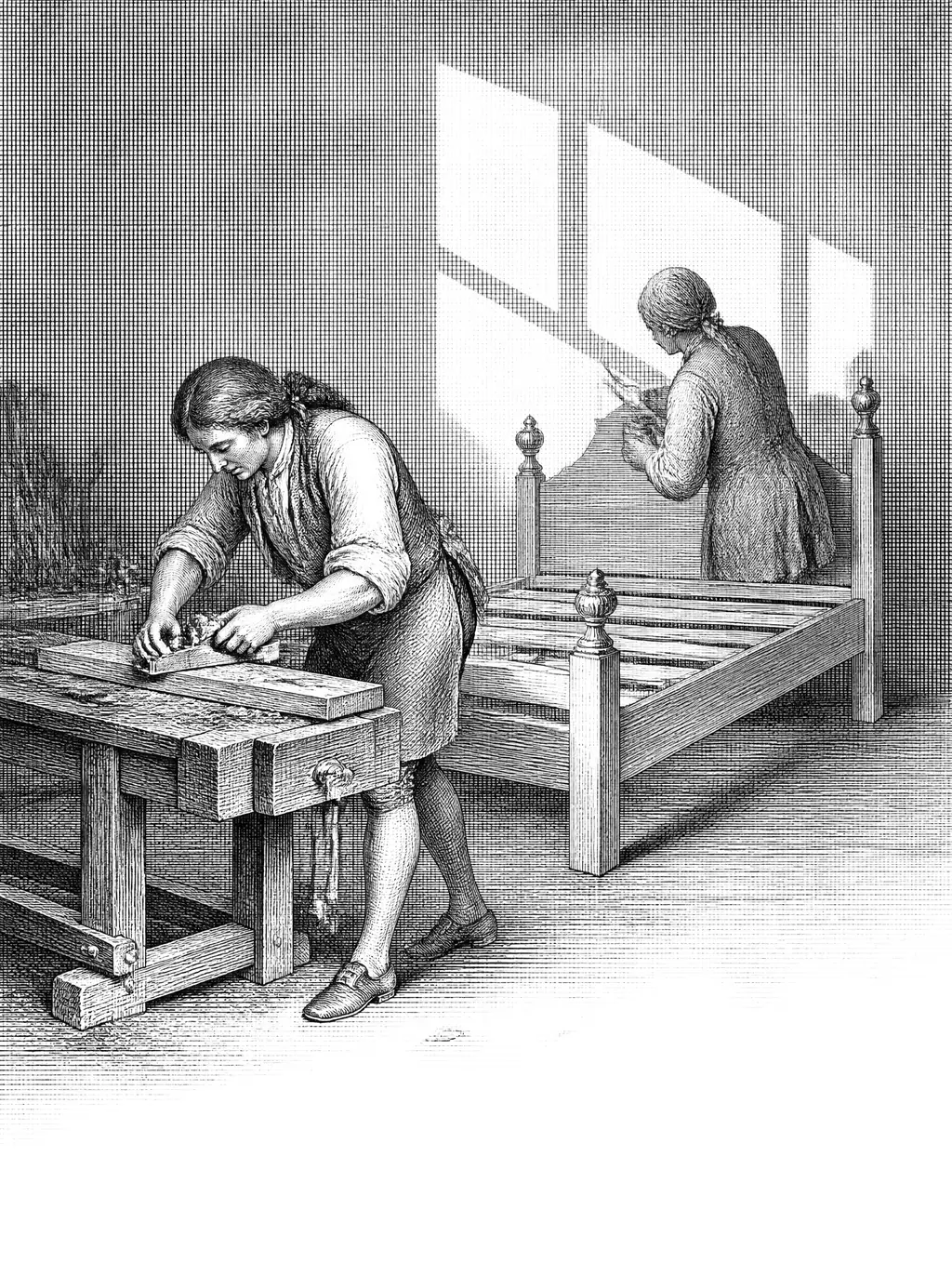
Socrates walks Glaucon through a ladder of beds: the Form of Bed that only reason grasps, the carpenter's bed built from that Form, and the painter's bed, a picture of the carpenter's bed seen from one angle only. Poets, Socrates argues, work exactly like painters, and tragedy is built from the very same kind of copy. Hold a mirror up and turn it, Socrates says, and you will quickly make the sun, the sky, the earth, and every bed. That is the painter's whole skill: a maker of appearances, who has never made a thing. The reader who winces at that description of painting is meant to wince harder when it is applied to Homer.
The world it came from
Plato wrote the Republic in Athens around 375 BC, a quarter century after the city had put his teacher Socrates to death. Book X, where the argument about imitation comes, is the last book, and it returns to a subject the dialogue had already treated in Books II and III: what stories the young guardians of the ideal city should be allowed to hear. In Plato's Athens, Homer was scripture, school curriculum, and public entertainment at once; tragedy was a civic festival attended by the whole citizen body. Plato had himself, by tradition, written tragedies before he met Socrates, and burned them. The theory of Forms, developed in the middle books, gave him a new weapon: if reality is the Forms, then art is at two removes from it.
The idea
The tragic poet is an imitator, and therefore, like all other imitators, he is thrice removed from the king and from the truth. Painting copies an appearance rather than a reality; poetry copies actions and characters without the poet needing any real expertise in what he describes, so both trade in likeness rather than knowledge. Two charges travel together. The first is about truth: imitation has no grip on the real. The second is about the soul: imitation feeds the part of us that weeps and laughs and wants, the part reason should govern, and it does so by presenting suffering we would be ashamed to indulge in ourselves. On both counts poetry is dismissed from the just city, with regret and an invitation to appeal.
How the reasoning runs
The argument has three tiers and a coda. First, for each kind of thing there is one Form; a craftsman who makes a bed looks to that Form, so the bed is one step from reality. Second, a painter looks only to the bed, and only to its appearance from one side, so the painting is two steps from reality: an imitation of an appearance. Third, the poet is a painter in words. Homer describes generals and doctors without having been either, and no city was ever governed by him, so his poems are appearances of virtue, not virtue. Coda: imitation feeds the lower part of the soul, so it does harm as well as no good. Therefore banish it, unless it can plead its case.
Seen in life
You have watched more surgeries on television than any surgeon has performed, and you have never held a scalpel. You know what leadership looks like, from films in which actors who have never led anyone strode down corridors to music. Plato's Socrates wants you to feel the gap. What you have absorbed are appearances of skill, composed by people who copied other appearances, and the vividness that makes them stick is exactly what he distrusts. The scene in which the doctor breaks bad news beautifully teaches you nothing about medicine and quite a lot about what a beautiful breaking of bad news should look like. That, he would say, is a copy of a copy, doing its work on the part of you that does not check.
Why it matters
This threatens poetry's whole claim to teach anything true about courage, justice, or the gods, since a copy of a copy carries no guaranteed link to the underlying reality it depicts. A city that takes its moral education from Homer, on this argument, may be absorbing polished appearances rather than genuine wisdom itself. It also forces the question every later theory of art has had to answer: what, if anything, does art know? Aristotle's reply that poetry is more philosophical than history, because it shows what kinds of things happen, only exists because Plato asked. So does every defence of fiction as a way of knowing, and every worry about what the screen is teaching the young.
“The tragic poet is an imitator, and therefore, like all other imitators, he is thrice removed from the king and from the truth.”
From the source
Socrates presses the point to its sharpest form: “The tragic poet is an imitator, and therefore, like all other imitators, he is thrice removed from the king and from the truth.” The painter, three steps back from a real bed, becomes the working model for every imitative art, poetry fully included. The passage is Republic Book X, 597e, in Benjamin Jowett's translation. Plato's 'king' is obscure; most readers take it to mean the Form itself, or the god who made it, the one true bed of which all others are copies. A few pages later Socrates adds the second charge, that poetry waters the passions, and closes with the admission that he himself feels Homer's charm and would gladly hear the case for readmitting him.
The pushback
Doesn't this prove too much, condemning nearly every art form, including the very dialogues Plato wrote to make this argument in the first place? Defenders of poetry, from Aristotle onward, have replied that imitation can still capture something universal about human action, even without the imitator possessing a craftsman's technical knowledge of the subject. A second objection targets the ladder itself. The painter does not copy the carpenter's bed; the painter makes a new thing, a picture, with its own craft and its own truths about light and shape, and Plato's own Athens had painters who knew that. The metaphor of the mirror does not describe what a painter does, and once the painter is released from the ladder, the poet goes with him.
The reply
Plato's answer to the self-reference charge is built into the text: the Republic is not an imitation of appearances but an argument, and the myths inside it are labelled as myths and serve reason. Whether that distinction holds is disputed; his dialogues are dramatic, and he knew it. To Aristotle he never replied, since the Poetics came after his death, but a Platonist can say that showing what happens is not knowing why, and Plato asked for the why. On the painter, the tradition has conceded. Almost no one now thinks a painting is a copy of an appearance, and the ladder has lost that rung. What survives is the ethical charge: art moves the part of you that does not check, and something should.
Where it went next
Aristotle's Poetics is the first and greatest reply, rescuing imitation by making it a way of grasping universals. Plotinus rescued it differently, arguing that the artist looks past the object to the Form and so stands closer to truth, not further. Augustine and the iconoclasts inherited the suspicion; Sidney's Defence of Poesy (1595) and Shelley's Defence of Poetry (1821) inherited the invitation to appeal. In the twentieth century Iris Murdoch's The Fire and the Sun took Plato's side with reservations, and Erich Auerbach's Mimesis (1946) made the word the title of the history of Western realism. Every argument about screen violence, deepfakes, and whether fiction teaches or corrupts is Book X with new examples, and the poets have still not won the appeal outright.
Where this leads
Life imitates art shows Oscar Wilde taking the opposite side of this very old argument, insisting that art does not trail behind reality copying it badly, but actively teaches people what to notice and feel, reshaping their perception rather than merely reflecting it back at them. Plato's cave is the same ladder seen from inside. The prisoners take shadows for the world, and Book X says the poet is a maker of exactly such shadows. Put the two together and the charge against art becomes clear: it is not that poetry lies, but that it keeps you comfortable facing the wall. Wilde's reply is that the shadows were always all we had, so choose good ones.