Symposium · Political Philosophy · Pl. 2Aristotle · 384–322 BC
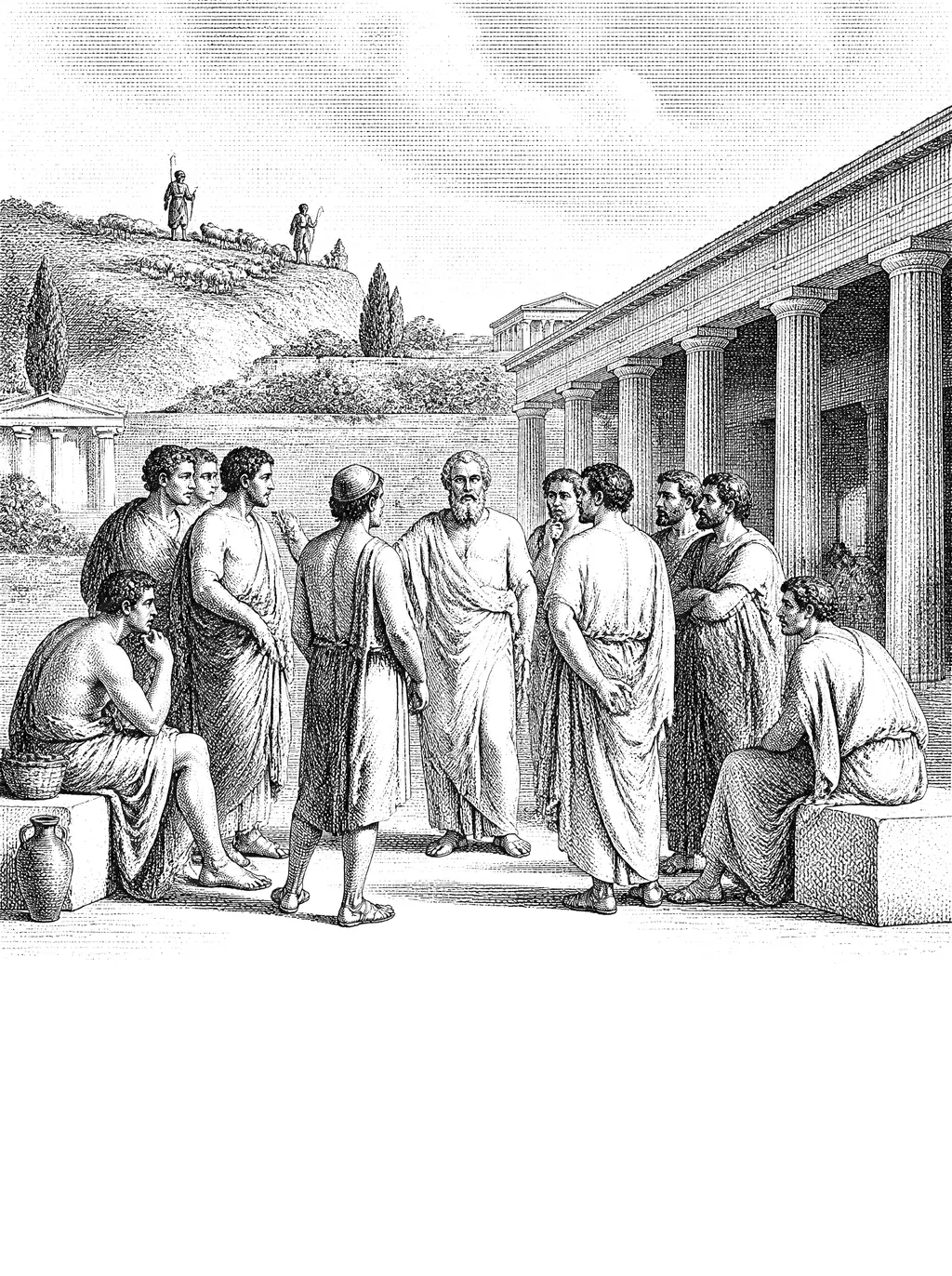
Man Is a Political Animal
A claim built from small societies up
Aristotle traces the city back through its smaller ancestors, the household, the village, arguing each one exists so that the next, larger form of community can exist, until the city itself appears as the point where a group finally becomes self-sufficient. He does not treat this as an accident of history. He treats it as nature completing itself. The claim was made about a form of life that was already dying. Aristotle wrote the Politics while Macedonian armies were swallowing the independent cities he described, and his own most famous student was doing the swallowing. He was giving the polis its theory at the moment it stopped being the future.
The world it came from
Aristotle was born in 384 BC in Stagira, in the north, the son of a physician to the Macedonian court. He spent twenty years in Plato's Academy, left Athens after Plato's death, and around 343 was hired by Philip of Macedon to tutor his son Alexander. He returned to Athens in 335 and founded the Lyceum, where his school collected descriptions of 158 constitutions; the one on Athens survived on papyrus and was found in 1890. He was a resident alien in Athens, unable to own property or vote. When Alexander died in 323 and anti-Macedonian feeling rose, Aristotle left, reportedly saying he would not let Athens sin twice against philosophy. He died in Chalcis the following year.
The idea
A city is a natural production, and man is naturally a political animal, and whosoever is naturally and not accidentally unfit for society must be either inferior or superior to man. The gift of speech, which lets people communicate not just pleasure and pain but what is just and unjust, shows humans are built for a shared, deliberative life beyond mere survival together. Political here does not mean interested in politics. It means belonging to a polis, a self-governing community, the way a bee belongs to a hive. Bees, though, only signal. Humans argue about what is fair, and that arguing, Aristotle says, is the activity the city exists to house.
How the reasoning runs
Start with what nature means for Aristotle: a thing's nature is what it is when fully grown, the oak rather than the acorn. Next, trace human community as it grows. Two people form a household to survive; households form a village for more than daily needs; villages form a city, the first self-sufficient community. So the city is the mature form of human association, its nature, and it exists not merely for living but for living well. Third, look at the equipment. Animals have voice, which signals pain and pleasure. Humans alone have speech, which can state what is just and unjust, and nature makes nothing without a purpose. Therefore humans are built for the city, and whoever needs none is a beast or a god.
Seen in life
You move to a new town for work and spend the first year as a private citizen in the fullest sense: you commute, you shop, you stream, you speak to nobody who is not paid to speak to you. You are not unhappy, exactly. Then a developer proposes to close the park at the end of your street, and you go to the council meeting to object. Something happens in that room. You are arguing with strangers about what is fair to everyone, and you find that you are better at it than you expected and that you care more than you knew. Aristotle would say that you had been living like an animal with a good apartment. Speech about justice is what the equipment is for.
Why it matters
This treats political community as fulfilling human nature, not merely protecting people who would otherwise prefer solitude. On this view, a person entirely outside any community is not simply unlucky, but missing something essential to being fully human, since reasoning about justice together with others is exactly what language and reason were built for. The consequence is a different measure of a good state. Hobbes and Locke ask whether a government keeps you safe. Aristotle asks whether it gives you somewhere to be a citizen, to deliberate and decide with others. A society that keeps everyone comfortable and nobody involved passes the first test and fails the one he cared about.
“A city is a natural production, and man is naturally a political animal, and whosoever is naturally and not accidentally unfit for society, must be either inferior or superior to man.”
From the source
Having traced the household and the village up to the city, Aristotle states the conclusion directly: “A city is a natural production, and man is naturally a political animal, and whosoever is naturally and not accidentally unfit for society, must be either inferior or superior to man.” The sentence is in Book I, Chapter 2 of the Politics. Aristotle then makes the contrast with other animals: they have voice, to signal pleasure and pain, but only humans have speech, which is for declaring what is useful and harmful and therefore what is just and unjust. He closes with the image of a severed hand, which is a hand in name only, because the whole is prior to the part.
The pushback
Doesn't calling political life natural risk making whatever political order already exists look inevitable and beyond question, rather than one arrangement among many that people actually chose and could choose differently? Aristotle's own careful distinctions between good and corrupt forms of government suggest he did not mean naturalness to excuse bad governance from criticism. The harder objection is that he did use nature to excuse something. In the same book he argues that some people are slaves by nature, fit only to be tools of others, and that women are naturally subordinate. The argument that reads a purpose off human equipment produced the political animal and the natural slave in the same chapter, and it is not obvious how to keep one without the other.
The reply
The tradition's answer has been to separate the method from its misuse. The political-animal argument rests on a capacity everyone can see: people everywhere talk about fairness. The natural-slave argument rests on an empirical claim that some people lack that capacity, and the claim is false; Aristotle himself admits that it is hard to tell who the natural slaves are, which should have told him something. Later readers from Aquinas onward kept the first argument and dropped the second, and it survived the loss. That is a real reply, and it is partial. It shows the two claims can be separated, not that Aristotle's way of reading nature has a safeguard against the next such error.
Where it went next
Aquinas took the phrase into Latin as a social and political animal and made it the foundation of Christian political thought. Hobbes attacked it head on in Leviathan, asking why, if people are political by nature like bees and ants, they need a sovereign to keep them from each other; his answer, that people compete for honor and bees do not, is the start of modern contract theory. Hannah Arendt revived the Greek idea in The Human Condition in 1958, arguing that speaking and acting among equals in public is the highest human activity and that modern life has crowded it out. Communitarian critics of liberalism, such as Alasdair MacIntyre and Michael Sandel, still start from Book I.
Where this leads
Until philosophers are kings approaches the same claim about political community from a much sharper angle still, asking not merely whether humans naturally belong in cities, but which humans, specifically, are actually fit to govern the cities they belong to. Aristotle's answer is broader than his teacher's: citizens rule and are ruled in turn, because the capacity for speech about justice is spread wide. The golden mean supplies the ethics underneath. A city exists for living well, living well is a life of virtue, and virtue is the mean between excess and deficiency, found by practice among others. The Politics is the Ethics with a public square.