Symposium · Ethics · Pl. 6Aristotle · 384–322 BC
The Golden Mean
Between two failures
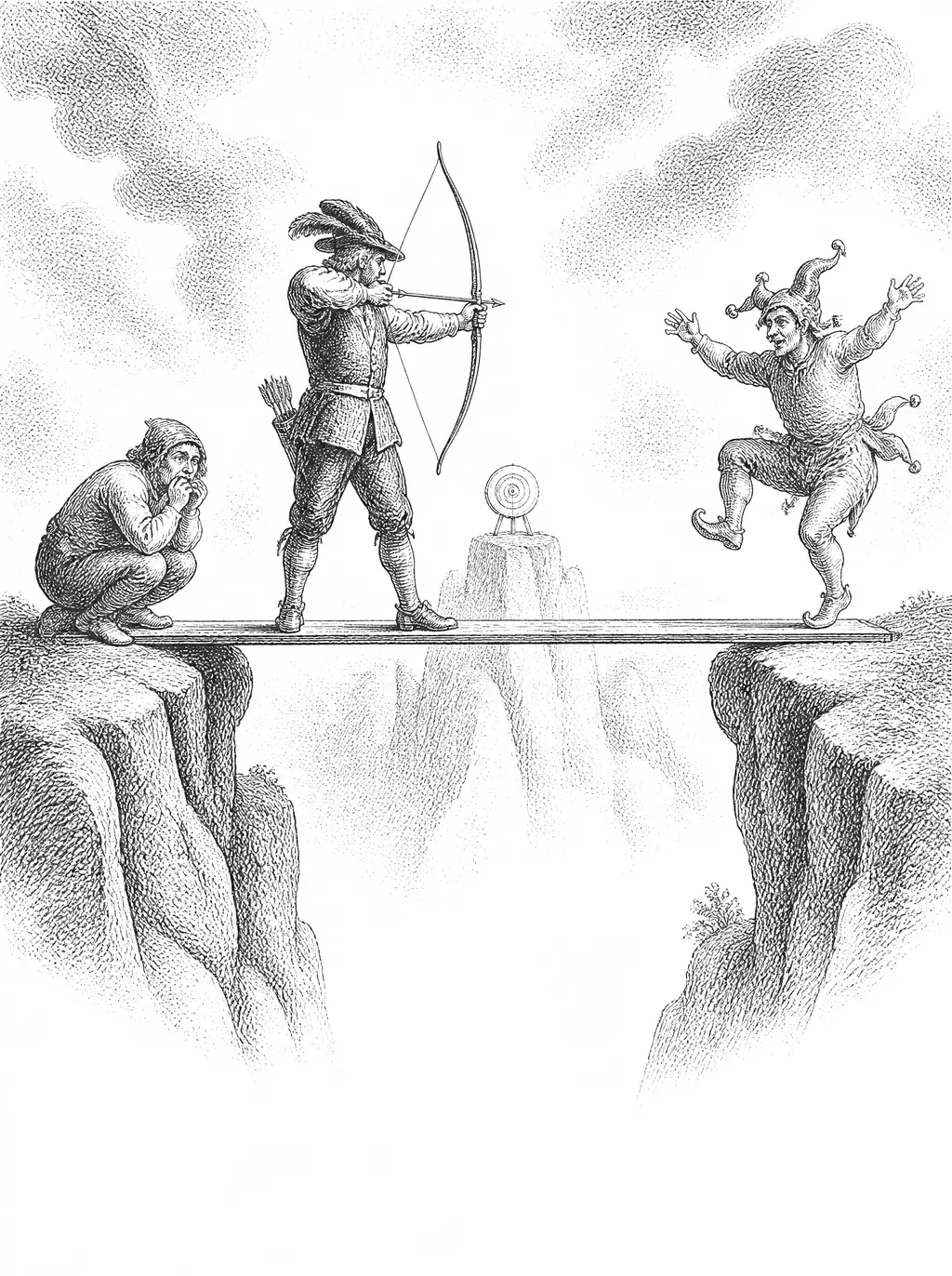
Aristotle noticed that almost every virtue sits between two opposite vices, one of excess and one of deficiency. Too little confidence and you are a coward; too much and you are reckless. Too little generosity and you are stingy; too much and you are wasteful. Virtue, again and again, turned out to be a narrow target sitting between two easier ways to miss. He listed the targets in a table: good temper between irascibility and spinelessness, wit between buffoonery and boorishness, truthfulness between boasting and false modesty. Some of the vices had no names in Greek, and Aristotle had to invent them, which he took as a sign that nobody had looked at the pattern before.
The world it came from
Aristotle was born in 384 BC in Stagira, in the north of Greece, the son of a physician to the Macedonian court. At seventeen he went to Athens and spent twenty years in Plato's Academy. When Plato died in 347 he left, studied marine animals on Lesbos, and tutored the boy who became Alexander the Great. In 335 he returned to Athens and founded the Lyceum. The Nicomachean Ethics is probably his lecture notes, edited later, perhaps by or for his son Nicomachus. His problem was Plato's. Plato had said that virtue was knowledge of a single Form of the Good. Aristotle, trained on animals and their habits, wanted an account of virtue that a person could actually acquire, and that looked at how good people in fact behaved.
The idea
Moral virtue is a state concerned with feeling and action, and the right amount of either is neither too much nor too little but exactly what the situation calls for, given to the right person, at the right time, for the right reason, in the right way. That precise target is the mean, and hitting it consistently, not avoiding feeling altogether, is what virtue actually trains. The mean is relative to us, not a fixed midpoint. Ten pounds of food is too much for a beginner and two too little, but a trainer does not prescribe six to everyone; he prescribes what this athlete needs. And some actions have no mean at all. There is no right amount of adultery, theft, or murder. Their names already contain the wrongness.
How the reasoning runs
Begin with how virtue is acquired. Nobody is born brave; people become brave by doing brave things, as they become builders by building. So virtue is a habit formed by practice. Second, every craft is ruined by too much and too little: too much exercise destroys strength, and so does too little. Third, the same holds for the feelings virtue concerns. Fear, confidence, appetite, and anger can all be felt too much or too little, and both errors are faults. Fourth, therefore the virtue that concerns each feeling is the state that hits what is intermediate, as a good craftsman does. Fifth, because the target moves with the case, hitting it takes judgment. Aristotle calls that judgment practical wisdom, and without it the habits are only luck.
Seen in life
Your teenage son has come home two hours late without calling. You can feel the two vices from the inside. One is the explosion: the shouting that would frighten him and teach him nothing except to lie better next time. The other is the shrug, the tired decision that it is not worth the fight, which teaches him that nothing he does registers. Aristotle's mean is not the tepid average of those two. It is the anger that fits: real, visible, directed at the thing he did and not at him, over when it has been heard. You will not find it by calculating. You will find it, if you find it, because you have practiced finding it, and because tonight you stop to look.
Why it matters
This rejects two popular shortcuts at once: that virtue means suppressing emotion entirely, and that virtue means simply following whatever feels natural in the moment. Both miss the actual target, which shifts with context and requires judgment, not a fixed rule, to locate. Aristotle is describing a skill you develop through practice, not a formula you can apply mechanically. That makes the account honest about how people actually improve. You do not become patient by deciding to be patient. You become patient by acting patiently, at first awkwardly and then less so, until the feeling catches up with the act. The mean tells you what you are aiming at while that happens, and warns you that overcorrecting is a way of missing too.
“Virtue then is in a sense a mean state, since it certainly has an aptitude for aiming at the mean.”
From the source
Aristotle states the definition directly in the Nicomachean Ethics: “Virtue then is in a sense a mean state, since it certainly has an aptitude for aiming at the mean.” The mean here is relative to the person and situation, not a fixed midpoint the same for everyone. The sentence comes from Book II, chapter six, where Aristotle has just compared virtue to a craft that hits its work exactly, so that nothing could be added or taken away. He goes on to give the full definition: virtue is a settled disposition, concerned with choice, lying in a mean relative to us, determined by reason, as the person of practical wisdom would determine it. Then comes the qualification that the mean is, in respect of what is best, an extreme.
The pushback
Critics ask how you actually locate the mean in a real, messy situation, since Aristotle offers no formula, only the promise that a person of practical wisdom will know it when they see it. Aristotle's own answer accepts this limitation: ethics, for him, is not an exact science, and expecting the same precision you get from mathematics is itself a kind of error. A second objection is that the pattern does not fit every virtue. Justice has no obvious excess. Honesty is not a mean between lying too much and too little. Kant's complaint was sharper: the difference between a vice and a virtue is one of kind, not degree, and a doctrine that treats thrift as a little less than prodigality has misdescribed both.
The reply
To the first objection Aristotle's tradition answers that the demand for a formula is the mistake. Medicine has no formula either, and nobody concludes that health is arbitrary. The mean gives you the shape of the target and a warning about the two ways to miss; the rest is the work of a lifetime. The second objection is only partly answered. Aristotle himself treats justice separately and admits the schema strains there. Kant's charge that the mean is quantitative is answered by the qualification that the mean is an extreme in respect of what is best: the brave person is not slightly less afraid than the coward but rightly afraid, which is a different thing. Whether that saves the doctrine or replaces it is still argued.
Where it went next
Horace gave it the name; the phrase golden mean is his aurea mediocritas, not Aristotle's. Aquinas built the mean into Christian moral theology, and Maimonides made it the spine of his Eight Chapters on Jewish ethics, prescribing that a person who errs toward one vice should practice its opposite until he lands in the middle. The doctrine went into eclipse under Kant and Mill and returned in 1958 when Elizabeth Anscombe argued that modern moral philosophy had lost the concept of virtue. Philippa Foot, Alasdair MacIntyre in After Virtue, and Rosalind Hursthouse rebuilt the tradition, and virtue ethics is now the third major school beside its two rivals. Aristotle's insistence that character is habit reappears in every modern account of how practice shapes the brain.
Where this leads
The dichotomy of control approaches a similar territory from a different direction, distinguishing what is properly yours to manage, your judgments and reactions, from what only looks like it belongs to you, which is a version of finding the right target for your effort. Eudaimonia is the reason the mean matters: Aristotle wants you to hit it not because moderation is pleasant but because a life of hitting it, again and again, is what a flourishing human life consists of. Read the two Aristotle beats together and the shape of his ethics appears. Eudaimonia names the goal, the mean names the daily target, and practical wisdom is the eye that connects them, case by case, for as long as you live.