Symposium · Political Philosophy · Pl. 12Plato · c. 428–348 BC
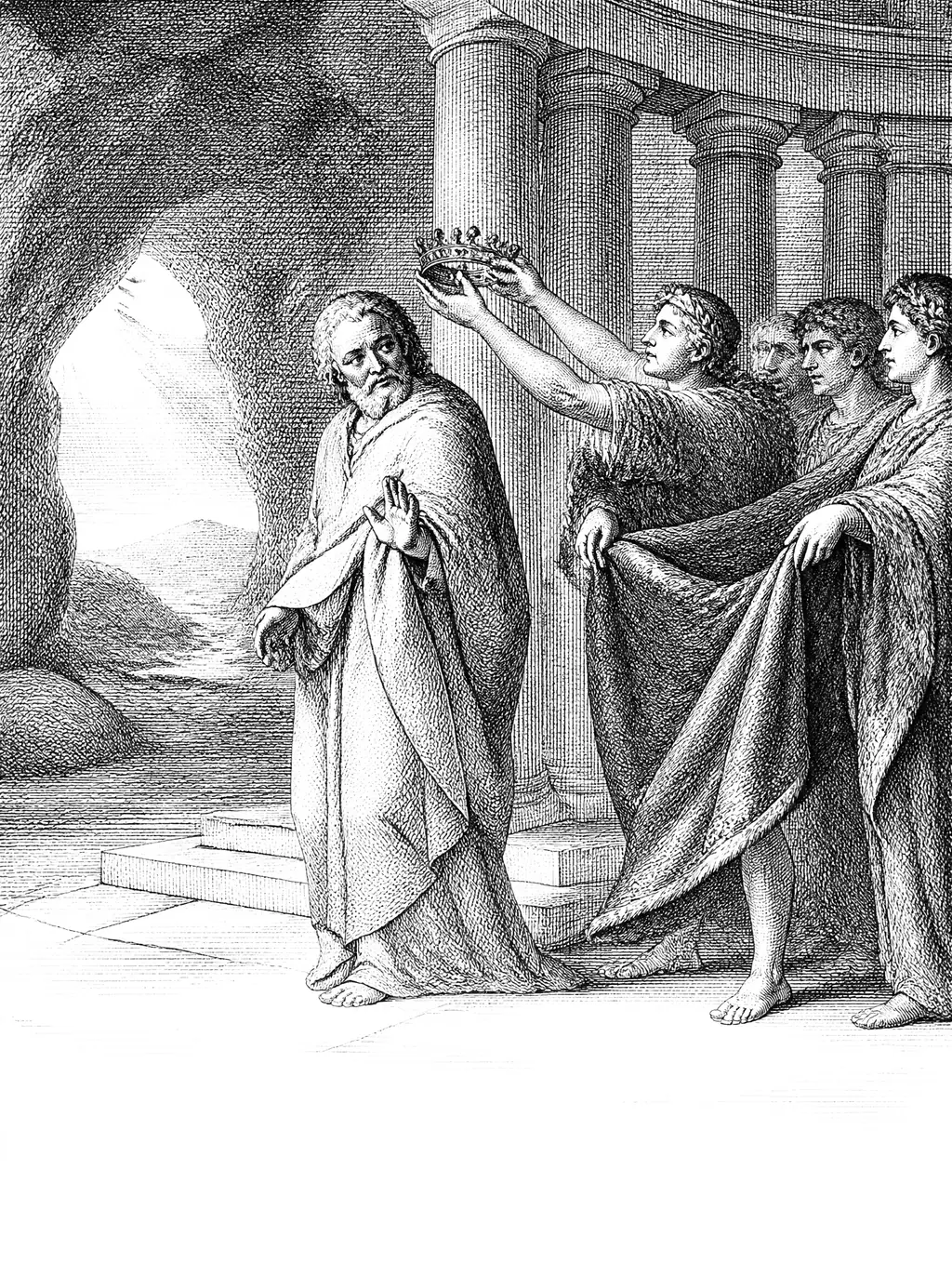
Until Philosophers Are Kings
The wave he expects to be mocked by
Socrates has spent the dialogue building a picture of a just city, and now approaches the claim he calls the biggest wave of all, certain it will strike his listeners as absurd and draw laughter and scorn down on him. He states it anyway, because the argument, once built, leaves him no honest way to avoid saying it plainly. The joke, and Plato knew it, is that the city he was writing in had killed the one philosopher it had. Athens tried Socrates and made him drink hemlock. So when the character Socrates says that cities will not be well until philosophers rule them, the man speaking is one whom his city chose to silence instead.
The world it came from
Plato grew up in an Athens losing the Peloponnesian War, which ended in 404 BC with the city's defeat by Sparta. The victors installed the Thirty Tyrants, an oligarchy that included Plato's relatives Critias and Charmides, who killed hundreds before being overthrown. The restored democracy then tried and executed Socrates in 399 BC. A letter attributed to Plato, whose authenticity is disputed, describes how these events convinced him that no existing city was governed rightly and that only philosophy could say what right government was. He founded the Academy around 387 BC and wrote the Republic in the decades after. Twice he sailed to Syracuse to advise its young tyrant Dionysius II, and both attempts ended badly.
The idea
Until philosophers are kings, or the kings and princes of this world have the spirit and power of philosophy, and political greatness and wisdom meet in one, cities will never have rest from their evils, nor the human race. Only rulers who genuinely love wisdom and pursue truth, rather than power or reputation for its own sake, can govern in the actual interest of the whole city. Plato's philosopher is not a professor. He is someone who has seen what goodness and justice actually are, the way a navigator knows the stars, and who would rather keep looking at them than rule. That reluctance is the qualification. The people who want the job are exactly the ones who should not have it.
How the reasoning runs
Begin with a premise about skill. Ruling is a craft like navigation or medicine: it has a subject matter, the good of the city, and it can be done well or badly. Next, a craft is done well only by someone who knows its subject. So the city is ruled well only by someone who knows what the good of the city is. Third, that knowledge is philosophy, the study of what justice, goodness, and order really are rather than what they seem. Everyone else is steering by opinion. Fourth, those who have this knowledge do not crave power, since they have something they prefer, so they must be compelled to rule. Therefore a well-ordered city puts its reluctant knowers in charge and keeps its eager ones out.
Seen in life
You sit on the hiring panel for a hospital's chief executive. One candidate has run three hospitals, speaks in polished paragraphs, and clearly wants the post very much. Another is a physician who has quietly redesigned the emergency department so that fewer people die waiting, hates meetings, and applied only because colleagues begged her. Plato asks which one you trust with the building. His answer is the second, and his reason is not that ambition is wicked. It is that the first candidate knows how to get the job and the second knows what the job is for. Then notice your discomfort. You would like to believe the knowledge and the wanting go together. Plato's claim is that they usually do not.
Why it matters
This challenges a deep assumption most political systems still run on: that wanting power and being fit to hold it are more or less the same qualification. Plato insists the two routinely pull apart, since the people most eager to rule are often the least suited to it, while the people best suited rarely seek it out on their own. The claim cuts against democracy and monarchy alike, since a crowd can be fooled and a king can be a fool. It is why the Republic is still assigned, and still resented. Every argument for expertise in government, and every warning against it, is an argument about the wave Socrates was afraid to ride.
“Until philosophers are kings, or the kings and princes of this world have the spirit and power of philosophy, and political greatness and wisdom meet in one, cities will never have rest from their evils.”
From the source
Socrates states the claim directly: “Until philosophers are kings, or the kings and princes of this world have the spirit and power of philosophy, and political greatness and wisdom meet in one, cities will never have rest from their evils.” Jowett's sentence runs on to add: nor the human race, as I believe. The passage is in Book V of the Republic. Socrates has just told Glaucon that he is about to be deluged by laughter and dishonor. What follows is a definition of the philosopher as one who loves the whole of wisdom rather than pieces of it, and then, in Books VI and VII, the images that explain why such people are rare: the ship whose crew fights over the helm, and the prisoners in the cave.
The pushback
Handing absolute rule to whoever is judged wisest sounds like an open invitation to tyranny dressed up as enlightenment, with no real check on a philosopher-king who turns out to be wrong, corrupt, or simply mistaken about what wisdom actually requires in a given case. Plato's own later dialogues show him wrestling with exactly this worry. Karl Popper sharpened the objection in 1945. Plato asked who should rule, and every answer to that question ends in some form of unchecked power. The better question, Popper argued, is how to organize institutions so that bad rulers can be removed without bloodshed. Democracy wins on that test not because crowds are wise but because they can fire people.
The reply
Plato's defenders note that his philosopher-kings are not unchecked. They own no property, live in common, and are selected through decades of testing designed to weed out anyone who wants power for its own sake; the checks are built into the person rather than the office. They also point to the Laws, Plato's last work, where he concedes that no such rulers are available and designs a second-best city governed by law instead of by wisdom. That concession answers Popper partly: Plato himself came to prefer institutions to saints. What remains unanswered is the selection problem. Someone must decide who has seen the good, and that someone has not seen it either. The Republic never says who checks the checkers.
Where it went next
Marcus Aurelius was hailed as the philosopher on the throne that Plato had asked for, and his Meditations show a ruler who found the crown a burden, which Plato would have counted in his favor. Al-Farabi in tenth-century Baghdad rebuilt the idea as the virtuous city, with the prophet as philosopher-king. Every argument for rule by experts, from Plato's Academy to the modern civil service and the independent central bank, descends from Book V, and so does every warning against them. Popper made the Republic the first target of The Open Society and Its Enemies in 1945. The cave and the ship of state are still the two most-used images for why the public gets politics wrong.
Where this leads
Man is naturally a political animal answers a related question from the opposite direction entirely, Aristotle arguing that ordinary citizens themselves, not a rare philosopher-king alone, are the natural participants in governing the very city they all belong to together. Aristotle had spent twenty years in Plato's Academy, and his answer is a student's revision of a teacher's mistake. The tripartite soul is the psychology under the politics. Plato's city has three classes because his soul has three parts, and the philosopher rules the city for the same reason that reason should rule the appetites: it alone can see what is good for the whole.