Symposium · Philosophy of Religion · Pl. 2Augustine of Hippo · 354–430 AD
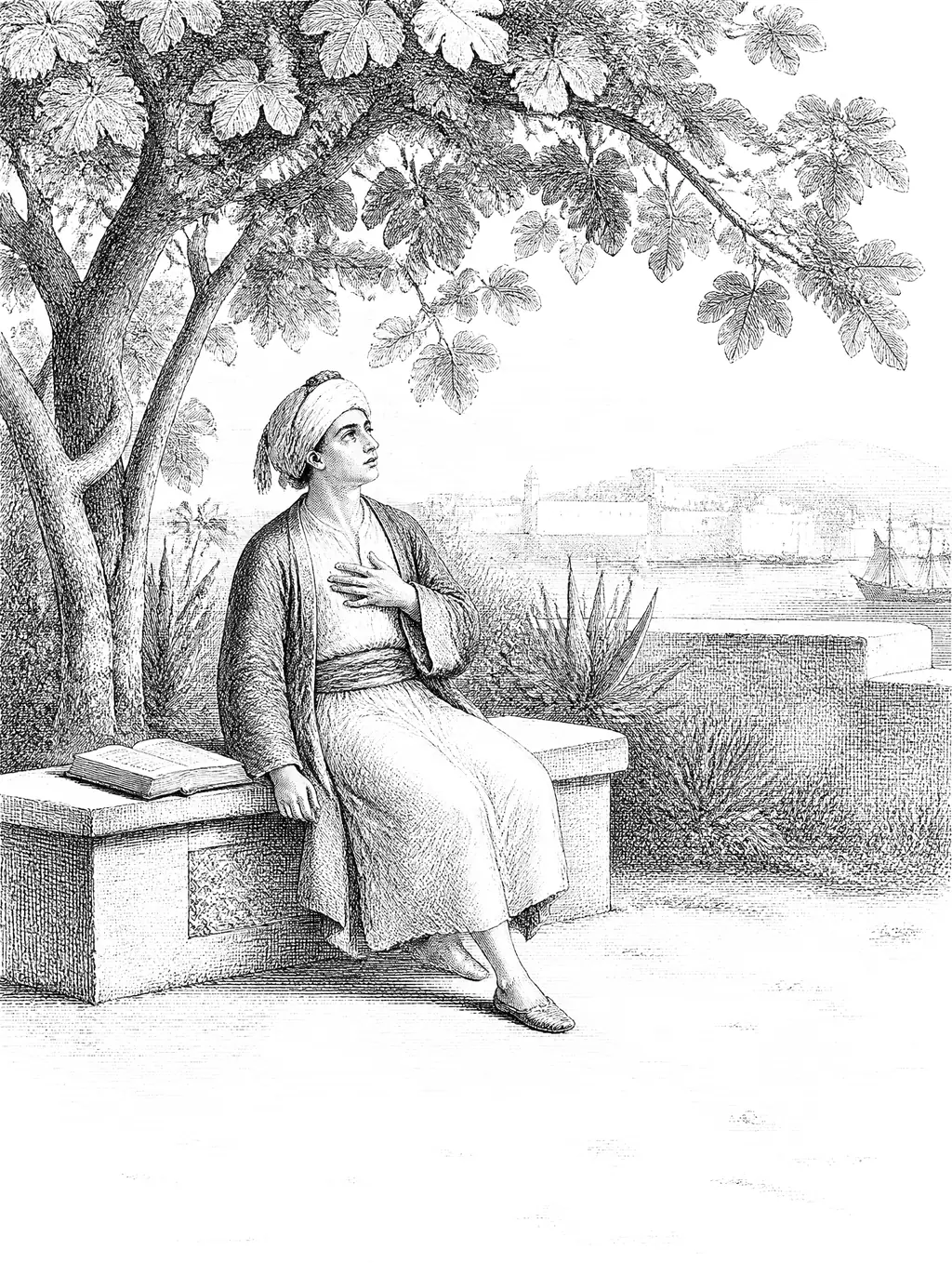
Our Heart Is Restless
A restlessness with a shape
The Confessions opens not with an argument but with an address to God, praising him before anything else has even been explained. Augustine frames his whole life story, the ambition, the affairs, the years chasing philosophical fashions, as one long search for a satisfaction that none of it could ever quite deliver in full. He wrote the Confessions around 397, a decade after his conversion, as bishop of a port town in North Africa. It is the first extended autobiography in Western literature, and it is addressed, from the first line to the last, to God.
The world it came from
Augustine was born in 354 in Thagaste, a small town in Roman North Africa, to a pagan father and a Christian mother, Monica. He studied rhetoric in Carthage, took a concubine and had a son, joined the Manichaean sect for nine years, taught in Rome and Milan, and rose toward a career at the imperial court. In Milan he heard Ambrose preach, read the Platonists, and in a garden in 386 underwent the conversion that Book VIII of the Confessions describes. Baptised in 387, he returned to Africa and was made bishop of Hippo in 395. The Confessions looks back on this life from the other side. The problem it answers is personal: why did nothing he chased satisfy him?
The idea
Thou madest us for Thyself, and our heart is restless, until it repose in Thee. Human longing, on this account, is not a random assortment of competing desires that happen never to be satisfied, but one single underlying desire, built into human nature itself, that only union with God was ever actually capable of answering. The claim has two halves. Restlessness is a fact about how humans are made, not a fault in how this one lived. And the rest it seeks is not another object in the series but the maker of the series.
How the reasoning runs
Augustine argues from the shape of desire. Step one: he wanted many things, sex, praise, friendship, understanding, and got most of them. Step two: each, once gained, opened onto a further want. Step three: this cannot be explained by bad luck in the objects, since the pattern held across every kind of good, including the finest. Step four: so the wanting is not for any of them; they were each mistaken for something else. Step five: a desire that no finite good satisfies is either a defect or a signal. Augustine rejects the first because the desire is the best thing in him, the source of his search. So it is a signal, and what it points to is the infinite good that made it.
Seen in life
You get the job you wanted at twenty-five, the house at thirty-five, the recognition at forty-five, and at each step there is a week of satisfaction and then the familiar hum returns. You can read that hum in two ways. The psychologist calls it hedonic adaptation, a treadmill built into the brain, and offers gratitude exercises. Augustine calls it a compass. The difference is not in the data, which both accept, but in what the hum is taken to be about. If you are a believer, his reading tells you that the hum is the best of you, not the worst. If you are not, it still names the experience with unusual precision, and it warns you against expecting the next acquisition to be the one that quiets it.
Why it matters
This gave Western religious thought one of its most enduring images: restlessness itself as evidence of a specifically God-shaped need, rather than as simple bad luck or a failure of self-discipline. It reframed the entire experience of dissatisfaction, chasing one goal after another, as a clue pointing toward its true object. The image made Augustine the founder of the inward turn in Western thought. Before him, philosophy mostly looked at the cosmos to find the good. After him, it looked at the self, and found there a want that seemed to exceed the world.
“Thou madest us for Thyself, and our heart is restless, until it repose in Thee.”
From the source
Augustine states the claim in the opening page of his autobiography: “Thou awakest us to delight in Thy praise; for Thou madest us for Thyself, and our heart is restless, until it repose in Thee.” Everything that follows in the Confessions works out this single diagnosis across the whole span of a restless, searching life. The passage comes as a prayer, not a proposition. Augustine asks how he can call on a God he does not yet know, and whether God is in him or he in God. The sentence about restlessness is his first answer: the seeking is itself the sign of being sought. Book X returns to it as the memory of a happiness he has never possessed and yet recognises.
The pushback
Couldn't this restlessness be explained just as well by ordinary psychology, the simple fact that no single finite pleasure ever fully satisfies a mind built to keep wanting more, without needing to posit any specifically divine object behind the wanting at all? Augustine's reply is that the shape of the restlessness itself points beyond any finite candidate. A second objection is that the argument proves too much. If unfulfilled desire signals a divine object, then every unfulfilled desire does, including the ones for revenge or status. Augustine needs a way to say which restlessness points upward.
The reply
Augustine's reply to the psychological objection is that the psychologist has described the pattern and not explained it. Why should a creature be built to want more than any available good, unless the want was for something that is not among the available goods? That is an inference, not a proof, and he knows it; the Confessions is a prayer, not a demonstration. On the second objection, he has an answer in his theory of disordered love: every desire is a desire for the good, and the bad ones are good desires aimed at the wrong target. So all restlessness points upward in origin, though not in direction. Whether that rescues the argument or just restates the faith is the fair question a sceptic will keep asking.
Where it went next
The restless heart became the template for religious autobiography from Bunyan to Merton, and for the wider genre of the search narrative in which a life is read as a hunt for its object. Pascal's argument from the human condition, Kierkegaard's despair, and Heidegger's care all descend from it. C. S. Lewis's argument from desire, that a want nothing on earth satisfies suggests we were made for another world, is Augustine's line turned into an inference. Psychologists from William James onward have used his conversion narrative as the standard case. Sartre inverted him: the self as a lack that nothing fills, with no God to fill it. The opening sentence is quoted at funerals and in atheist memoirs alike.
Where this leads
Wager, then, without hesitation shows Pascal, over a thousand years later, arriving at religious commitment through a very different route, treating belief as the conclusion of a cold calculation about risk and reward rather than as the felt satisfaction of a restlessness woven into the structure of the human heart itself. The leap of faith is the modern heir. Kierkegaard also starts from a self that nothing finite settles, but where Augustine reads the restlessness as a road that ends in rest, Kierkegaard makes the crossing a leap that has to be repeated every day.