Symposium · Philosophy of Religion · Pl. 7Al-Ghazali · 1058–1111
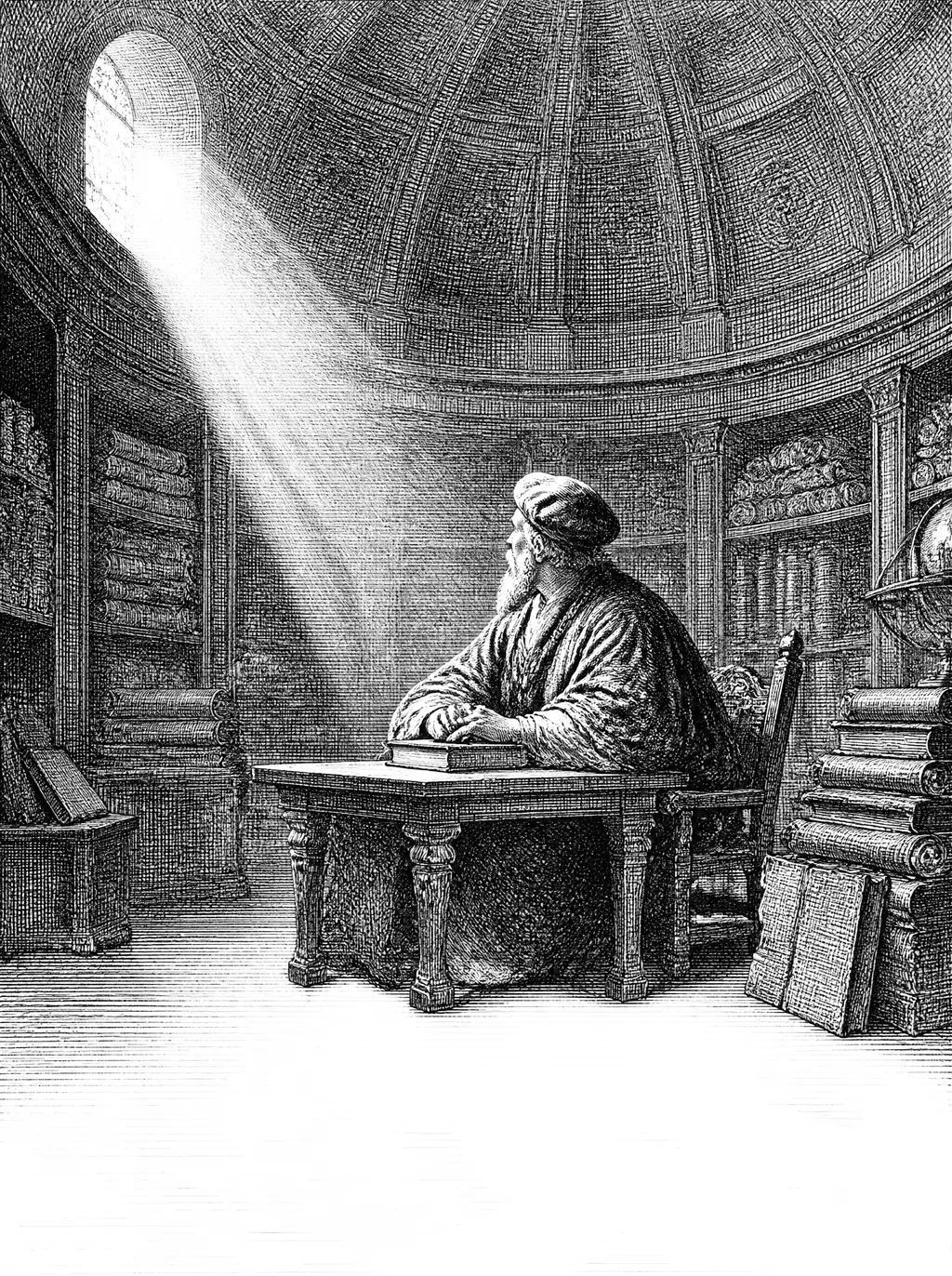
A Light Cast Into My Heart
A skepticism with no floor
Ghazali describes methodically stripping away every basis for certainty he could find. Sense perception fails, since the eye judges a star tiny when it is vastly larger than the earth. Reason itself then comes under suspicion too, since some further judge, unknown and unverifiable, might expose reason's own conclusions as equally mistaken. He tells this in Deliverance from Error, a memoir written late in life. The doubt was one crisis of two. Years later a second, deeper one cost him his voice, his appetite, and the most prestigious teaching post in the Islamic world.
The world it came from
Abu Hamid al-Ghazali was born in 1058 in Tus, in what is now northeastern Iran. By 1091 he held the chair of law at the Nizamiyya college in Baghdad, the most prestigious post in Sunni scholarship, appointed by the vizier Nizam al-Mulk. He lectured to hundreds and wrote against the philosophers, above all Avicenna, in The Incoherence of the Philosophers. In 1095 he broke down, lost the ability to lecture, and left Baghdad under the cover of a pilgrimage, spending roughly a decade in retreat in Damascus, Jerusalem, and Tus. Deliverance from Error looks back on both crises. It answers a question he had asked as a young man: which of the competing schools actually delivers certainty?
The idea
I owed my deliverance, not to a concatenation of proofs and arguments, but to the light which God caused to penetrate into my heart. After two months trapped in total skepticism, unable to trust senses, reason, or any chain of argument built from either, Ghazali reports his certainty returning not through a new proof, but through what he describes as a direct illumination. The light did not hand him new propositions. It restored his trust in the self-evident truths he already held, so that reason could go back to work. In his image, it is what happens when the eye is healed, not what the healed eye then sees.
How the reasoning runs
Follow the descent first. Sense perception is refuted by reason: the eye says the shadow stands still, reason proves it moves. So reason is the judge of the senses. Then ask: what judges reason? Perhaps a faculty beyond reason exists that would expose its axioms as the senses' errors were exposed. That we have not met such a judge does not prove there is none. Dreams make the point: in sleep you are certain of what waking shows to be nothing. So intellectual certainty has no proof of its own to rest on. Now the ascent. Any argument for the reliability of first principles would use first principles, and so be circular. If trust returns, it cannot come from argument. Ghazali reports that it did return, and names its source.
Seen in life
You know the feeling if you have ever argued yourself into a corner at two in the morning. Every reason you give for trusting your own mind is itself a product of that mind. You can see the circle and you cannot step out of it by thinking harder. Then you sleep, and in the morning the world is simply there again, and you trust it. Ghazali's claim is that this return is not a lapse in rigour but the actual foundation of everything you call rigour. What he adds, and what a non-believer will not add, is a name for where the morning comes from. The structure of the experience is shared. The interpretation is where the two of you part.
Why it matters
This offered an influential alternative to purely argumentative routes toward religious certainty, treating a specific kind of inward experience as capable of grounding conviction where formal proof had completely run dry. It shaped later Sufi and mystical traditions that treat direct spiritual experience as a genuine source of knowledge in its own right. It also gave a precise account of the limits of argument. Reason can defend its conclusions but not its own starting point, and anyone who claims otherwise is running in a circle. Descartes would meet the same wall five centuries later and reach for God to get over it.
“I owed my deliverance, not to a concatenation of proofs and arguments, but to the light which God caused to penetrate into my heart—the light which illuminates the threshold of all knowledge.”
From the source
Ghazali describes the resolution of his crisis directly: “I owed my deliverance, not to a concatenation of proofs and arguments, but to the light which God caused to penetrate into my heart—the light which illuminates the threshold of all knowledge.” No chain of reasoning, he insists, could have restored what pure doubt had taken away. He then explains what the light did. It restored his trust in the necessary truths of the intellect, so that he could once again build on them. Whoever thinks that unveiling depends on proofs, he says, has narrowed the wide mercy of God. The proofs came back afterward. The trust came first.
The pushback
Isn't appealing to an inward light exactly the kind of unverifiable, private experience that rigorous philosophy is supposed to be suspicious of, especially right after a rigorous demonstration that neither senses nor reason can be fully trusted on their own? Ghazali's defenders note that he never claims the light replaces reason, only that it restores confidence reason alone could not supply. A harder version: the light explains too much. If an inner illumination can validate reason, it can validate anything, and a Sufi, a Christian mystic, and a Cartesian each report their own. Ghazali's account gives no test for telling a true light from a wish.
The reply
Ghazali's defence is that he never asks the light to prove a doctrine. It restores the first principles of thought, which are the same for everyone, believer or not, and every later argument is then held to ordinary standards. On that reading the objection about rival mystics misses the target, because the light licenses no particular creed. But he goes further in the later chapters, treating Sufi experience as a knowledge in its own right, and there the objection lands. He admits that such tasting cannot be conveyed to someone who has not had it, and offers no test beyond the transformed life of those who have. That is not nothing, but it is not a proof, and he does not pretend it is.
Where it went next
Ghazali's account fed the Sufi mainstream for centuries; his Revival of the Religious Sciences became the standard manual of inward Islam. Ibn Rushd, known in Latin as Averroes, answered his attack on philosophy point by point in The Incoherence of the Incoherence. Whether Descartes read him is disputed, but the resemblance between Deliverance and the Meditations, the doubt of the senses, the dream argument, the return via God, is close enough that scholars keep asking. In the twentieth century, Alvin Plantinga's argument that belief in God can be properly basic, warranted without evidence, is a cousin of Ghazali's claim that first principles need no proof. William James quoted him among his witnesses in The Varieties of Religious Experience.
Where this leads
Our heart is restless shows Augustine reaching a related conclusion many centuries earlier from within a different religious tradition entirely, arguing that human restlessness itself points toward a specific object capable of resolving it, an inward signal neither pure argument nor pure doubt was ever equipped to settle on its own. The method of doubt shows Descartes running the same experiment in 1641 and finding a floor in the thinking self. Ghazali found none, and reports that the floor was given to him. The two memoirs make a matched pair.