Symposium · Philosophy of Religion · Pl. 13Blaise Pascal · 1623–1662
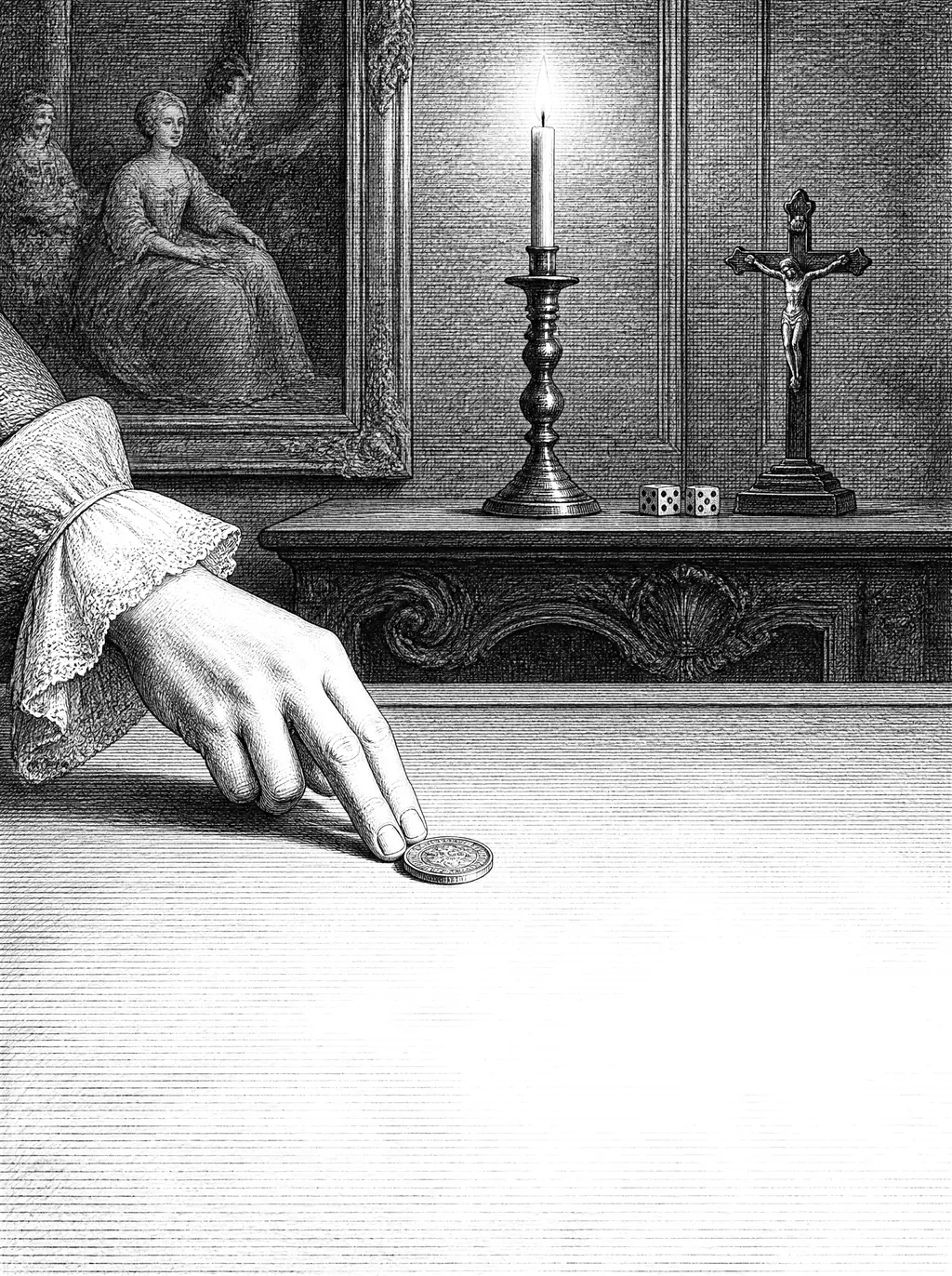
Wager, Then, Without Hesitation
A bet you cannot decline
Pascal treats belief in God not as a question to be settled by proof, but as a wager everyone is already forced to make simply by living a life one way or another. Reason alone, he grants, cannot determine whether God exists. But refusing to bet, he insists, is itself already a bet. The wager sits among the fragments Pascal left when he died at thirty-nine, notes for a defence of Christianity he never wrote. It is addressed to a particular reader: the gambler, the courtier, the man who has heard the arguments and shrugged.
The world it came from
Blaise Pascal was a prodigy who published on conic sections at sixteen, built a calculating machine in his twenties, and in 1654 exchanged letters with Fermat that founded the mathematics of probability, prompted by a gambler's question about how to divide the stakes in an interrupted game. That same year he underwent an intense religious experience he recorded on a scrap of parchment sewn into his coat. He allied with the austere Jansenists at Port-Royal, attacked the Jesuits in the Provincial Letters, and began collecting notes for an apology for Christianity aimed at the worldly sceptics he had known in Paris. He died in 1662. The notes were published as the Pensées in 1670. The wager is one fragment among hundreds.
The idea
Let us weigh the gain and the loss in wagering that God is. If you gain, you gain all; if you lose, you lose nothing. Wager, then, without hesitation that He is. Since the potential reward, infinite happiness, and the potential cost of losing, a finite sacrifice of worldly pleasure, are so wildly out of proportion, rational self-interest points toward belief. The argument is not that God exists. It is that when you cannot know, and must act, you should choose by the stakes. Pascal's own reader objects that he cannot make himself believe, and Pascal's answer is to start with the practices and let belief follow.
How the reasoning runs
The steps run like this. First, reason cannot settle whether God exists; the evidence is balanced, or at least not decisive. Second, you must nonetheless live one way or the other; there is no neutral square on the board. Third, lay out the outcomes. If you bet on God and God exists, you gain infinite happiness. If you bet on God and God does not exist, you lose a little: some pleasures, some pride. If you bet against and God exists, you lose everything. If you bet against and God does not exist, you gain a little. Fourth, any finite chance of an infinite gain outweighs any finite stake. So betting on God dominates. Fifth, since belief cannot be willed, act as believers act, and habit will do the rest.
Seen in life
You are deciding whether to buy the insurance. The odds of the house burning are small, the premium is real, and the loss if it burns is everything. You buy it, and no one calls you irrational for paying for something that probably will not happen. Pascal asks you to notice that you already reason this way about finite stakes and to see what happens when one stake becomes infinite. The believer finds the analogy obvious. The non-believer's reply is usually that faith is not a policy you can sign, and that a God worth the name would see through the calculation. Both replies are fair, and both are in the Pensées, because Pascal wrote the objections down before he answered them.
Why it matters
This reframed religious belief as a decision under uncertainty rather than a conclusion drawn from evidence, borrowing the emerging mathematics of probability and expected value to make a case theology alone had never made in quite this way. It became one of the first arguments in the history of decision theory itself. It also changed the question from what you can prove to what you can lose. Whether or not the bet convinces, that shift, from evidence to stakes, is why economists, ethicists, and every argument about catastrophic risk still reach for Pascal's table.
“Let us weigh the gain and the loss in wagering that God is...If you gain, you gain all; if you lose, you lose nothing. Wager, then, without hesitation that He is.”
From the source
Pascal lays out the calculation directly: “Let us weigh the gain and the loss in wagering that God is...If you gain, you gain all; if you lose, you lose nothing. Wager, then, without hesitation that He is.” The elided line asks the reader to estimate the two chances. The math, he insists, leaves no rational alternative. Then comes the objection Pascal puts in his reader's mouth: I am made so that I cannot believe. His answer is not another proof. Learn from those who were once bound as you are, he says; they took holy water and had masses said, and it made them believe. Follow the way by which they began, and act as if you believed. What you lose, he adds, are the poisoned pleasures.
The pushback
Doesn't the wager assume only two live options, this particular God or none, when countless rival gods and religions could equally well demand the same bet with entirely different, mutually exclusive stakes attached? Pascal's defenders have proposed various fixes, but this many-gods objection remains the wager's most persistent and least fully answered weakness. A second objection is moral. A God who rewards a belief adopted for its payout, and punishes an honest doubt, would be a God not worth betting on. Belief bought by self-interest looks like the opposite of faith, and a good God would know the difference.
The reply
Pascal's defenders answer the many-gods objection by narrowing the field: the wager is addressed to a reader who already takes one tradition as the live option, so the choice is between that faith and none, not a menu. That rescues the argument for that reader only. On the moral objection, the reply is that the wager is not the destination but the first push. Pascal expects the practices to produce a real faith, and a real faith is not mercenary even if its first step was. Whether a belief can shed its origin like that is doubtful; William James called the wager a last desperate snatch at a weapon. But Pascal never claimed the bet was noble. He claimed it was the move a sensible gambler would make.
Where it went next
The wager was the first argument to use expected value, before the mathematics had a name, and decision theorists still teach it as the founding case of choice under uncertainty with infinite payoffs. William James rejected its mechanism and kept its conclusion in The Will to Believe. Diderot pointed out that an imam could reason the same way, the many-gods objection in one sentence. Modern discussion runs through Ian Hacking's paper on its logic and through Pascal's mugging, a puzzle in which a tiny probability of a vast reward is used to extort a rational agent. Outside philosophy the table shows up wherever a catastrophic outcome must be weighed: climate policy, existential risk, the precautionary principle.
Where this leads
Our heart is restless shows Augustine centuries earlier reaching for religious conviction through a very different route than calculation, describing belief as answering a deep, felt need built into human nature itself, rather than as the conclusion of a rational bet weighed carefully against its odds and its stakes. The best of all possible worlds is Leibniz applying a different mathematics to the same God: not the odds of his existing but the optimisation he must have performed. Pascal bets; Leibniz computes. Both were mathematicians who thought the numbers could carry you to the threshold, and no further.