Symposium · Philosophy in Fiction · Pl. 1Herman Melville · 1819–1891
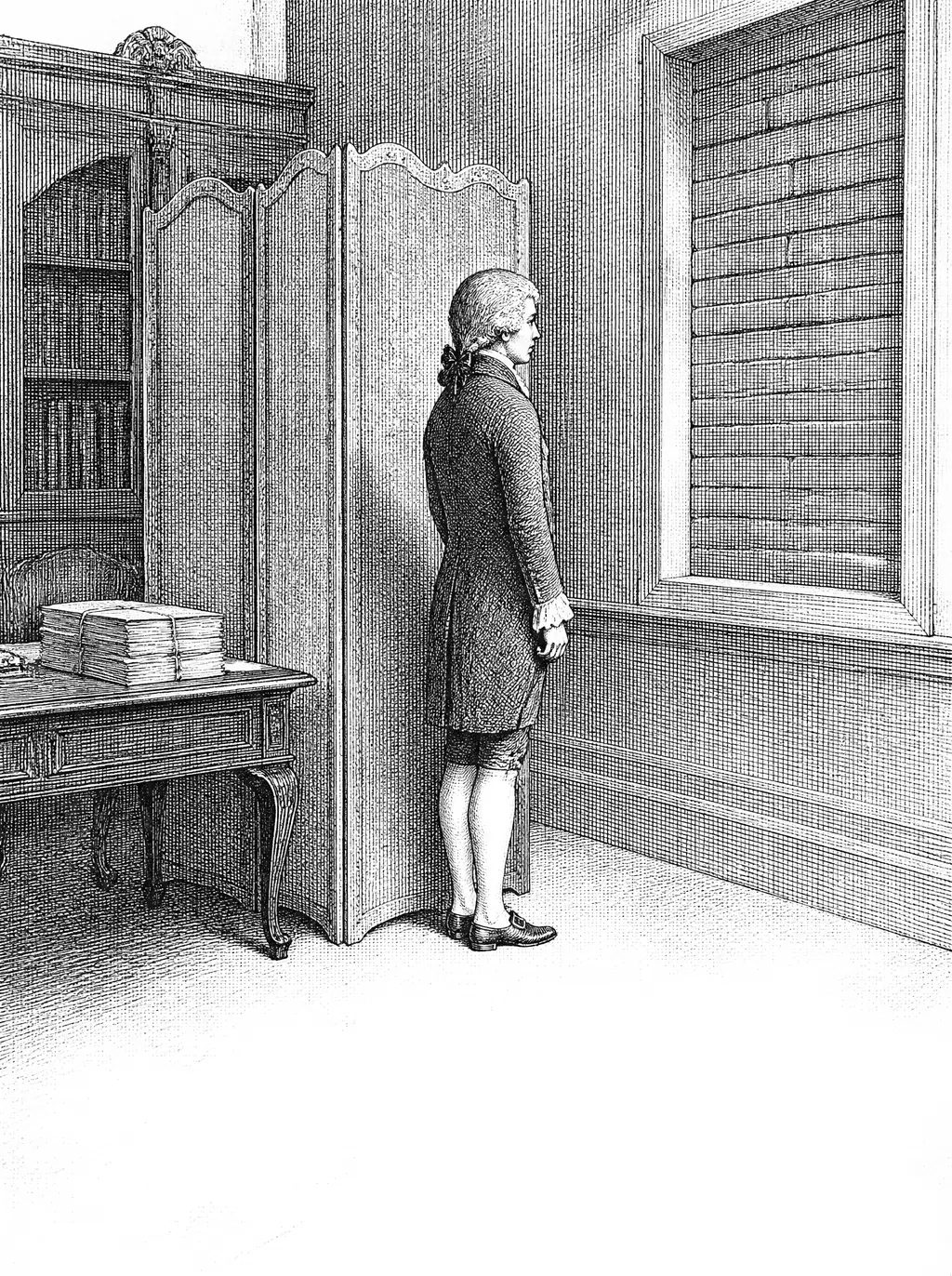
I Would Prefer Not To
A refusal with nothing behind it
A lawyer on Wall Street hires a third copyist, a pale, quiet young man named Bartleby, who at first works with astonishing appetite. On the third day the lawyer asks him to help compare a copy against the original, a routine part of the job that every scrivener does. From behind his screen Bartleby answers in a mild, firm voice that he would prefer not to. He is not angry, not insolent, and not asking for anything. He offers no grievance and names no principle. He simply declines, and goes on declining, and the office slowly organises itself around the hole where his compliance used to be.
The world it came from
Melville published Bartleby, the Scrivener in Putnam's Monthly Magazine in 1853, subtitled A Story of Wall-Street. Moby-Dick had come out two years earlier and failed, and Pierre had been mauled by reviewers; Melville was thirty-four and finished as a commercial novelist. The narrator is the unnamed lawyer, an elderly, comfortable, self-described safe man with chambers on Wall Street, and the story is his account rather than Bartleby's, which is the whole difficulty. The office copies legal documents by hand in the years just before the typewriter. The closing line reports a rumour that Bartleby once worked in the Dead Letter Office in Washington, sorting mail that could never be delivered.
The idea
Bartleby's formula is not a refusal in the ordinary sense. He does not say he will not, which would be defiance and could be met with dismissal, argument, or force. He says he would prefer not to, which reports a state of his own and makes no demand on anyone. There is nothing to negotiate with, because nothing has been asked for. The lawyer keeps searching for the grievance he could settle and finds none, and each attempt to reason leaves him more entangled. The story isolates a form of resistance that neither fights nor obeys, and shows that a system built on both has no reply prepared for it.
How the reasoning runs
Watch how the lawyer's authority actually works. It runs on reasons: give an order, receive either compliance or an objection, and answer the objection. Every part of it assumes the other person will enter the exchange. Bartleby stays outside it. He does not deny the lawyer's right to give the order, does not claim a right of his own, and does not leave when dismissed. The lawyer tries payment, pity, threats, and finally moves his entire practice to another building to escape a man who never once raised his voice. What the story argues, by demonstration, is that power over a person requires that person's participation in a language of reasons, and that withdrawing from it is not the same as fighting.
Seen in life
Someone on the team stops volunteering. They attend, they answer direct questions, they meet the letter of the job, and they decline everything else without complaint or explanation. There is no grievance to address, no policy broken, and no confrontation available. Managers usually reach for a category to make this legible, and call it burnout, or disengagement, or quiet quitting, because a name restores the sense that something is being reported. Melville withholds the name for fifteen thousand words. The lawyer's discomfort is not that Bartleby is hostile. It is that Bartleby is not, and there is nothing to fix, and the office keeps running around him.
Why it matters
The story gave political thought a pure specimen of passive refusal, written seven years after Thoreau's night in jail and a century before the sit-ins. It also anticipated a specific modern subject: the office worker doing copying that has no visible product, in a building with no view, for an employer who is genuinely kind and completely unable to help. Melville makes the narrator decent, which is what stops the story becoming a complaint about bad bosses. The kindness is real and it changes nothing, and that is a claim about institutions rather than about men.
“I would prefer not to.”
From the source
The formula arrives without warning, in the middle of an ordinary request, and the lawyer records his own shock at it. Bartleby, without moving from his privacy behind the screen, replies in a singularly mild, firm voice: “I would prefer not to.” The lawyer sits a while in perfect silence, rallying his stunned faculties, decides his ears have deceived him, and repeats the request as clearly as he can. The same answer comes back. He crosses the room in high excitement demanding to know what the man means, and Bartleby says it again, and gently disappears behind the screen. The phrase returns more than twenty times in the story and is never once explained.
The pushback
Isn't this a portrait of illness rather than a position? Bartleby stops eating, stops working, stops leaving the building, and dies in the Tombs prison yard curled against a wall. Reading his condition as a philosophy of refusal risks making a virtue of a collapse, and the Dead Letter Office rumour at the end invites exactly the pathologising the story is often praised for avoiding. A second objection is practical. Passive refusal without a stated demand cannot win anything, since nobody can concede to a claim that was never made, and Bartleby changes nothing about Wall Street at all.
The reply
The reply on the first point is that the story never lets you decide, and refuses the diagnosis on purpose: the lawyer offers the Dead Letter rumour in his last paragraph, admits he cannot verify it, and even so it is the only explanation the reader gets. Wanting a cause is the lawyer's compulsion, and the reader inherits it. On the second objection the concession is real. Bartleby wins nothing. What the story records is the existence of a position that authority cannot process, not a strategy for using one, and later readers who wanted a tactic have had to supply the demand Melville deliberately left out.
Where it went next
Camus and Beckett both drew on the figure, and Beckett's stalled narrators are its closest descendants. Gilles Deleuze wrote a long essay in 1989 calling the formula an agrammatical sentence that hollows out language from inside. Agamben treated Bartleby as the pure form of potentiality, the being who can and does not. The phrase turned up on placards at Occupy Wall Street in 2011, a few streets from the offices Melville describes, and in labour writing about refusal ever since. It survives because it is empty enough to carry any cause and shaped enough to be recognised at once.
Where this leads
To live deliberately shows Thoreau performing a refusal with the reasons attached, going to the woods on purpose and publishing the argument, which is everything Bartleby withholds. Bad faith gives Sartre's account of the opposite error, the person who hides behind a role and calls it necessity, and Bartleby is his exact photographic negative. Hell is other people names the pressure the lawyer feels once the office fills with a presence he cannot dismiss and cannot ignore, and which returns his own decency without ever using it.