Symposium · Pragmatism · Pl. 14Henry David Thoreau · 1817–1862
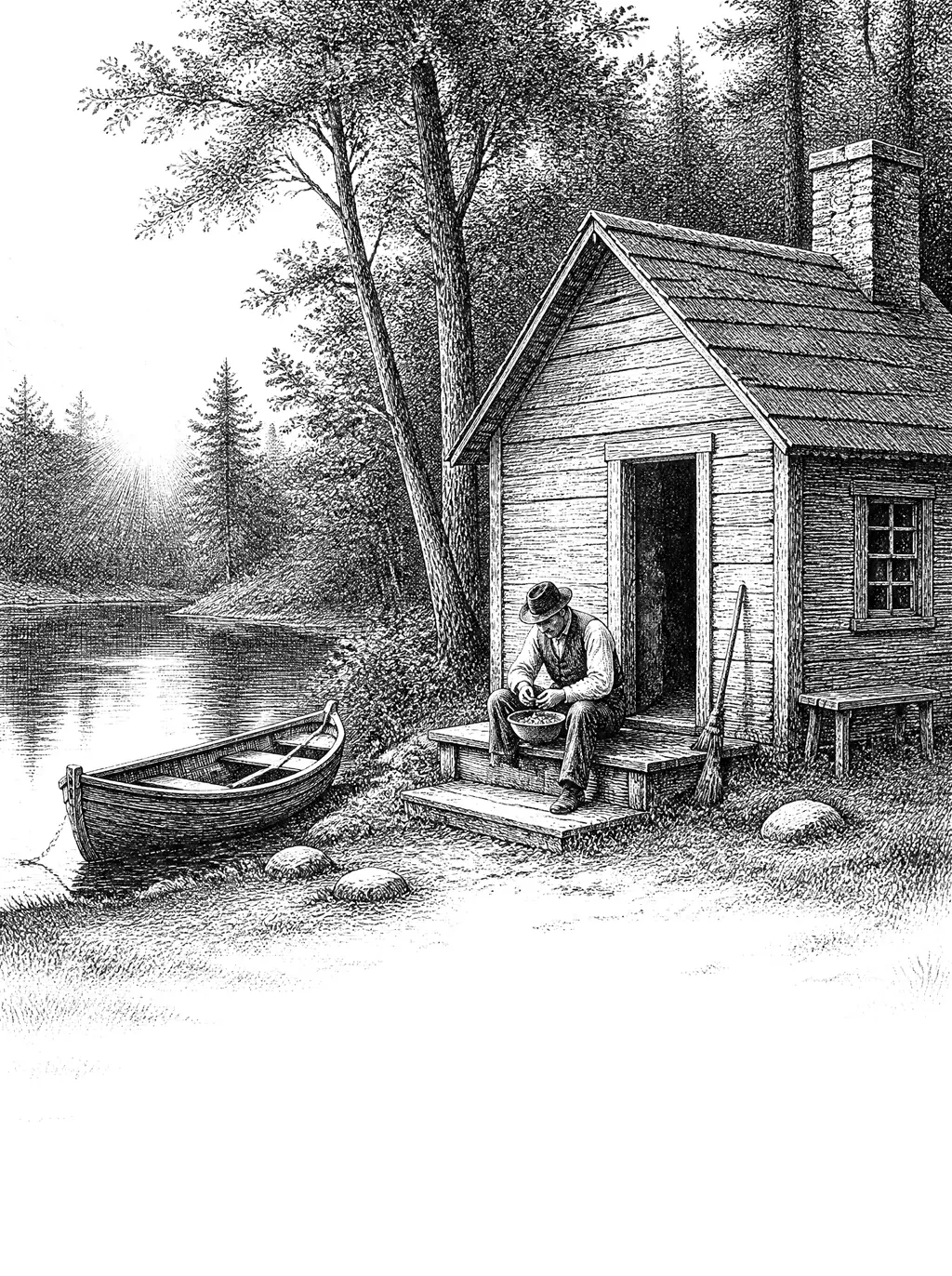
To Live Deliberately
A philosophy tested by living it
Rather than argue in the abstract about what a genuinely considered life would look like, Thoreau simplified his own circumstances drastically, building a small cabin at Walden Pond and reducing his needs to the bare minimum, treating the experiment itself as his real philosophical method rather than mere illustration of a prior theory. He kept accounts. Walden's first chapter lists what the cabin cost, to the half-cent, and what he earned from beans. The ledger is not a joke. It is the data, and Thoreau wants you to check his numbers, because an experiment you cannot audit is only a story.
The world it came from
Thoreau moved into the cabin on July 4, 1845, on land owned by Emerson, a mile and a half from Concord, and stayed two years, two months, and two days. He was twenty-seven, a Harvard graduate who had failed as a schoolmaster, worked in his family's pencil business, and lived in Emerson's house as a handyman. In 1846 he spent a night in the Concord jail for refusing the poll tax. Walden took nine more years of revision and appeared in 1854, when the country was arguing about the Fugitive Slave Act. The problem it answers is the one Emerson had posed and not tested: what does a life look like when you strip it to what you can verify yourself?
The idea
I went to the woods because I wished to live deliberately, to front only the essential facts of life, and see if I could not learn what it had to teach, and not, when I came to die, discover that I had not lived. Deliberate living, on this account, means stripping away every borrowed convention and unexamined habit until only what actually matters remains visible and testable. Deliberate is the operative word. Thoreau does not say simply or naturally; he says chosen, with the alternatives in view. The cabin was a way of making every cost visible so that each could be weighed: a house measured in days of labor, a meal in hours of hoeing. What survives that weighing is essential. What does not was habit.
How the reasoning runs
Step one: the cost of a thing is the amount of life you must exchange for it. Step two: most people never see that cost, because custom sets their needs before they can examine them. Step three: the only way to see the cost is to remove the custom and measure: build the house yourself, grow the food, count the hours. Step four: when you do, most so-called necessities turn out to be optional, and the time they consumed is returned to you. Step five: that returned time is what a life is for, and a philosophy that cannot show you how to get it is not worth the name. Conclusion: to live deliberately is to run this audit on your own life, and to report the results honestly.
Seen in life
You are deciding whether to take a promotion that adds forty thousand dollars and ten hours a week. Thoreau's audit starts with the second number. Ten hours a week is five hundred a year; over a decade it is two and a half working years. Now ask what the money buys, and whether you would buy it at that price if it were offered plainly: a larger apartment for two and a half years of your life. You might say yes. The point is not that you must say no. The point is that most people never see the exchange rate, because the raise is announced and the hours are assumed. Thoreau's cabin was a way of making the exchange rate visible. He wants you to build one.
Why it matters
This treated a philosophy of living not as a set of propositions to accept but as an experiment to be actually run and reported on, a distinctly practical, first-person method of inquiry that anticipated the pragmatist insistence on testing ideas against genuine, lived experience rather than settling them by argument alone. Thoreau belongs on this shelf for that method, not for any doctrine. He was not a pragmatist and never met the word. But the habit of treating a way of life as a hypothesis, running it, keeping the ledger, and reporting what happened is what James and Dewey later asked of every idea. Walden is the earliest American book to do it so deliberately.
“I went to the woods because I wished to live deliberately, to front only the essential facts of life, and see if I could not learn what it had to teach, and not, when I came to die, discover that I had not lived.”
From the source
Thoreau states his purpose directly: “I went to the woods because I wished to live deliberately, to front only the essential facts of life, and see if I could not learn what it had to teach, and not, when I came to die, discover that I had not lived.” Everything else in Walden reports back on how that experiment actually went. The line opens the second chapter. The first chapter, Economy, is the ledger: the cabin's materials at twenty-eight dollars and twelve and a half cents, and the argument that a thing's cost is the life exchanged for it. The final chapter reports the result: he left the woods for as good a reason as he went, having several more lives to live.
The pushback
Isn't Thoreau's experiment far easier to run than he lets on, given his relatively short stay, his proximity to town, and the family support quietly available to him the whole time, rather than a genuinely self-sufficient test of deliberate living? Admirers reply that the point was never pure isolation, but a serious, deliberately stripped-down test of what life actually requires. A harder objection is about who can run the experiment at all. Thoreau was unmarried, childless, healthy, and educated, on a rich friend's land, with a family business to return to. A mother of three in the Concord mills could not have fronted the essential facts for a week. If the method needs those conditions, it is not a method but a report on one privileged life.
The reply
Thoreau's own reply, in Economy, is that he does not ask anyone to copy him. He wants each reader to run their own audit on their own terms, and the cabin was his, not a template. That answers the copying charge and not the deeper one. The audit itself is easier for the unencumbered, and Walden never says what deliberate living looks like for someone whose essential facts include other people's needs. The tradition has been honest about this. Jane Addams answered him, in effect, by moving into a Chicago tenement rather than a cabin and asking what the essential facts were there. Her finding was that they were social. Thoreau's method survives; his answer was one person's, and he said so.
Where it went next
Walden sold slowly and then never stopped. Thoreau's essay on civil disobedience, from the jail night of 1846, reached Gandhi in South Africa and Martin Luther King in Montgomery, both of whom named it. Within American philosophy the lineage was slower to be claimed. James admired Thoreau's independence, and Dewey's experimentalism shares its shape, but it was Stanley Cavell, in The Senses of Walden in 1972, who argued that Walden was a work of philosophy and not a nature book. The environmental movement took Thoreau as its founder, from John Muir through Aldo Leopold to Rachel Carson. Every voluntary-simplicity, minimalist, and off-grid movement since has been running some version of his audit, usually without the ledger.
Where this leads
For action is indeed the sole medium shows Jane Addams reaching a related conclusion from an almost opposite direction, finding that genuine moral understanding comes not from withdrawing to test one's own life in solitude, but from immersing oneself directly in the concrete, shared struggles of a crowded community instead. The absurd is the twentieth-century version of Thoreau's question. Camus asks whether life is worth living once you stop borrowing the answer, and Thoreau's fear of discovering at death that he had not lived is the same fear from the other side. One went to the woods; the other stayed in the city and wrote. Both refused to let the question be answered for them.