Symposium · Existentialism · Pl. 8Jean-Paul Sartre · 1905–1980
Hell Is Other People
No torturer needed
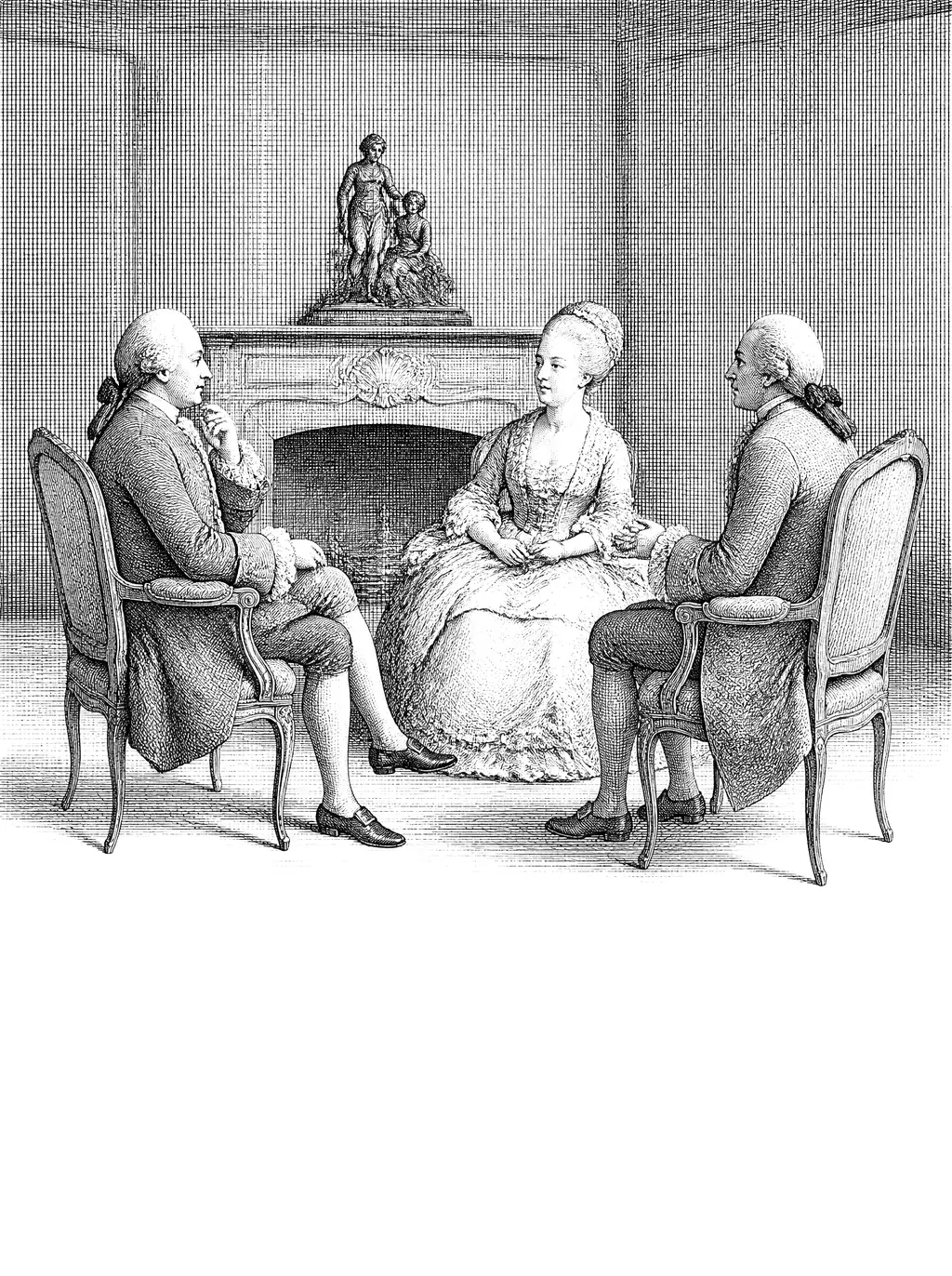
In No Exit, three dead characters are shown into a single drab room and told this is hell. They wait, braced for flames or instruments, and nothing comes. Instead, one of them slowly realizes what the room actually is for: each of the three sees the others clearly, judges them accurately, and cannot look away, forever, from what the others see in return. The play is one act, three characters, one room with a bronze ornament on the mantelpiece and no mirrors. It opened in Paris in May 1944, under the German occupation, and it has not left the stage since.
The world it came from
No Exit, in French Huis clos, opened at the Théâtre du Vieux-Colombier in Paris in May 1944, a few weeks before the Allied landings, in a city under German occupation. Sartre had been a prisoner of war in 1940 and had published Being and Nothingness the previous year; the play stages the chapter of that book called The Look. He wrote it fast, for friends who wanted equal parts, and in one act, which Sartre later said was partly so audiences could get home before the curfew. The three characters are Garcin, a journalist who deserted and was shot; Inès, a postal clerk who drove a woman to suicide; and Estelle, who killed her own child. Each needs something from another that the third will not allow.
The idea
For Sartre, other people are not merely inconvenient or occasionally irritating. Their gaze turns you into an object with fixed qualities from the outside, coward, flirt, failure, in a way you can never fully control or escape while they are looking. You experience your own freedom as a subject from inside; another person's gaze freezes you into something judged and defined, and that freezing is what the play calls hell. The trap is mutual. Garcin needs Inès to say he is not a coward; Inès wants Estelle; Estelle wants a man's eyes on her. Each is the wall the other two cannot get past.
How the reasoning runs
Begin with the difference between being a subject and being seen. From inside, you are a freedom, always ahead of any description. Then someone looks at you, and you feel yourself become a thing in their world: a coward, a flirt, a bore. Sartre's second step is that you cannot refute the look, because the look is not an argument. You can only look back, and turn the other into an object in turn, which they experience as you did. Third: since neither party can win this exchange, and neither can stop needing the other's recognition, every relationship carries the conflict inside it. Remove death, exits, sleep, and even mirrors, and what remains is three people condemned to be each other's only mirror, forever.
Seen in life
You are in a meeting and you say something clumsy. Nobody responds, but you catch a colleague's glance, and in that instant you are no longer the person who meant well; you are the person who said that. For the rest of the hour you are watching yourself from her chair. You cannot get back to the inside. Later you replay the moment and compose the explanation you will never give, because giving it would only be more material for the look. Sartre's characters have no meeting to leave. What you feel for an hour, they feel forever, with the added torment that each of them needs the very verdict they dread. Notice how little of the torment required an actual enemy.
Why it matters
This names something sharper than ordinary social anxiety: a genuine philosophical tension between your own lived freedom and the fixed image other people inevitably form of you, an image you cannot simply correct by explaining yourself better. Understanding the mechanism does not remove other people from your life. It changes what you expect that presence to always cost you. It also explains why the usual remedies fail. Explaining yourself, performing better, hiding: each is addressed to the look, and the look is not listening. The only relief in the play is the one none of them will take, which is to stop needing the verdict.
“Hell is other people.”
From the source
As the three characters finally grasp what their locked room actually is, and that no torturer is ever coming through that door to relieve them, one of them, Garcin, delivers the play's famous closing verdict on the whole arrangement: “Hell is other people.” Sartre said in a 1965 recording that the line has always been misunderstood. He did not mean that relations with other people are always poisoned, but that when they are twisted, when we depend too much on the judgment of others, then the other is hell. The three are damned because each is dead, and the dead cannot change what they were; the living can. The door in the room opens at one point. Nobody leaves.
The pushback
Doesn't this sound like an excuse for isolating yourself, treating every human connection as a threat to be minimized? Sartre is not arguing that other people are worthless or that solitude is the answer; the three characters in the play are trapped specifically because they keep needing each other's validation while resenting the judgment that comes attached to it. There is a philosophical objection too. If every gaze objectifies, then love, friendship, and simple kindness are impossible in principle, and that contradicts ordinary experience. A theory that cannot account for a friend has left something out.
The reply
Sartre's later gloss answers the first objection: hell is a dependence on the verdict, not the presence of the person, and the living can refuse the dependence. The second objection has more force, and Sartre half conceded it. Being and Nothingness treats love as a doomed attempt to possess another's freedom, and its account of relations is unrelievedly a war. He spent the following decades trying to add what was missing: a theory of groups in the Critique of Dialectical Reason, and in interviews a plain admission that his early work had no room for reciprocity. The play stands as a diagnosis of the pathological case. That it reads as a description of the normal one is the fault of its brilliance, and of its author's first book.
Where it went next
Frantz Fanon took Sartre's look and applied it to race in Black Skin, White Masks in 1952, describing the moment a child's stare fixes a Black man into an object. Beauvoir had already used it for women in The Second Sex. Emmanuel Levinas answered Sartre with the face of the other as a call to responsibility rather than a threat, the exact inversion of the play. In the wider culture the line became a proverb, usually quoted as a misanthrope's motto, which is the reading Sartre spent twenty years disowning. The play itself is among the most performed of the century, and its set, a room with no mirrors, remains the sharpest image philosophy has produced of what it means to be seen.
Where this leads
Bad faith describes one of the main ways people try to manage this exact pressure, molding themselves to fit the fixed image someone else's gaze demands, rather than sitting inside the freedom that gaze can never actually reach or touch. Not born a woman applies the same look to a whole sex. Beauvoir's woman is the Other in a man's world, fixed by his gaze into a role, and her book is the long form of what Sartre's one act compresses: what happens when the verdict comes from outside and you cannot stop needing it.