Symposium · Philosophy in Fiction · Pl. 2Franz Kafka · 1883–1924
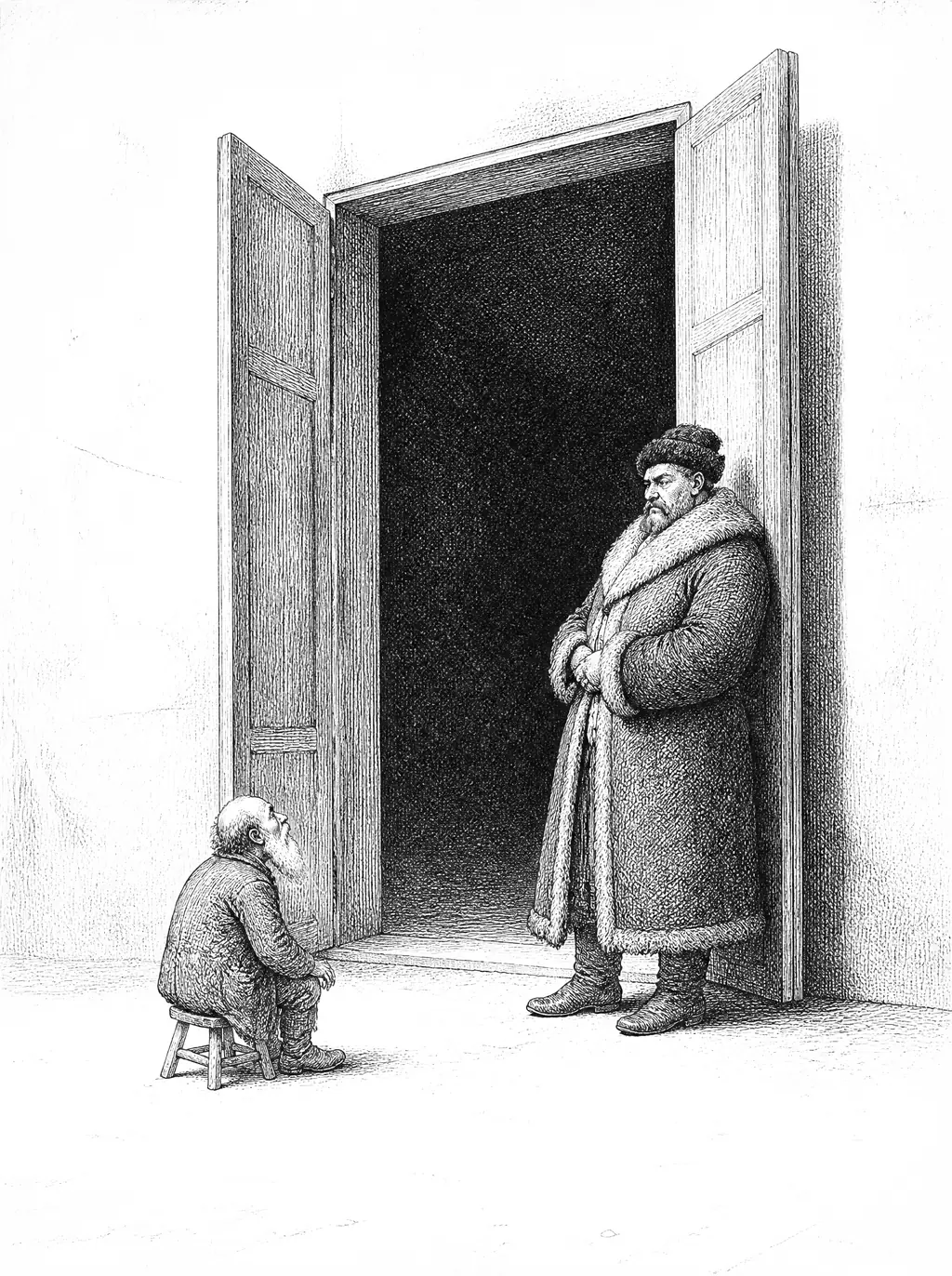
The Door Made Only for You
A door nobody locked
A man from the country comes to the law and asks to be let in. The doorkeeper says not now. The door stands open the whole time, and the doorkeeper never touches him. The man sits down on a stool beside it and waits. He waits for years. He offers bribes, which are accepted so that he cannot say he left anything untried. He grows old and half blind, and studies the fleas in the doorkeeper's fur collar, and asks them to help persuade the doorkeeper. Then he dies. The story is two pages long, and nothing in it is forbidden except by the man's own consent.
The world it came from
Kafka wrote Vor dem Gesetz in 1914 and published it in the Prague Jewish weekly Selbstwehr in September 1915. It is one of the few pieces he released himself; most of his work he asked Max Brod to burn. The parable also sits inside the unfinished novel Der Process, where a prison chaplain tells it to Josef K. in a cathedral, and then spends several pages arguing with him about what it means, offering readings that contradict one another and settling nothing. Kafka trained as a lawyer and spent his working life at a workers' accident insurance institute in Prague, writing assessments of claims that arrived from people who could not get through the door.
The idea
The parable puts a barrier where no barrier is. The law is open, the entrance is unlocked, and the doorkeeper's authority consists entirely of the man's willingness to treat him as an authority. What holds the man in place is not force but the request for permission, since asking already concedes that permission is required. And the door is not general. It was built for him, meant for nobody else, and it exists exactly as long as he does. The thing he spent a life waiting to be admitted to was his own, and waiting was the only way to be kept out of it.
How the reasoning runs
Set the pieces out and the trap is visible. The man wants access to the law, so he behaves lawfully, and behaving lawfully means observing the doorkeeper's word. Every year of obedience is fresh evidence to him that obedience is the right approach, because a door still open must mean the wait is nearly over. The doorkeeper never lies: he says the man may not enter now, and mentions further doorkeepers inside, each more terrible than the last. Both statements are true, and both are useless, because neither answers the only question that mattered, which the man never asks. He asks how to be admitted. He never asks whether he needed admitting.
Seen in life
You want to start the thing you keep describing to friends. First you need the qualification, then the savings, then a clearer market, then a quieter year. Each condition is real and each is checkable, and nobody has ever told you no. There is no committee. The person you are waiting on for a decision is not aware of holding one. Kafka's parable is what that looks like at the scale of a life: a permission structure with no one in it, staffed entirely by your own good behaviour, guarding an entrance that is open and that was, in any case, cut to your measure and to nobody else's.
Why it matters
This is the sharpest short account of authority that runs on compliance rather than on power. It applies to a bureaucracy, to a legal system that is always about to hear you, to a religion promising access on terms it never quite states, and to the private permissions people wait for. It also created a way of writing: a story that is completely clear sentence by sentence and completely unsettled as a whole, which is why the chaplain in the novel can list several readings and refuse to pick one. Kafka gave the twentieth century a picture of the invisible obstacle, and lent his name to it.
“No one else could be admitted here, because this entrance was meant for you alone. I am going now, and I am closing it.”
From the source
At the end the man's sight is failing and he cannot tell whether the world is getting darker or his eyes are deceiving him. He asks one last question, having wondered for years why nobody else has ever come to this door, since everyone strives for the law. The doorkeeper bends down close to his ear, because the man is shrinking and can no longer hear well, and roars at him: “No one else could be admitted here, because this entrance was meant for you alone. I am going now, and I am closing it.” The German is Kafka's; this English is Symposium's own translation of the public-domain original.
The pushback
Doesn't the parable prove less than it seems to? The doorkeeper is real, the further doorkeepers he describes may also be real, and a man who walked in might have been stopped by force at the second threshold or the third. Reading the story as a lesson about self-imposed limits requires assuming the way was clear, which Kafka is careful never to say. The chaplain in the novel makes a stronger version of the charge: on one reading the doorkeeper is the one deceived, bound to a post for a lifetime by a duty he cannot leave, and the man from the country is the free one.
The reply
The reply is that the ambiguity is the content, not a flaw in it. A parable which settled whether the man could have entered would become advice, and advice is exactly what the man from the country spent his life collecting. What the story does establish is narrower and survives every reading: he never tried, and the door was his. Whether force waited inside is unknown to him because he took the doorkeeper's account of the inside as a substitute for looking. On the chaplain's inversion, both figures can be trapped at once, which is Kafka's usual arrangement and makes the parable worse rather than better.
Where it went next
Walter Benjamin wrote that Kafka's parables unfold like buds rather than resolving like fables. Jacques Derrida devoted a long 1982 essay to this one, arguing that the law is nothing but the deferral of access to it. Giorgio Agamben used it to describe a law that is in force without meaning anything. Orson Welles put the parable at the opening and the close of his 1962 film of The Trial, narrating it himself. Kafkaesque entered ordinary English, usually misused for merely annoying paperwork, when the parable's point is quieter and worse: the obstacle is often open, and often yours.
Where this leads
The absurd names the gap Camus found between a person's demand for sense and a world that returns none, which is the man's position at the door once the years have passed and no explanation has arrived. The leap of faith shows Kierkegaard confronting the same threshold and drawing the opposite conclusion, that where no guarantee is available you must go through anyway. The prophecies of what courts will do gives the practical lawyer's answer, with Holmes insisting that the law is not a hidden presence behind a door but a prediction about what officials will actually do to you.