Symposium · Pragmatism · Pl. 6Oliver Wendell Holmes Jr. · 1841–1935
The Prophecies of What Courts Will Do
A deliberately unflattering viewpoint
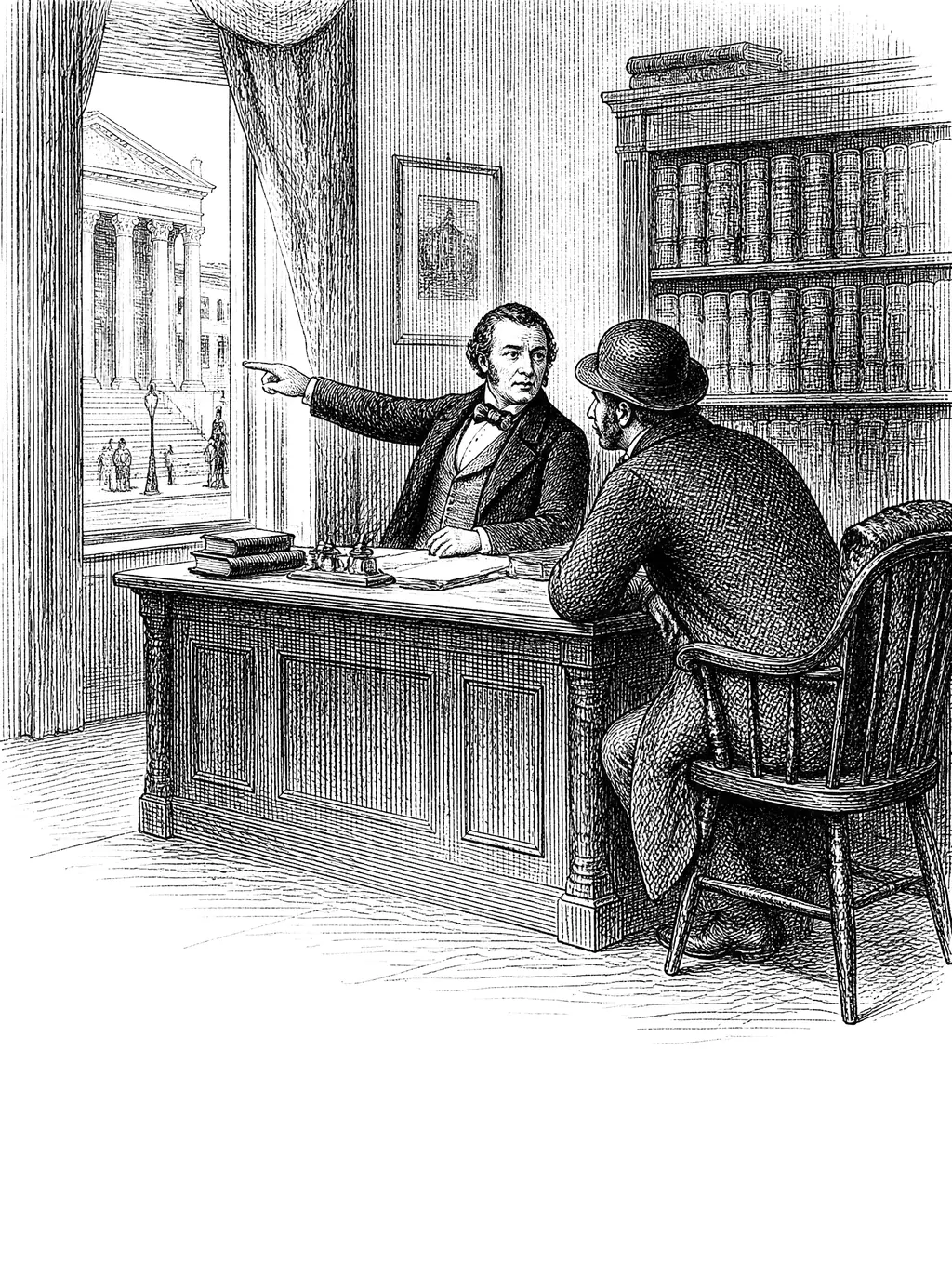
Holmes proposes studying law not through the eyes of a good citizen concerned with moral duty, but through the eyes of what he bluntly calls a bad man, someone who cares only about which actions will actually bring down the power of the courts on him, and which will not. The bad man is not a villain. He is a client. He walks into your office with a contract he wants to break and asks one question: what will happen to me if I do. Holmes says that if you answer him honestly, you have just described the law, all of it, with nothing left over.
The world it came from
Holmes gave The Path of the Law as a speech at Boston University School of Law in January 1897 and published it in the Harvard Law Review that March. He was fifty-five and had sat on the Supreme Judicial Court of Massachusetts for fifteen years; his appointment to the United States Supreme Court came five years later. As a young man he had been wounded three times in the Civil War, and in the early 1870s he argued with Peirce, James, and Chauncey Wright in the Cambridge circle later called the Metaphysical Club. His target in 1897 was the law-school orthodoxy that treated law as a body of logical principles, and the confusion, as he saw it, between what the law is and what it ought to be.
The idea
The prophecies of what the courts will do in fact, and nothing more pretentious, are what I mean by the law. Legal duty, on this account, is not fundamentally a moral concept borrowed from ethics, but a prediction: if you do this, the court will very likely make you pay damages, or send you to prison, regardless of what morality independently says. The definition has a practical shape. It tells the student what to study: not the nobility of legal maxims but the pattern of past decisions, which is what lets you forecast the next one. And it tells the reformer where to aim. If a rule survives only because it always has, that is a reason to look hard at it, not to keep it.
How the reasoning runs
Step one: the object of legal study is prediction. Step two: moral words like duty, right, and malice appear in law, but their legal meaning differs from their moral one. A legal duty to keep a contract means only that you will pay damages if you break it. Step three: so the moral vocabulary misleads; it makes lawyers think they are reasoning about ethics when they are forecasting judges. Step four: strip the vocabulary away and ask the bad man's question. What remains, the prophecies, is what the law operationally is. Step five: this clears the ground for a separate question, what the law should be, which Holmes wants answered by policy and social advantage, not by logic dressed up as history.
Seen in life
You are deciding whether to leave a job six months before a non-compete clause expires. Your lawyer does not open with ethics. She tells you that in this state, courts have refused to enforce clauses longer than a year, that the last three cases against engineers at your level settled for nothing, and that your employer has never actually sued anyone. That is the law, on Holmes's account: a forecast of what a judge would do, built from the record of what judges have done. Notice what the forecast leaves out. Whether you owe your employer loyalty is a real question, but it is a different one, and mixing it with the forecast makes you worse at both. Holmes wants them on separate pages.
Why it matters
This gave American jurisprudence a sharply practical, predictive definition of law, separated from moral philosophy, that shaped an entire later movement of legal realism. It let lawyers and judges analyze legal rules as tools for forecasting outcomes rather than treating every legal question as first a question of underlying ethical principle. It also gave reformers a lever. If the law is what courts do, then a rule with no reason behind it except that it is old has no defense, and Holmes says as much in a line about the revolting quality of a rule that persists only because it was laid down in the time of Henry IV. Separate what is from what ought to be, and the ought becomes something you can argue for.
“The prophecies of what the courts will do in fact, and nothing more pretentious, are what I mean by the law.”
From the source
Holmes states his working definition without softening it: “The prophecies of what the courts will do in fact, and nothing more pretentious, are what I mean by the law.” Legal duty, filled with moral content by ordinary usage, means to the bad man mainly a prediction of concrete consequence, nothing more. The lecture then works through examples: the duty to keep a contract, which in law means only a prediction of damages; the word malice, which in tort law need not mean anything malicious. Holmes closes by warning against the fallacy that law can be worked out like mathematics, insisting that history explains a rule but cannot justify it, and predicting that the lawyer of the future will be the man of statistics and the master of economics.
The pushback
Doesn't stripping law down to bare prediction lose something genuinely important, the sense in which law also expresses and enforces a community's actual moral commitments, not merely its enforcement machinery? Holmes would likely reply that he is offering a tool for clear legal analysis, not denying that morality shapes what laws get written in the first place. H. L. A. Hart pressed a harder objection in 1961. The prediction theory cannot describe the law from the judge's own point of view. A judge deciding a case is not predicting what she will do; she is asking what the rule requires, and she treats that rule as a reason. A theory built for the bad man cannot explain the judge, and without the judge there is nothing to predict.
The reply
Holmes's defenders answer Hart by narrowing the claim. The Path of the Law is a lecture to law students about how to study, and its definition is a lens for the counselor, not a complete theory of legal obligation. Read that way, the bad man is a device for stripping moral gloss off legal words, and Holmes says plainly that he is speaking of the law as a business. The internal point of view is real, but it is not what the client is buying. That reply concedes a lot. It gives up the ambition, which Holmes clearly had, of saying what law is. And the tradition has never squared his own judicial practice with the theory: Holmes the justice spoke of rules and reasons, not forecasts of himself.
Where it went next
The Path of the Law is the founding text of American legal realism. Karl Llewellyn and Jerome Frank in the 1920s and 1930s took the prediction theory and the suspicion of legal logic and built a movement that reshaped law schools and, through the New Deal, administrative law. Holmes's call for the master of economics was answered half a century later by law and economics at Chicago, where Richard Posner treated legal rules as incentives. Hart's Concept of Law in 1961 made the theory a standing target in analytic jurisprudence, and the exchange is still taught in the first year. Holmes himself sat on the Supreme Court for thirty years, and his dissents on free speech from 1919 onward are quoted more often than the lecture.
Where this leads
The cash-value of an idea shows William James applying a closely related pragmatist instinct to philosophy generally, insisting that grand abstract words earn their meaning only by cashing out in some concrete, practical difference, exactly the demand Holmes makes of the word duty within the narrower context of law. The categorical imperative is the opposite pole. Kant grounds duty in reason alone and would find nothing in the bad man's question worth answering. Holmes read Kant and rejected him. Put the two side by side and you can see the whole distance between a morality of principle and a jurisprudence of consequence, and decide for yourself where a court belongs.