Symposium · Philosophy of Religion · Pl. 3William Blake · 1757–1827
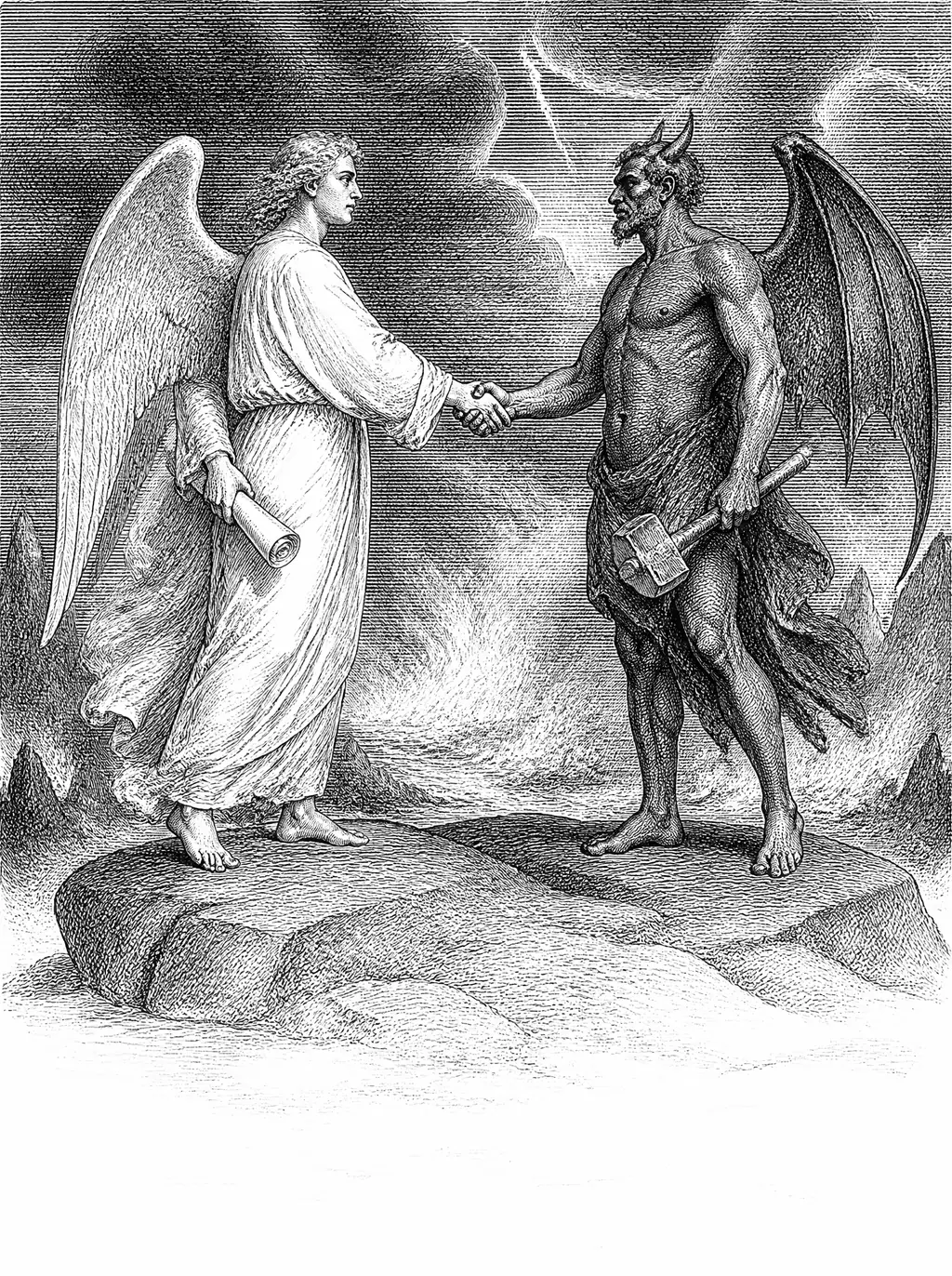
Without Contraries Is No Progression
A marriage no church would perform
Written as visionary prophecy rather than argument, Blake's book stages a deliberately provocative union: heaven's reason married to hell's energy, each treated not as a moral verdict to be handed down but as one half of a single, necessary tension running through every genuine human life. The Marriage of Heaven and Hell was etched and printed by Blake himself around 1790, a handful of copies, each page coloured by hand. It sold almost nothing in his lifetime. It reads now as one of the strangest books in English.
The world it came from
Blake wrote the Marriage in London around 1790, in the first flush of the French Revolution, when radicals like Tom Paine and Joseph Priestley met at the publisher Joseph Johnson's table and Blake, an engraver by trade, moved at the edge of that circle. His target was specific: the Swedish visionary Emanuel Swedenborg, whose New Church Blake had briefly joined and whose tidy separation of heaven from hell he now found smug. Behind Swedenborg stood the whole moralising religion of his day, which Blake believed had turned the body into a sin and energy into a devil. The book is a parody of Swedenborg's visions, a manifesto, and a set of proverbs, printed on plates Blake etched himself.
The idea
Without contraries is no progression. Attraction and repulsion, reason and energy, love and hate, are necessary to human existence. What conventional religion calls Good, Blake argues, is really passive reason obeying rules, while what it calls Evil is active energy, and civilization's error has been trying to suppress that energy rather than genuinely reconciling it with reason. The devil's voice in the book puts the doctrine bluntly: energy is the only life, and it comes from the body; reason is its outer boundary. That is not a creed to be followed but a correction, aimed at a culture that had made obedience the whole of virtue.
How the reasoning runs
Blake argues by inversion and by example rather than by syllogism, but the structure can be drawn out. Premise one: every living thing moves by desire, and desire is bodily. Premise two: what religion calls Good, obedience to a rule, is passive; it restrains but generates nothing. Premise three: a system that treats generation as evil must therefore condemn life itself, which is absurd. So the labels are wrong. Reason and energy are contraries, both needed, like the banks and the current of a river. The error is not having a rule but letting the rule pretend to be the whole. The proverbs of hell then work as counter-examples, one per line, each showing a case where restraint breeds sickness and excess leads to wisdom.
Seen in life
You grew up being told that the right feelings were the quiet ones. Anger was a fault, appetite a weakness, ambition a form of pride. Then at thirty you notice that the people you admire, the friend who left a bad marriage, the colleague who told the board the truth, all did the thing you were taught to suppress. Blake's diagnosis is that you were sold a half of yourself as the whole. The fix is not to burn the rulebook. Reason, in his scheme, is still one of the contraries, and a life of pure impulse is as dead as one of pure obedience. The fix is to stop calling one half of your nature by the name of the devil.
Why it matters
This challenged the standard religious picture of good and evil as a war to be won outright, proposing instead that the two are locked in a productive tension neither side can survive without. It shaped Romantic and later existentialist thinking about morality as something forged through struggle rather than settled by pure, untroubled obedience. For readers inside a faith, the book is a warning against a religion of prohibition. For readers outside one, it is a defence of the parts of themselves that the surrounding culture still labels shameful. Both can use it without agreeing on what heaven and hell are.
“Without contraries is no progression. Attraction and repulsion, reason and energy, love and hate, are necessary to human existence.”
From the source
Blake states his founding principle without qualification: “Without contraries is no progression. Attraction and repulsion, reason and energy, love and hate, are necessary to human existence.” From these contraries, he continues, spring what the religious mistakenly separate and label simply Good and simply Evil. A few plates later the devil delivers a table of errors: that body and soul are two, that energy is evil and reason alone good, that God will torment man in eternity for following his energies. Against each stands a contrary. The book's most quoted section, the Proverbs of Hell, then compresses the doctrine into some seventy aphorisms.
The pushback
Doesn't celebrating energy alongside reason risk excusing real cruelty and destruction as just another necessary contrary, rather than something to be genuinely opposed and reduced wherever it appears in human life? Blake's defenders reply that he is describing a psychological and creative tension within the self, not offering a blank license for harming other people. A second objection is historical. Blake wrote in the year the Revolution still looked like liberation. Within a few years the Terror showed what unbound energy could do, and Blake's later prophecies grew darker. Did he keep the doctrine, or did events revise it?
The reply
Blake's defenders point to the text: the contraries are named as pairs, and reason is never abolished, only demoted from tyrant to partner. The proverb that says the tigers of wrath are wiser than the horses of instruction is a proverb of hell, spoken in a voice Blake frames rather than simply endorses. On the historical objection there is real evidence of revision. The later prophetic books make energy without form into a monster of its own, and Blake's Urizen and Orc are a reasoner and a rebel who each become tyrants in turn. So the marriage survived, but Blake came to fear both spouses. The 1790 book states the tension at its brightest and does not yet reckon with its cost.
Where it went next
The book had almost no readers until Alexander Gilchrist's biography (1863) and Swinburne's essay revived Blake for the Victorians. Yeats edited him in the 1890s and built a private mythology on his. Aldous Huxley took the title The Doors of Perception (1954) from one of its lines, and Jim Morrison took his band's name from Huxley. Nietzsche never read Blake, but Beyond Good and Evil argues a close cousin of the same thesis, and readers have paired them ever since. In philosophy of religion the Marriage stands as the plainest statement of the view that a faith built on prohibition has misread its own God, a charge that later thinkers from Jung to the liberation theologians would restate.
Where this leads
God is dead shows Nietzsche, writing decades later, reaching a related conclusion about conventional morality from an entirely different direction, arguing that the collapse of inherited religious authority leaves human beings needing to build new values themselves, rather than simply inheriting the old fixed boundary between good and evil. Eternal recurrence pushes the same question into time. If you had to live every contrary again, the anger with the calm, would you still say yes? Blake's marriage is the affirmation Nietzsche's test demands, written ninety years earlier.