Symposium · Existentialism · Pl. 4Friedrich Nietzsche · 1844–1900
Eternal Recurrence
A demon's whisper
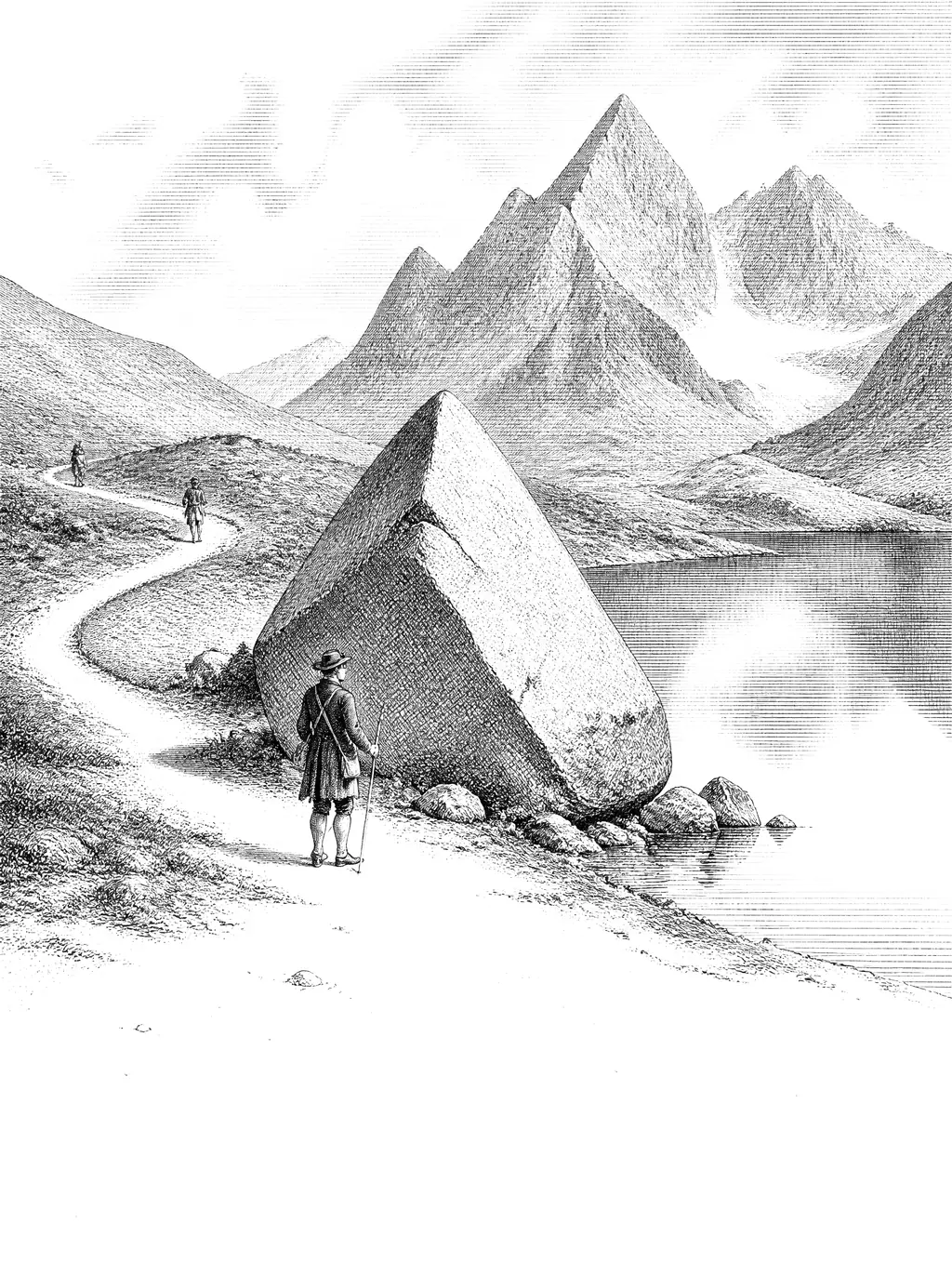
Nietzsche poses a thought experiment as though a demon crept into your loneliest hour and whispered that you would have to live this exact life again, and again, infinite times, down to every sigh and every small joy, with nothing new. He does not ask whether it is true. He asks what your reaction to the thought reveals about how you actually feel about your life. The thought came to him in August 1881, walking by a lake in the Engadine, beside a rock shaped like a pyramid. He wrote on a scrap of paper: six thousand feet beyond man and time.
The world it came from
Nietzsche dated the thought precisely: August 1881, on a walk along Lake Silvaplana near Sils-Maria, in the Swiss Alps, where he spent seven summers in a rented room. He was thirty-six, two years out of his professorship, half blind, and in constant pain. The idea first appeared in print the next year as section 341 of The Gay Science, and again in the third part of Zarathustra in 1884, where the animals sing it and Zarathustra nearly dies of it. The Stoics and the Pythagoreans had taught versions of cosmic return, and Nietzsche, a trained classicist, knew them. In his notebooks he tried to prove it from physics: finite matter, infinite time, therefore every state must recur. He never published the proof.
The idea
Eternal recurrence images the whole of existence as a wheel, cycling through the same events without end. Whether or not it is literally true, Nietzsche uses it as a test: could you affirm your life so completely that you would welcome its exact repetition, forever, rather than wishing even one part of it away? Most lives, tested this way, reveal how much of themselves they secretly regret. The demon's question ends with a choice: do you curse him, or do you answer that you have never heard anything more divine? Nietzsche calls the thought the greatest weight, and asks how well disposed you would have to become to want nothing more than this.
How the reasoning runs
Suppose, as a working hypothesis, that every moment of your life will return exactly, infinitely. Nothing about the world changes under this assumption; only your relation to it. Now examine your reaction. If the thought is unbearable, you have learned that you are tolerating your life rather than affirming it, on the unspoken condition that it ends. If the thought can be welcomed, you have found a life that needs no exit. Second step: since the events are the same either way, the difference lies entirely in the will. Third: the will can be trained, and the demon's question becomes a discipline. Whatever you are doing, ask whether you would do it again forever. Nietzsche thought this question, held daily, would reorganize a life around what could bear repetition.
Seen in life
You are halfway through a Tuesday you would not have chosen: a commute, a meeting that could have been an email, a dinner eaten standing up. Run the demon. Not this year forever, this Tuesday forever, with the meeting and the cold dinner and the small resentment you have been carrying since ten in the morning. Most people, put to the test, find two things. Some of the day they would take back gladly, and it is rarely the parts they expected. And some of it they have been enduring on a promise that it will pass, which the demon revokes. Nietzsche is not asking you to enjoy the meeting. He is asking what you would have to change so that you could.
Why it matters
This turns an abstract cosmological idea into the sharpest possible measure of how you are actually living. It is much easier to tolerate a compromise, a wasted year, or a resentment when you assume it happens once and then is gone for good. Imagining it looping forever removes that escape hatch, and forces the harder question of whether you would choose it again. It is also Nietzsche's substitute for judgment. With no God to weigh a life at its end, the recurrence weighs it from inside, at every moment, and the verdict is delivered by your own reaction to the thought.
“Everything goeth, everything returneth; eternally rolleth the wheel of existence. Everything dieth, everything blossometh forth again; eternally runneth on the year of existence.”
From the source
Nietzsche first poses the demon this way in The Joyful Wisdom, section 341: “What if a demon crept after thee into thy loneliest loneliness... and said to thee: This life... thou must live it once more, and also innumerable times.” In Part III of Thus Spoke Zarathustra, his own animals later sing the same vision back to him: “Everything goeth, everything returneth; eternally rolleth the wheel of existence. Everything dieth, everything blossometh forth again; eternally runneth on the year of existence.” Common's translation, quoted here, keeps the archaic pronouns. The Zarathustra chapter is The Convalescent: the thought has laid Zarathustra low for seven days, and his animals, the eagle and the serpent, sing it while he lies silent. He calls them buffoons and barrel-organs for turning it into a song.
The pushback
Doesn't the whole thought experiment depend on a claim about the universe, endless identical repetition, that has no evidence behind it and may not even be coherent as physics? Nietzsche is largely unconcerned with defending it as literal cosmology. Its force is psychological: even as a pure thought experiment, it still exposes exactly which parts of your life you cannot yet honestly affirm. Georg Simmel added a technical objection: from finite states and infinite time, exact recurrence does not follow, since three wheels turning at incommensurable speeds never return to their starting alignment. And if everything recurs, choice looks pointless; whatever you decide, you decided it already.
The reply
Nietzsche's published answer to the physics is silence, and Simmel's wheels probably win; the notebook proof was never good, and he seems to have known it. The fatalism objection has a better reply. Recurrence does not say you decided already; it says that what you decide now is what recurs, so the decision carries infinite weight rather than none. A weight is not a chain. Where the reply stays partial is on the thought's coherence as a test. If the only thing that changes is your attitude, a critic may ask why you need the cosmology at all, and Nietzsche's answer, that a thought experiment without teeth does not bite, is a claim about psychology rather than a defense of the doctrine.
Where it went next
Heidegger devoted a lecture course to the thought in 1937 and called it the center of Nietzsche's philosophy. Gilles Deleuze, in 1962, read it selectively: only what affirms returns, and the doctrine is a filter that lets the reactive fall away. Milan Kundera opened The Unbearable Lightness of Being in 1984 with the demon and drew the opposite moral, that a life lived once is unbearably light. Nietzsche's note from Sils-Maria is now on a plaque by the rock. Poincaré's recurrence theorem, arrived at independently, is sometimes enlisted as physics for the idea, which would have surprised Poincaré. The thought survives mainly as what Nietzsche made it: a question to put to a life.
Where this leads
Amor fati is the practical discipline this test points toward: not merely surviving the thought of endless repetition, but training yourself to actually want every part of it, the way the Stoics trained themselves to love whatever fate delivered, refusal by refusal, until none was left. God is dead is the vacancy the recurrence fills. Remove the judge who weighs a life at its end, and Nietzsche needs a judgment that works from inside; the demon supplies it, one moment at a time.