Symposium · Existentialism · Pl. 7Friedrich Nietzsche · 1844–1900
God Is Dead
News that hasn't landed
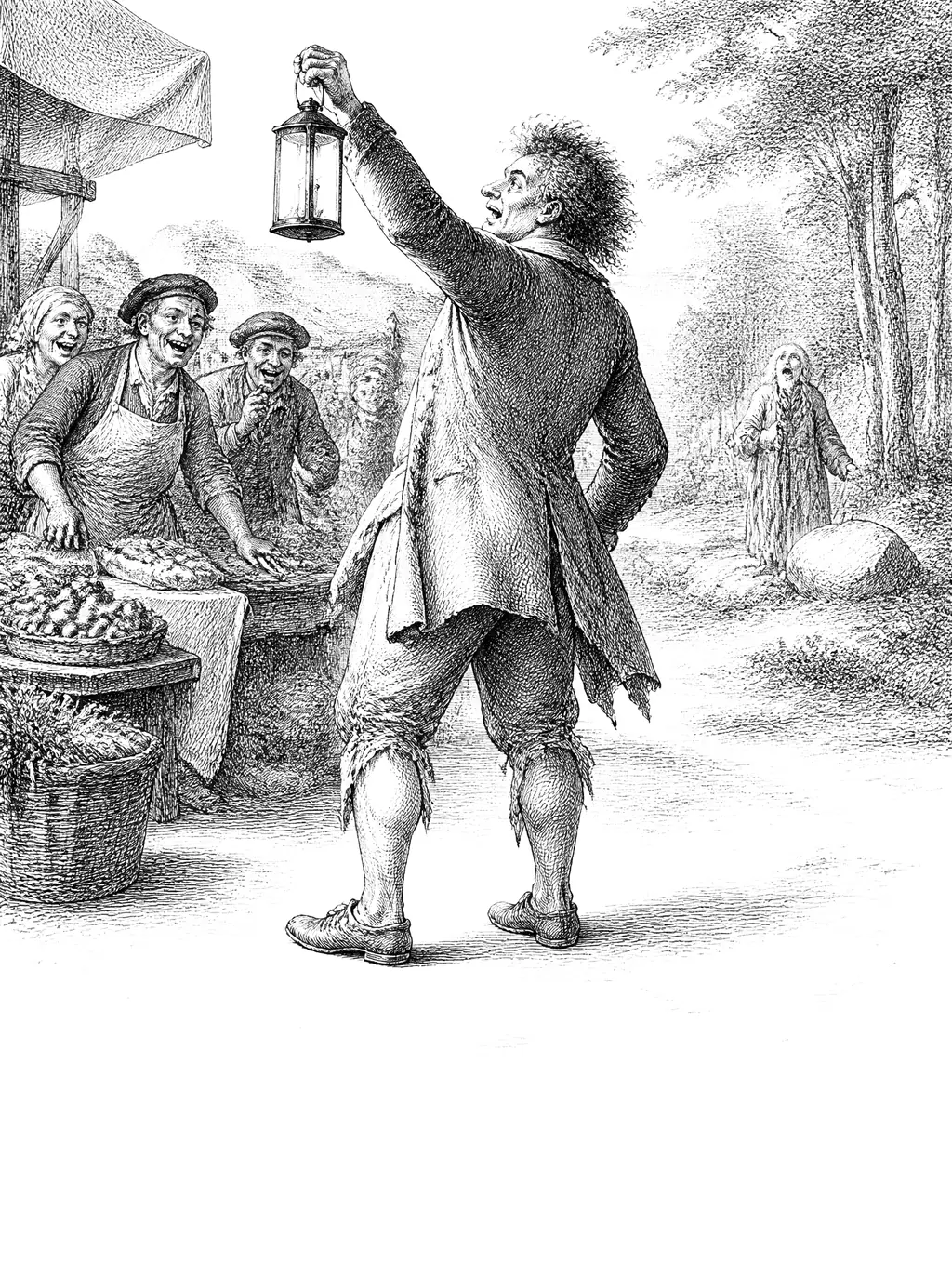
Zarathustra meets an old saint deep in a forest, still singing and praising his God exactly as he has for years. Zarathustra bows to him politely, walks on, and then says to himself, half in disbelief: how strange, that this old man in his forest has not yet heard the news everyone else will soon be forced to reckon with. The line had appeared the year before, in The Gay Science, in the mouth of a madman running through a marketplace with a lantern at noon. Zarathustra says it more quietly, and the quiet is the point.
The world it came from
Nietzsche was the son of a Lutheran pastor and lost his faith as a student at Bonn and Leipzig in the 1860s, reading David Strauss on the historical Jesus, Feuerbach, and Schopenhauer. The news he announces had been arriving for a century: biblical criticism, geology, Darwin, and a science that no longer needed a God to explain anything. The madman first cries God is dead in section 125 of The Gay Science, published in 1882. Zarathustra, begun the next year near Genoa, opens with the same sentence spoken to an old hermit. Nietzsche had left his Basel professorship, lived in cheap rooms, and had few readers. He was writing to a Europe that, in his view, had killed God and not noticed the body.
The idea
God is dead is not a scientific claim about an afterlife. It names a cultural event: the collapse of the shared foundation, belief in a divine order guaranteeing meaning and morality, that European civilization had built everything on for centuries. The foundation did not vanish all at once. It had already been quietly dying, and most people, like the old saint, simply had not heard yet. Nietzsche's madman adds that we are the murderers: not by argument, but by ceasing, over centuries, to live as if the old foundation held. The deed was done before anyone announced it.
How the reasoning runs
First premise: European morality, law, art, and the sense that life has a point were built on a Christian foundation, whether or not any individual believed. Second: that foundation has been removed by the very honesty Christianity taught, a will to truth that ended by turning on its own source. Third: a structure whose foundation is gone does not fall at once; it stands by habit, and the inhabitants go on using rooms that no longer rest on anything. Fourth: the interval between the removal and the collapse is dangerous, because people will either cling to the ruin or, when it falls, conclude that nothing matters. Therefore the task is neither to restore the old foundation nor to mourn it, but to build values that can stand without it.
Seen in life
You do not believe in God, and you have not for years. Yet you still think cruelty is wrong, that a promise binds, that each person has a dignity nobody may cancel, and you would be offended if asked to justify any of it. Ask anyway. Where does the dignity come from, if not from a Creator who granted it? What backs the promise, if there is no one keeping accounts? Nietzsche's old saint has not heard the news; his point is that most unbelievers have heard it and gone on singing the hymns with the words changed. Notice how much of your morality is still shaped like a church. That shape is what he means by the shadow of God.
Why it matters
If Nietzsche is right, this is not a private theological dispute but the deepest crisis a civilization can face, since every inherited answer to how to live, what is good, and what matters was resting on the very foundation now gone. He did not treat the news as good or bad in itself. He treated it as unavoidable, and asked what comes next once it lands. The madman says the event is still on its way, like light from a dead star. Nietzsche expected the real consequences to arrive over two centuries, and placed the crisis in the one after his own.
“Could it be possible! This old saint in the forest hath not yet heard of it, that God is dead!”
From the source
In the Prologue to Thus Spoke Zarathustra, walking alone into the mountains after leaving the old saint behind, Zarathustra says to his own heart in disbelief: “Could it be possible! This old saint in the forest hath not yet heard of it, that God is dead!” The madman's version, in The Gay Science, is the darker one. He asks how we did it, how we drank up the sea and wiped away the whole horizon, and whether we must not ourselves become gods to seem worthy of the deed. Then he throws down his lantern and says he has come too early: the event is still traveling toward us, and the churches, he adds, are now the tombs and sepulchers of God.
The pushback
Isn't this simply an atheist's opinion dressed up in dramatic language, no more binding on a believer than any other claim about God's existence? Nietzsche's real target is narrower and harder to dismiss: even among people who no longer believe, he argued, the moral and cultural habits built on that belief were still being used as if the foundation were intact, unnoticed and unexamined. A second objection: reports of the death were premature. Religion did not vanish in the century after Nietzsche; it grew in most of the world, and even in Europe the funeral he announced has kept being postponed.
The reply
To the believer, Nietzsche would say that his sentence is not addressed to you; it is a report on a culture, and a believer inside a culture that no longer runs on belief has felt the change even if the faith has not. The second objection is stronger, and he has only a partial answer. He was writing about the educated Europe he knew, and predicted the shadow would linger for centuries, so the persistence of religion does not refute him on his own terms. But he also expected the shadow to fade, and in much of the world it has instead thickened. Whether that is the last flare of a dying star or evidence that the star was never dead is a question his madman cannot settle.
Where it went next
Dostoevsky was working out the same problem in fiction at the same time, and Nietzsche discovered him with delight in 1887. Heidegger's 1943 essay Nietzsche's Word: God Is Dead read the sentence as the end of metaphysics itself. Time magazine put the question Is God Dead? on its cover in April 1966, and a short-lived death-of-God theology tried to build a Christianity that accepted the verdict. Camus took the announcement as his starting point and asked what is left; Sartre took it as the premise of Existentialism Is a Humanism. In popular use the line became a slogan, a graffiti joke, and a T-shirt, none of which capture the sadness of the madman throwing down his lantern. Nietzsche collapsed in Turin in January 1889 and never wrote again.
Where this leads
The overman is Nietzsche's proposed answer to the vacancy this idea leaves behind: once the old foundation is gone, someone has to actually build new values in its place, rather than going on living quietly off inherited ones nobody still believes. Eternal recurrence is the other candidate. If no God judges the whole of a life, Nietzsche needed a test that could, and the thought of living every moment again forever is the test he built. The overman is who passes it, and the recurrence is how you would know.