Symposium · Metaphysics · Pl. 8Heraclitus · c. 535 – c. 475 BC
The Unity of Opposites
Two instruments, one secret
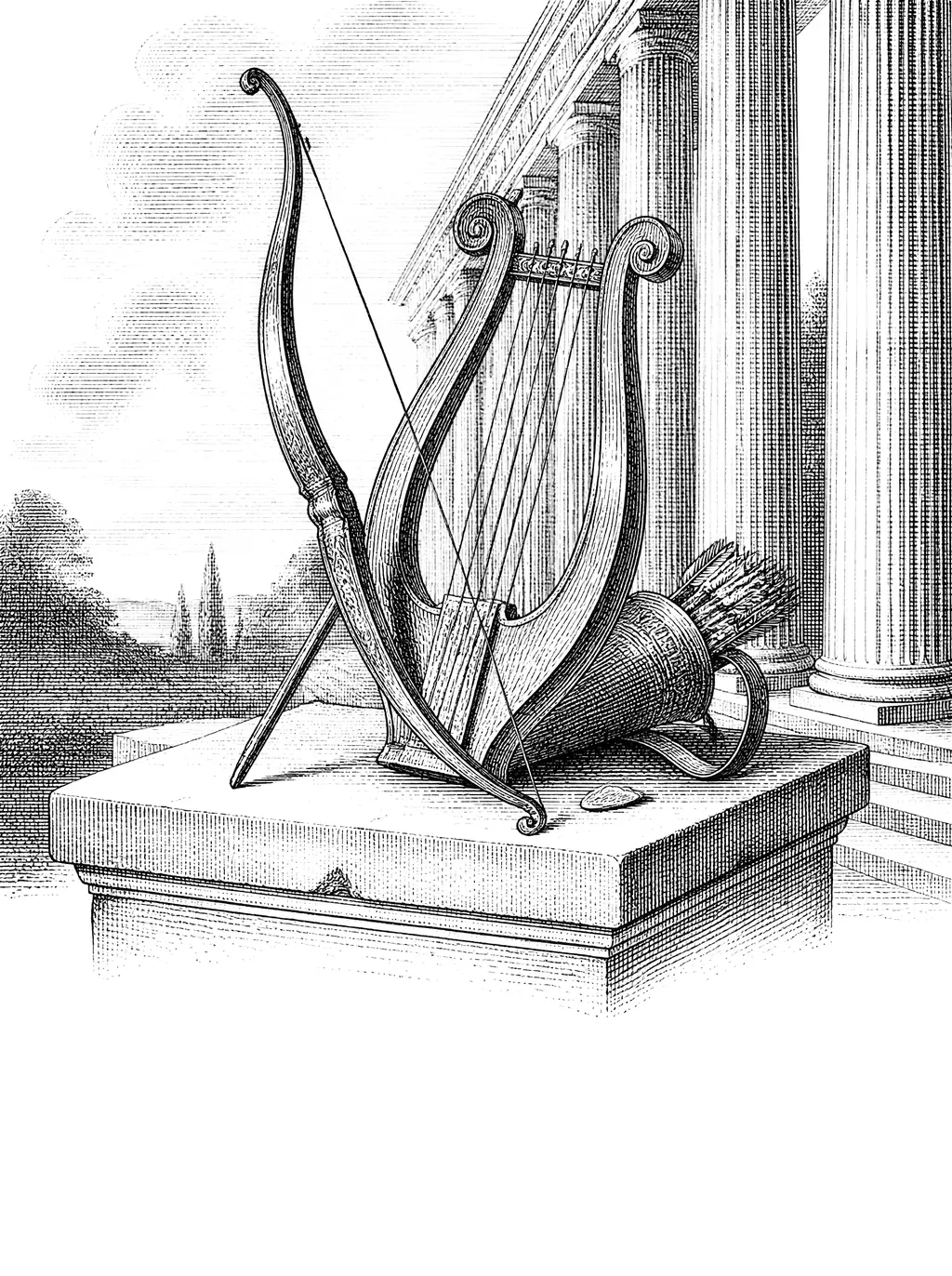
Loosen the string of a bow completely and it cannot fire an arrow. Loosen the string of a lyre completely and it cannot make a note. Heraclitus noticed that the thing making each instrument work at all is the very tension people usually think of as a problem to be resolved, not the source of the function itself. The wooden arms pull one way and the string pulls back, and neither wins. If either side won, the instrument would be a stick. Heraclitus took that ordinary fact about ordinary objects and made it the shape of the universe. Look anywhere, he said, and you will find the bow: two forces straining against each other, and the strain is the thing.
The world it came from
Heraclitus wrote in Ephesus, on the Ionian coast, around 500 BC, and he wrote against almost everyone. Hesiod, he said, did not know day and night, for they are one. Pythagoras he called the chief of swindlers. The Milesians had looked for the single stuff beneath appearances; Heraclitus thought they were asking the wrong question, because the interesting fact was not what things are made of but how opposed things hold together. He lived in a city that had passed between Lydian and Persian control and knew what conflict was. His word for it, polemos, war, he called the father and king of all. The fragments survive as quotations in later authors, most of them a sentence long.
The idea
Men do not know how what is at variance agrees with itself; it is an attunement of opposite tensions, like that of the bow and the lyre. Apparent opposites, hot and cold, up and down, war and peace, are not simply contradictions canceling each other out. They are held together in a working balance that depends on both sides pulling at once. Other fragments spell out the same structure. The road up and the road down are one and the same. Sea water is purest and foulest: drinkable for fish, deadly for men. Disease makes health pleasant, hunger makes satisfaction, weariness makes rest. Each opposite defines the other and needs the other to exist at all. Remove one and the other goes with it.
How the reasoning runs
Step one: look at the cases. A bow only works when the string pulls against the wood; a lyre only sounds when the string is stretched against the frame. Step two: generalise. Wherever something works, look for the opposed forces that make it work. Day is not opposed to night; the pair is one cycle. Health is not the absence of disease; it is a body in which contending processes hold steady. Step three: notice that a name for one opposite is empty without its partner. Up means nothing unless down exists. Step four: conclude that the unity people look for is not beneath the opposition but is the opposition, held in measure. Heraclitus called the measure logos and said it was hidden.
Seen in life
You are in the second year of running a company with your co-founder, and the two of you disagree about nearly everything. You want to ship; she wants to test. You chase the big customer; she protects the small ones. Your mentor tells you the friction is unhealthy and one of you should defer. Heraclitus says look at the bow. The company works because you pull both ways at once, and a version with only your instincts or only hers would fly apart or never move. The question is not how to end the tension but whether it is tuned: enough to hold, not so much that the string snaps. That is a different question, and answering it is the actual job.
Why it matters
This reframes conflict and tension as sometimes structural rather than accidental, a feature of how a working system holds together rather than proof that something has gone wrong. A relationship, an argument, a musical chord: several of the things people value most turn out to depend on opposing forces remaining in active tension, not on one side finally winning. It also changes what you look for when something breaks. If a system is a balance of opposed pulls, then failure is usually a lost opposition, not a present one: the check that stopped checking, the rival who went quiet. A city with no dissent, a body with no fever response, a mind with no doubt: each looks calm and each has lost its string.
“Men do not know how what is at variance agrees with itself. It is an attunement of opposite tensions, like that of the bow and the lyre.”
From the source
Heraclitus states the principle directly: “Men do not know how what is at variance agrees with itself. It is an attunement of opposite tensions, like that of the bow and the lyre.” The hidden attunement, he adds elsewhere, is better than the open one. The Greek word rendered attunement is harmonia, which meant a joint or a fitting-together before it meant a musical concord. The bow and the lyre were both instruments of Apollo, which may be part of the point: the god of order carries the two objects that show order to be strain. The fragment is quoted by Hippolytus, a Christian writer of the third century, who was using Heraclitus to attack a heretic and preserved him by accident.
The pushback
Doesn't celebrating tension risk excusing genuine, destructive conflict as secretly harmonious when it plainly is not? Heraclitus is not claiming every conflict is secretly fine; his image is narrower, pointing to cases where the very structure that produces friction is the same structure producing the function, the way a bow's tension is not a flaw in the bow. Aristotle raised a sharper objection. If the road up and the road down are the same, then a thing both is and is not what it is, and that violates the law of non-contradiction, the principle without which nothing can be said. Aristotle thought Heraclitus could not have believed his own words, since nobody can believe a contradiction. On that reading it is a confusion about the word same.
The reply
The defence of Heraclitus against Aristotle is that he never asserted a contradiction in Aristotle's sense. The road up and the road down are one road described from two ends, not one thing with incompatible properties at once. Sea water pure for fish and foul for men is two relations, not one property and its negation. What Heraclitus denied was that opposites can be understood in isolation, and that claim is compatible with logic. To the first objection: a bow can be over-strung. Heraclitus's own word was measure, and a conflict that breaks the string has lost its measure. The honest gap is that he gives no test for when a tension is tuned and when it is destruction. He shows the shape and leaves the judgment to you.
Where it went next
Plato and Aristotle both read the unity of opposites as a challenge to logic, and Aristotle's law of non-contradiction is in part a reply. The Stoics adopted Heraclitus's logos as the rational order of the cosmos. Two thousand years later Hegel made opposition the engine of his dialectic, in which every concept generates its negation and the two are held together in a higher unity, and he named Heraclitus as the origin of the method. Marx and Engels carried the dialectic into history. Nietzsche praised Heraclitus for affirming strife as justice. Systems theorists and ecologists describe stability as a balance of opposed feedback loops, and Niels Bohr put a yin-yang symbol on his coat of arms with the motto that opposites are complementary.
Where this leads
The dichotomy of control approaches tension from a more practical angle entirely: rather than resolving every pull between what you want and what actually happens, sort which side is genuinely yours to hold, and let the rest find its own balance. You cannot step in the same river twice is the other surviving half of Heraclitus's own thought, and the two fragments need each other. The river stays a river by exchanging its water; the bow stays a bow by holding a strain. Both describe a thing that exists only as a balance of contrary movements. Read them together and Heraclitus stops looking like a poet of chaos. He is describing the one kind of order that can survive change.