Symposium · Ethics · Pl. 1Baruch Spinoza · 1632–1677
Blessedness Is Not the Reward of Virtue
A proof, not a sermon
Spinoza's Ethics reads nothing like a typical moral treatise. It is laid out like Euclid's geometry, with definitions, axioms, and propositions building deliberately on each other, as if morality could be demonstrated the way a theorem is demonstrated. The final proposition of the entire book delivers its payoff: a claim about the actual relationship between virtue and happiness. Everything before it, five parts on God, the mind, the emotions, human bondage, and human freedom, has been scaffolding for that one line. Spinoza then adds a short note, the last words of the book, that all things excellent are as difficult as they are rare. It is the only place he admits how hard the road was.
The world it came from
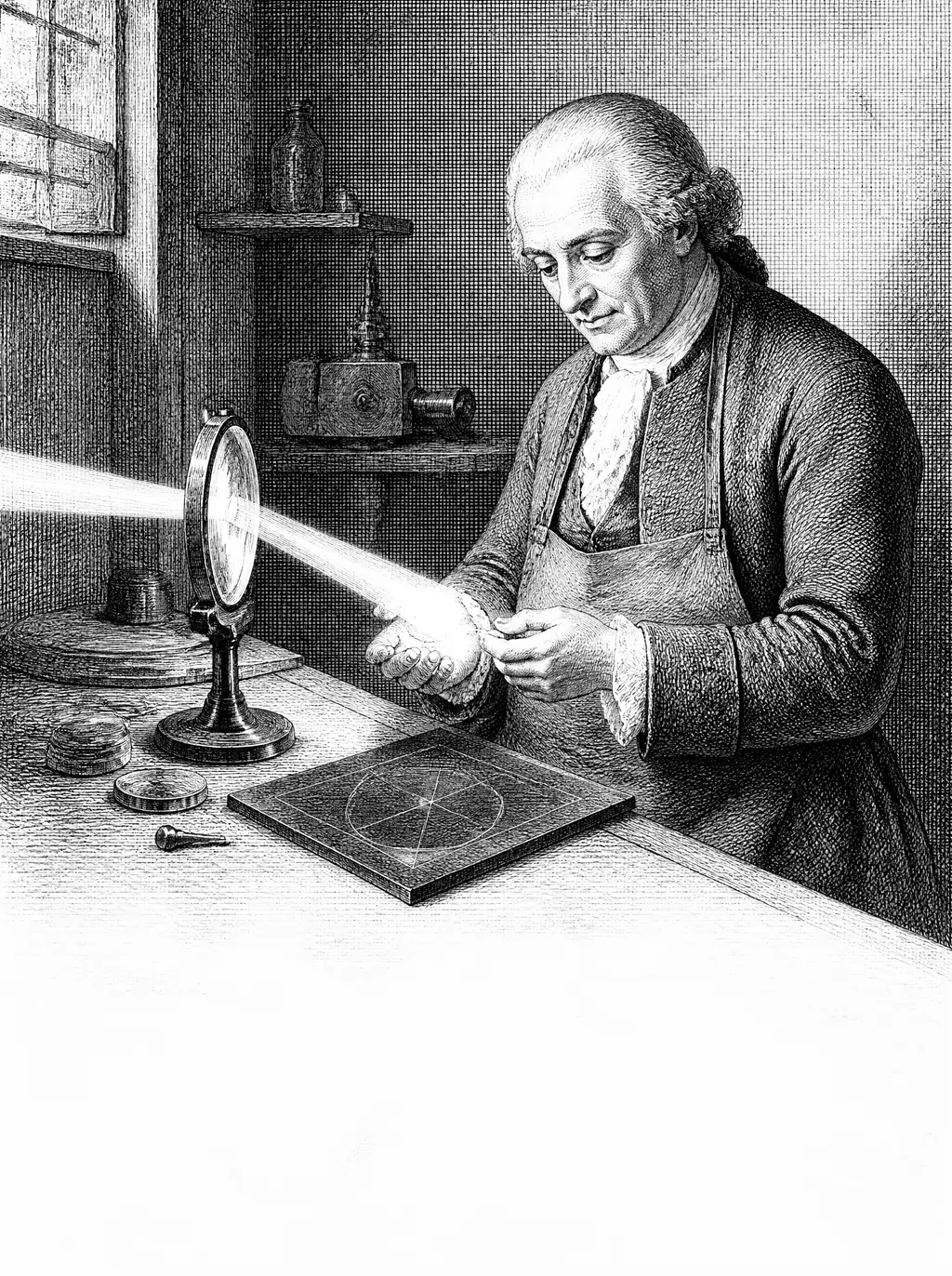
Spinoza was born in Amsterdam in 1632 to a family of Portuguese Jews who had fled the Inquisition. In 1656, at twenty-three, the synagogue expelled him with a curse of unusual violence, for opinions the document does not name. He ground lenses for a living, moved between small Dutch towns, and refused a professorship at Heidelberg in 1673 because it came with a condition about not disturbing the established religion. His Theological-Political Treatise, published anonymously in 1670, was banned within four years. He finished the Ethics in 1675 and did not dare publish it. He died in 1677 of a lung disease, probably worsened by glass dust, and his friends printed the book that year. It was banned the next.
The idea
Most people assume self-control produces happiness as a kind of prize: master your lusts first, and contentment follows as a reward. Spinoza reverses the order entirely. Understanding and rational love of what is real is itself blessedness, and that blessedness is what gives a person the actual power to control their passions, not the other way around. The understanding he means is specific. It is seeing each thing, including yourself, as a necessary part of a single nature, which Spinoza calls God or Nature. A passion is a confused idea about what is happening to you. See it clearly, as one effect among the causes that produced it, and it stops being a passion and becomes something you are doing rather than suffering.
How the reasoning runs
Begin with Spinoza's account of emotion. An affect is a change in your power to act, together with an idea of that change. When the idea is confused, the affect is a passion. Second, an affect that is a passion ceases to be one as soon as you form a clear and distinct idea of it. Third, understanding things clearly means understanding them through their causes, which ultimately means through nature as a whole. Fourth, understanding nature as a whole is what Spinoza calls the intellectual love of God, and it is the highest satisfaction the mind can have. So the same act that is blessedness is the act that dissolves the passions. Control is not the road to it. It is the view from it.
Seen in life
You have been told, since childhood, to count to ten before you answer an insult. Sometimes it works. Mostly you reach ten still furious and answer anyway, or swallow it and carry it home. Spinoza would say counting was never the mechanism. Try instead to understand the insult: the person who said it, the fear or the tiredness that produced it, the history that made you the kind of person it lands on. Do that fully, and notice that the anger has not been suppressed. It has changed into something else, closer to understanding, sometimes to pity. You did not control the emotion and then feel better. You saw clearly, felt better, and found that there was nothing left to control.
Why it matters
This matters because it changes where effort should go. If self-control were the cause of happiness, the path forward would be raw willpower, grimly restraining impulse after impulse. If understanding is the actual cause, and control follows from it, then the real work is deepening comprehension of yourself and the world, which brings the discipline along with it, rather than demanding discipline first. It also removes the idea of a reward altogether. On the ordinary picture, virtue is a payment and happiness is what you buy with it, and the transaction can fail. On Spinoza's, there is no transaction. A person who understands is already blessed, whether or not the world pays out, because the understanding was the thing being sought.
“Blessedness is not the reward of virtue, but virtue itself; neither do we rejoice therein, because we control our lusts, but, contrariwise, because we rejoice therein, we are able to control our lusts.”
From the source
Spinoza's Ethics closes on this claim, its final proposition: “Blessedness is not the reward of virtue, but virtue itself; neither do we rejoice therein, because we control our lusts, but, contrariwise, because we rejoice therein, we are able to control our lusts.” It is Proposition 42 of Part V. Blessedness consists in love toward God, and that love arises from the third kind of knowledge, so it is virtue itself. And because the mind that has this love has the power to restrain its lusts, and that power arises from the same knowledge, the restraint follows from the blessedness. The note that ends the book contrasts the wise person, who is scarcely ever disturbed in spirit, with the ignorant one, who is never at rest.
The pushback
A skeptical reader might ask whether this is just a semantic reversal, calling the same state by two different names depending on which comes first in your explanation. Spinoza's geometric method is meant to answer exactly this: the reversal is not a rhetorical trick but the conclusion of a long chain of argument about what the mind's power over emotion actually depends on. A harder objection is that Spinoza has denied free will entirely, since everything in his nature follows necessarily. If you could not have done otherwise, what is the word virtue doing, and what could an ethics be for? And the blessedness he describes, the intellectual love of a God who loves nobody back, looks available only to a handful of philosophers with unusual leisure.
The reply
Spinoza's answer to the free-will objection is that freedom was never the absence of causes; it is acting from your own nature rather than being driven by external ones, and understanding is exactly what moves a cause from outside you to inside you. An ethics does not need a will that could have done otherwise. It needs a difference between being pushed and understanding, and that difference is real. The elitism charge he half accepts. The final note says that the road is hard and that few find it. What he does not say, and what a reader is entitled to want, is what the rest of us are supposed to do meanwhile. The Treatise offers a lesser answer, obedience and decent laws, and it is plainly a second best.
Where it went next
For a century Spinozist was a word for atheist, and the book was read in secret. Then in 1785 Jacobi revealed that Lessing had confessed himself a Spinozist, and the scandal made Spinoza the philosopher German idealism had to answer. Goethe read him with awe. Novalis called him the God-intoxicated man. Hegel said that to be a philosopher one must first be a Spinozist. Nietzsche wrote a postcard in 1881 announcing that he had found a precursor. Einstein, asked whether he believed in God, said he believed in Spinoza's God. The neuroscientist Antonio Damasio argued in 2003 that Spinoza's account of the affects anticipated modern findings, and Jonathan Israel placed him at the origin of the radical Enlightenment. The Catholic Index that banned him ran until 1966.
Where this leads
The dichotomy of control approaches self-mastery from the opposite direction, starting with the discipline of separating what is yours to command from what is not, rather than starting, as Spinoza does, from understanding first and letting control simply follow along behind it. The golden mean is the account Spinoza was implicitly rejecting. Aristotle trains the passions to hit a target by habit; Spinoza dissolves them by understanding and thinks no habit could do the job. Read the three together and you have three answers to the question of what to do with an emotion: sort it, aim it, or see through it. Spinoza's is the least practical and, if he is right, the only one that finishes.