Symposium · Philosophy of Religion · Pl. 4Boethius · 477–524 AD
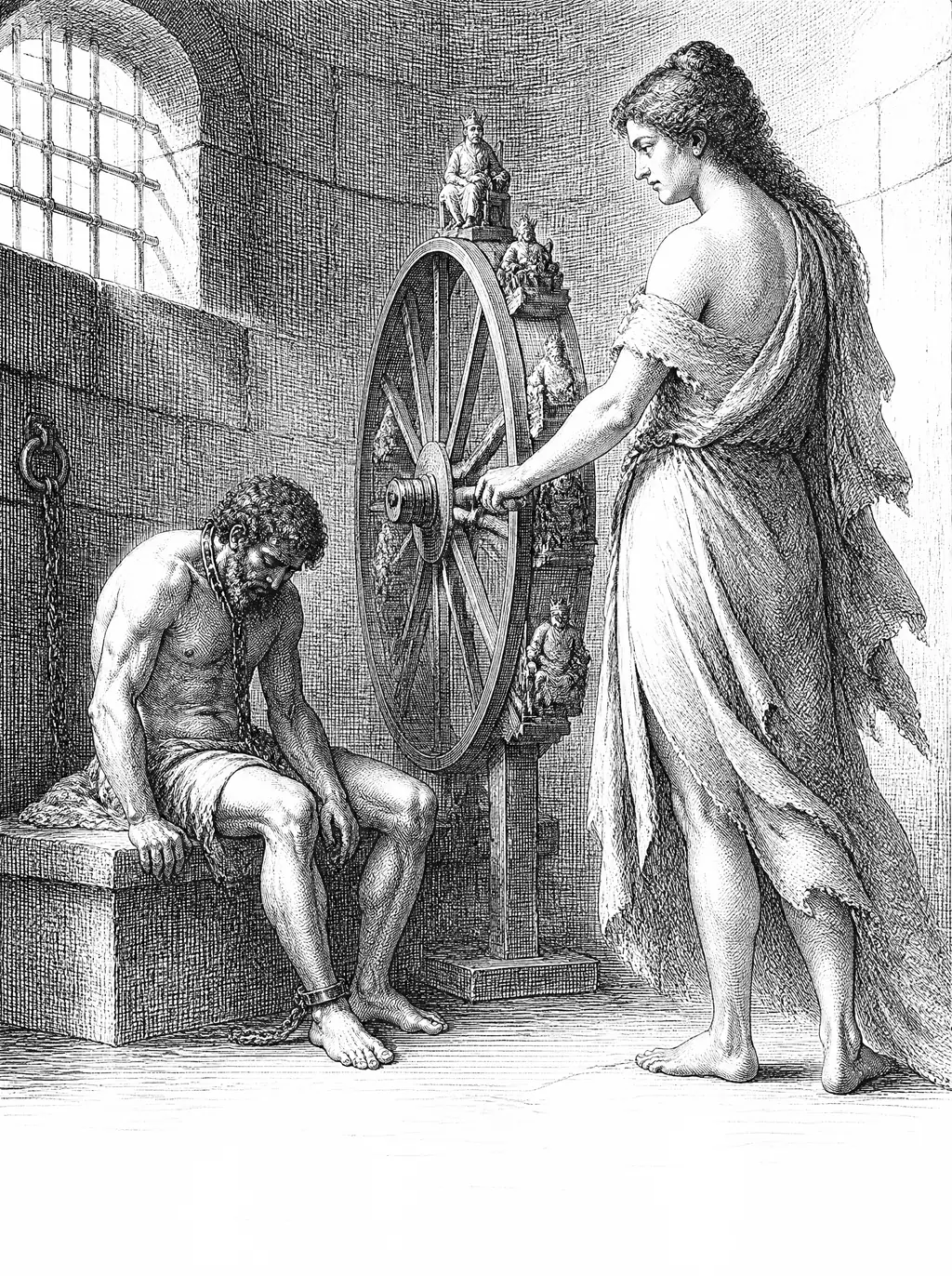
This Is My Art
A visitor with unwelcome advice
Stripped of wealth, office, and freedom, Boethius laments the collapse of his fortunes to a vision of Lady Philosophy, expecting sympathy. Instead she speaks in the voice of Fortune herself, unapologetic and entirely unmoved, reminding him that he never actually owned the good things he now grieves losing in the first place. The book was written in 523 or 524, in a prison near Pavia, by a man who had been consul and chief minister under the Gothic king Theodoric. He was executed, probably by clubbing, before he could see it read.
The world it came from
Anicius Manlius Severinus Boethius was born into the Roman senatorial aristocracy around 477, after the last western emperor had fallen. He served the Ostrogothic king Theodoric, who ruled Italy from Ravenna, rising to consul in 510 and to master of offices, the head of the civil service, in 522. He was also the most learned man in the Latin West, translating Aristotle's logic and planning to translate all of Plato. In 523 he was accused of treasonous correspondence with Constantinople, condemned without a hearing, and imprisoned near Pavia. The Consolation was written there. He was executed in 524 or 525. The problem he faced was the oldest one: where can a good man stand when everything falls away?
The idea
This is my art, this the game I never cease to play. I turn the wheel that spins. I delight to see the high come down and the low ascend. Fortune's whole nature, on this account, is inconstancy itself; expecting her wheel to stay fixed once it has raised you is not misfortune striking you unfairly, but a basic misunderstanding of what fortune actually is. Lady Philosophy makes Fortune speak for herself, and the speech is a legal defence. Fortune gave; Fortune takes. Nothing she lent was ever yours. A man who complains of her wheel has misread the terms of the loan.
How the reasoning runs
The Consolation moves in stages. First, Fortune's own defence: her nature is change, so a stable fortune would be a contradiction, and to accept her gifts is to accept her terms. Second, an inventory of what she gives, wealth, office, fame, pleasure, and a demonstration that each can be lost, so none can be the true good, since the true good cannot be taken from its possessor. Third, the positive claim: the true good is what is self-sufficient, which Philosophy identifies with God, and which a person shares in by virtue and reason, both of which prison cannot reach. Fourth, the reconciliation of providence with a world where the wicked prosper. What Fortune took was never the good, so its loss is not the loss of happiness.
Seen in life
Your company is acquired and the role you built over twelve years is dissolved in an afternoon. The email is polite. You are furious at the unfairness. Boethius would let you be furious for a page, and then hand you Fortune's speech. The title, the team, the sense of being needed: did you think those were yours? They were on loan from an organisation that owed you nothing but a salary. What was yours was the skill you built and the way you treated people, and neither left the building with the badge. Whether you hear that as consolation or as cold comfort depends on where you had stored your sense of worth. Boethius's bet is that you stored it in the wrong place.
Why it matters
This reframed suffering under reversal of fortune as a category error rather than pure injustice, arguing that true and lasting good must be sought in something the wheel cannot reach, virtue and reason, rather than in wealth, rank, or power. It shaped a thousand years of European thought about how to face disaster. The book was among the most copied texts of the Middle Ages. It gave Europe the wheel of Fortune as an image, the distinction between earthly and true goods as a framework, and a model for facing death with argument rather than with prayer alone.
“This is my art, this the game I never cease to play. I turn the wheel that spins. I delight to see the high come down and the low ascend.”
From the source
Fortune herself addresses Boethius directly, refusing to soften her case: “This is my art, this the game I never cease to play. I turn the wheel that spins. I delight to see the high come down and the low ascend.” Mount up if you wish, she adds, but do not call it a hardship to come down again. The image is the wheel. Fortune turns it, and the same motion that lifts one man drops another. In Book II she reminds Boethius that Croesus and Perses both fell from thrones, and asks why his fall should be an exception. The book then passes from Fortune's voice back to Philosophy's, who begins the harder work of saying what cannot fall.
The pushback
Isn't it cold comfort to be told your ruin was predictable, when the real question is not whether fortune is fickle but whether any lasting good exists that fickle fortune genuinely cannot touch at all? Boethius spends the rest of the book building exactly that case, locating true good in reason and providence rather than circumstance. A harder objection concerns the book's God. Boethius argues that providence sees all things at once from eternity, so foreknowledge does not compel our choices. Critics from the Middle Ages onward have asked whether that solves the problem of freedom or simply relocates it to a vantage point no one can check.
The reply
Boethius answers the first objection in Books III and IV: the good that Fortune cannot touch is participation in the one perfect good, reached through virtue, and he argues that the wicked, whatever they hold, are in fact powerless and unhappy because they never reach it. That is the Platonic answer, and it works to the extent that you accept its picture of the good. On foreknowledge, his solution in Book V, that God's eternity is a timeless present so that knowing is not causing, became the standard medieval reply and still has defenders. It is a real move, not a dodge. But it rests on a doctrine of eternity that many find harder to believe than the problem it solves.
Where it went next
Alfred the Great translated the Consolation into Old English, Chaucer into Middle English, and Elizabeth I into her own hand. Dante placed Boethius in the heaven of the sun and borrowed his cosmology. The wheel of Fortune turned in every medieval manuscript and in the Carmina Burana, and Chaucer's Troilus and Knight's Tale are built on his argument. The Book V solution to foreknowledge was taken up by Aquinas and is still discussed under the name eternalism. C. S. Lewis called the Consolation one of the most influential books ever written in Latin. In philosophy of religion it remains the classic case of a man arguing himself toward peace with the sentence already passed.
Where this leads
Where wast thou shows an older text reaching for a related consolation from an entirely different angle, God's own answer to Job's suffering refusing to explain the reasons behind it directly, instead reminding the sufferer of the sheer scale of a universe his own understanding was never built to fully grasp. The dichotomy of control is the Stoic version of the same sorting. Epictetus divides what is up to you from what is not; Boethius divides what Fortune lends from what she cannot reach. The lines fall in almost the same place.