Symposium · Philosophy of Religion · Pl. 11Book of Job · c. 6th–4th century BC (traditional dating)
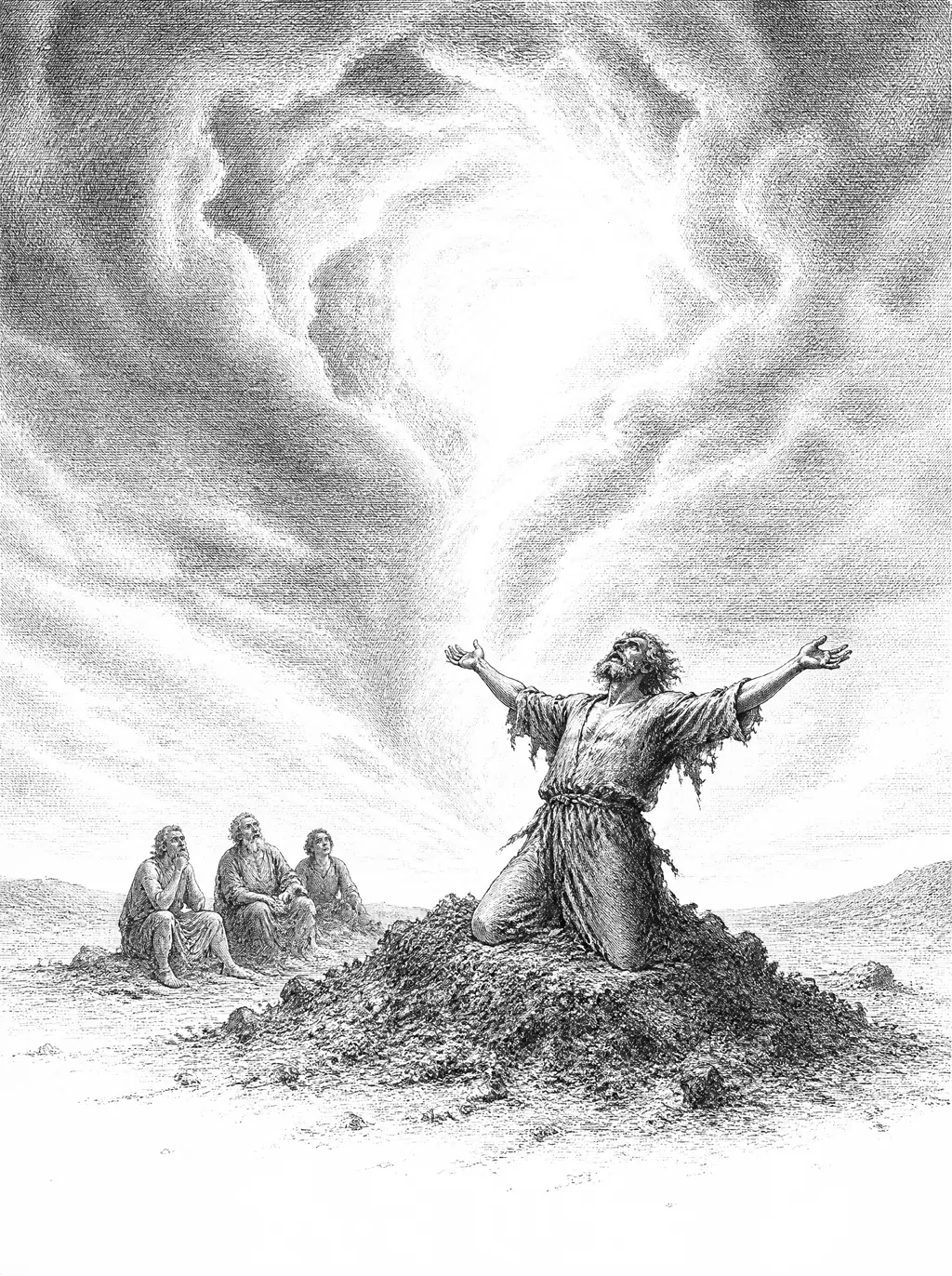
Where Wast Thou
A demand for an explanation
Job has lost his children, his wealth, and his health, and his friends insist he must have secretly sinned to deserve it. Job refuses that explanation and instead demands one directly from God. What he receives, after chapters of silence, is not a defense of divine justice but a whirlwind of unanswerable questions. The friends had a theory. Job had a wound. The book lets the wound speak for thirty-five chapters before the storm arrives, and then the storm never once mentions the wound.
The world it came from
The Book of Job sits in the Hebrew Bible among the wisdom writings, beside Proverbs and Ecclesiastes. Nobody knows who wrote it. Most scholars place its final form somewhere between the sixth and fourth centuries BC, after the Babylonian exile, though the folk tale it reworks may be far older. Job himself is not an Israelite; he lives in the land of Uz, outside the covenant, which lets the poet ask his question in the widest possible terms. The problem was live. Proverbs taught that the righteous prosper and the wicked fall. The exile had made that hard to believe. Job is the argument the tradition had with its own promise.
The idea
Where wast thou when I laid the foundations of the earth? God's response to Job's suffering is not an argument that the suffering was deserved, or even that it served some hidden purpose Job simply cannot see. It is a reminder of the sheer scale of creation, and of how small a place human understanding occupies within it. Notice what God does not say. He never repeats the friends' theory. He never tells Job about the wager with the accuser in the prologue. He asks about the sea, the snow, the ostrich, the war horse, Leviathan. The answer, if it is one, is the world itself.
How the reasoning runs
Set the pieces out. Job's friends argue from a premise: God is just, therefore suffering is punishment, therefore Job sinned. Job accepts the first step and denies the last, so he concludes that God owes him a hearing. Both sides share one assumption, that divine justice must be legible to a human observer. The whirlwind attacks that assumption, not Job. Question after question shows Job a domain he cannot enter: the sea's birth, the storehouses of snow, the hunting lion, the wild ass that laughs at the city. If Job cannot account for any of that, the poem asks, why expect the moral order to be simpler? The friends' theory and Job's demand fall together.
Seen in life
Your sister's child is born with a heart defect. At the hospital a visitor tells her everything happens for a reason. Another says God only gives such trials to the strong. She wants to scream at both of them. The Book of Job sides with her. The friends who speak for God are the ones God finally rebukes, and Job, who shouted at heaven, is the one called a faithful servant. Whether or not you believe there is anyone to shout at, the book leaves you with a usable rule. Do not explain another person's suffering to them. Sit down on the ash heap. The friends' one good moment was the seven days they spent in silence.
Why it matters
This offered a radically different response to suffering than either blaming the victim or promising a tidy explanation waiting just beyond human comprehension. It suggests that the honest answer to why the innocent suffer may not be a reason at all, but a confrontation with the limits of what any finite mind was ever built to grasp. That is uncomfortable for everyone. The believer loses the tidy theory. The skeptic loses the easy target, since the book already agrees that the theory is bankrupt. What remains is a question about scale, and a picture of a world not arranged around any one of us.
“Where wast thou when I laid the foundations of the earth? declare, if thou hast understanding.”
From the source
God's answer to Job opens with a challenge rather than a defense: “Where wast thou when I laid the foundations of the earth? declare, if thou hast understanding.” Chapter after chapter continues in this vein, cataloguing the wild, ungovernable scale of creation rather than ever addressing Job's suffering point by point. The questions run from the earth's cornerstone to the ostrich, the hawk, and finally two monsters, Behemoth and Leviathan, that no human can tame. Job's reply is short. He has spoken of things he did not understand, he says, and he repents in dust and ashes. Then God turns to the friends and says they have not spoken rightly about him, as Job has.
The pushback
Doesn't this response simply dodge the actual question Job asked, overwhelming him with scale instead of ever explaining why an innocent, righteous man had to suffer so badly in the first place? Readers have argued for centuries over whether the whirlwind speech is a genuine answer or a majestic refusal to give one at all. A second objection is harder. The epilogue restores Job's wealth twice over and gives him new children. If the poem's point was that suffering needs no ledger, why does the book end by balancing one? And no new child replaces a dead one.
The reply
The tradition's answer runs like this. Job asked for a hearing, and he got one. God speaks to him, at length, in person, which is more than the friends thought a sufferer could expect. Job's own response suggests that the encounter, not an explanation, was what he needed; he says he had heard of God, and now has seen. On the epilogue, many readers treat the prose frame as the old folk tale the poet inherited and left standing, so that the poem's argument sits inside a happier story it does not fully endorse. That is a partial answer. The book never says why the innocent suffer. It says only that the question is bigger than the questioner.
Where it went next
Job has been read more than argued with. Maimonides devoted chapters of the Guide for the Perplexed to it, treating the whirlwind as a lesson that God's knowledge is nothing like ours. Kierkegaard returned to Job in Repetition. Carl Jung's Answer to Job (1952) turned the tables and put God on trial. Archibald MacLeish's play J.B. (1958) set the story in a circus tent. Elie Wiesel wrote that he preferred the Job who protested to the Job who repented. Philosophers of religion still cite the book when they argue that the problem of evil may not have a solution of the kind the argument demands, only a response.
Where this leads
Vanity of vanities shows a very different book of the same scripture reaching a related but distinct conclusion about the limits of human understanding, finding not awe at creation's scale but a weary futility in every human effort to grasp lasting meaning or advantage from anything done under the sun. Epicurus's old questions gives the same problem its logical form: if God can stop evil and will not, or wills and cannot, what follows? Job stands before that dilemma and hears it answered by a storm rather than a proposition.