Symposium · Aesthetics · Pl. 7Longinus · 1st century AD
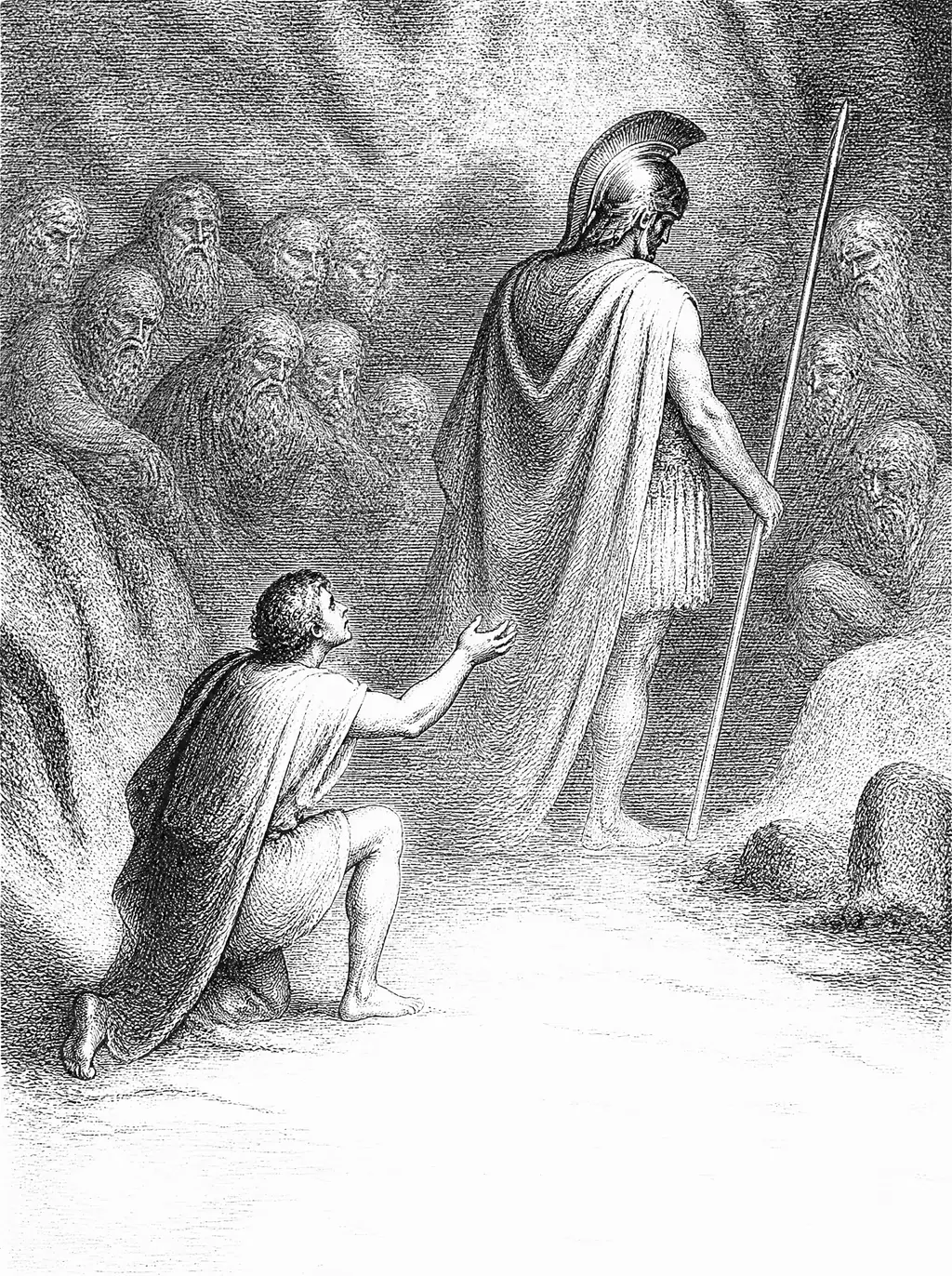
The Image of a Great Soul
Ajax says nothing at all
Longinus offers a strange example of sublimity: the silence of Ajax in the Odyssey, who refuses even to speak to the man who wronged him. No elaborate speech, Longinus argues, could have been grander than that single unspoken refusal, because sublimity is not decoration layered onto content, but a trace left by real greatness of mind. In the underworld, Odysseus approaches the ghost of Ajax, who lost the contest for Achilles' armour to him and killed himself over it. Odysseus pleads. Ajax turns and walks away into the dark without a word. Longinus asks you to notice what you feel at that turn, and to notice that no sentence produced it.
The world it came from
Nobody knows who wrote On the Sublime. The manuscript names a 'Dionysius or Longinus', and most scholars now date the work to the first century AD and treat the author as unknown. He wrote in Greek, under Roman rule, for a friend called Terentianus, and he was answering a lost treatise by one Caecilius that had tried to define the sublime by cataloguing figures of speech. The setting matters. Rhetoric was the core of elite education, oratory had lost its political point under the emperors, and prose was swollen with display. The treatise ends by asking why great writers had become rare, and answers, with hedges, that comfort, greed, and the loss of freedom had shrunk men's souls. The question of greatness was not academic.
The idea
I have hinted elsewhere in my writings that sublimity is, so to say, the image of greatness of soul. A single unspoken thought can be more sublime than an elaborate speech, because sublimity marks the scale of the speaker's mind directly onto the words themselves, rather than functioning as a decorative effect added on top of ordinary content. Longinus names five sources of the sublime. Two are gifts: the power to form grand conceptions, and strong, inspired emotion. Three are craft: figures of thought and speech, noble diction, and dignified arrangement. The first source is the one that matters most, and it cannot be taught in the ordinary way. It can be fed, by living with great minds and asking how Homer or Plato would have said this.
How the reasoning runs
The argument has a shape you can follow. First, notice what sublimity does: it does not persuade, it transports. A great passage takes you out of yourself, and you feel elevated, as if you had produced the words. Second, ask what produces that effect. Longinus tests figures of speech and finds that the same figure can be sublime in one writer and hollow in another, so the figure is not the cause. Third, what varies between the two cases is the mind behind the words. Grandeur of conception shows through even in silence, as with Ajax, and no amount of ornament supplies it when it is absent. Therefore the sublime is the image of greatness of soul, and craft can only serve it, never replace it.
Seen in life
You are watching a documentary about a mountain rescue. The survivor is asked what she thought when she saw the helicopter, and she says nothing for a long time, then: I thought about my daughter's shoes by the door. The room goes still. No adjective, no swell of music yet, and you are undone. Longinus would say the sentence is sublime because of the size of what stands behind it, a whole life pressed into an ordinary detail, and the restraint that let it stay ordinary. A scriptwriter who tried to improve it with bigger words would kill it. When a plain line lands harder than the speech around it, you have met his test.
Why it matters
This located greatness in literature and rhetoric in something like moral and intellectual stature rather than technique alone, making sublimity partly a matter of character. It shaped later European criticism's recurring instinct to read great writing as evidence of a great mind, an idea Burke and Kant would each rework many centuries later. It also explains a familiar experience: why some writing you cannot fault leaves you cold, and some rough writing lifts the hair on your neck. Longinus says the second kind has flaws because it dares, and the first is flawless because it never leaves the ground. He would rather have Homer nodding than a perfect minor poet. That preference has shaped what readers forgive.
“Sublimity is, so to say, the image of greatness of soul.”
From the source
Longinus states the claim while explaining how to train the soul toward greatness: “Sublimity is, so to say, the image of greatness of soul.” He has hinted at it elsewhere in his writings, he says, and he immediately illustrates it with Ajax's silence, a wordless moment he judges grander than anything the hero could have said aloud. The passage is chapter nine of On the Sublime, in H. L. Havell's 1890 translation. The chapter also quotes Genesis, 'Let there be light', as an example of grandeur from the lawgiver of the Jews, a rare case of a pagan critic praising the Hebrew scriptures. The treatise survives in one damaged manuscript, with about a third of the text missing.
The pushback
Can sublimity really be reduced to a soul's greatness, when plenty of technically brilliant, carefully constructed passages move readers deeply without any obvious sense of a towering personality behind them? Longinus does allow that craft and technique matter too, treating natural greatness of mind as the seed that trained skill must still cultivate into finished sublimity. A second objection is about evidence. 'Greatness of soul' is inferred from the very passage it is supposed to explain, so the theory risks circularity: the lines are sublime because the mind was great, and we know the mind was great because the lines are sublime. And plenty of authors of sublime passages were, by every other record, small, vain, and cruel.
The reply
Longinus has a partial answer to the circularity. He gives an independent test: a passage is sublime if it survives repeated reading by many different people across time. The judgment of all ages is his evidence, and the greatness of mind is his explanation of what that evidence tracks. The biographical objection he cannot fully meet, and the tradition has not either. His 'soul' is better read as the mind at the moment of composition, the scale of what the writer could conceive and hold, rather than a report on their conduct. That saves the theory but loosens the link to character that made it attractive. What remains firm is the negative claim: ornament without conception is never sublime, and you can hear the difference.
Where it went next
The treatise was almost unread until Boileau translated it into French in 1674, after which it became the most influential piece of ancient criticism in Europe. Pope's Essay on Criticism praises the bold Longinus as a critic who was himself sublime. Burke's 1757 Enquiry moved the sublime from the writer's mind to the object's terror, and Kant in 1790 moved it again, into the mind's discovery of its own reason in the face of what overwhelms it. Wordsworth's egotistical sublime, Coleridge's high argument, and Emerson's essays all keep the link between grandeur of style and grandeur of person. In the twentieth century Lyotard revived the sublime for abstract painting, and Harold Bloom made greatness of soul the standard of the canon.
Where this leads
The strongest emotion the mind can feel shows Edmund Burke arriving at a related theory of the sublime many centuries later, though he grounds it in terror and vastness rather than in the moral stature of the writer, locating greatness in the object experienced rather than the soul producing it. Concerning the beautiful is the closer cousin. Plotinus said beauty is form that the soul recognises as its own kin, and Longinus says the sublime is the mark of a mind you recognise as larger than your own. In both, the aesthetic experience is a meeting between souls through a made thing. Burke breaks that link; the two ancients keep it.