Symposium · Philosophy of Mind · Pl. 1John Searle · 1932–2025
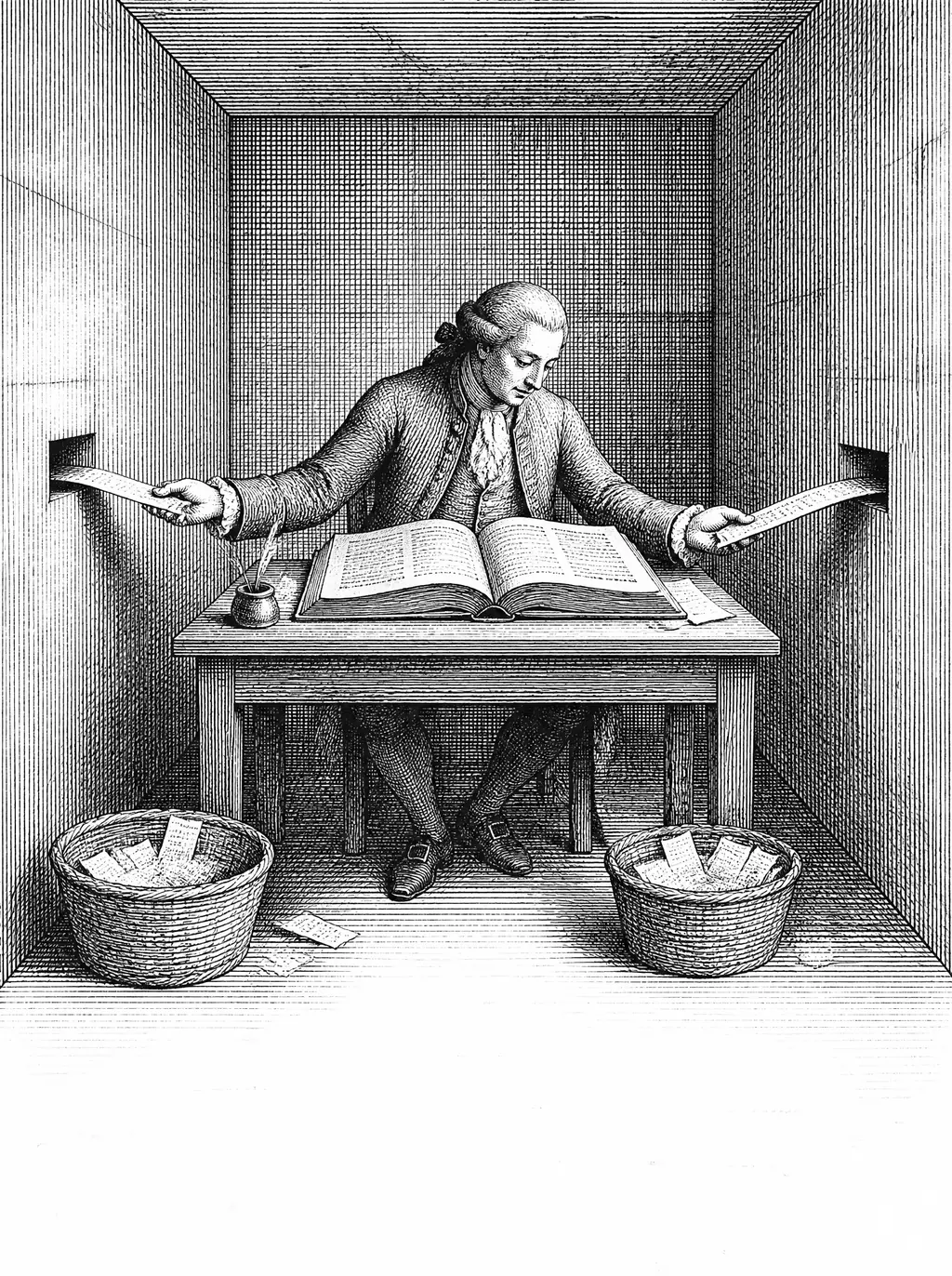
The Chinese Room
Perfect answers, zero understanding
Searle imagines himself sealed inside a room, fed slips of paper covered in Chinese characters he cannot read, armed only with an English rulebook that tells him which symbols to send back out in response to which symbols coming in. Followed carefully enough, the system produces replies indistinguishable from a fluent Chinese speaker's, entirely without Searle understanding one word of it. From outside, the room passes every test anyone could devise. Native speakers slide questions under the door and get answers that make sense. Inside, a man who speaks only English matches squiggles to squoggles. The question Searle asks is the one you already want to ask: where, in all of this, is the understanding?
The world it came from
Searle published Minds, Brains, and Programs in 1980 in the journal Behavioral and Brain Sciences, which printed it alongside twenty-seven replies from critics. He was at Berkeley, known for work on speech acts and about to publish a book on intentionality, the mind's capacity to be about things. His target was a position he named strong AI: the claim that a correctly programmed computer does not merely simulate a mind but has one. He had in view Roger Schank's programs at Yale, which answered questions about short stories using scripts of typical restaurant visits, and the claim of Allen Newell and Herbert Simon that a physical symbol system has what it takes for intelligence. The Chinese Room was built to fit Schank's machine exactly.
The idea
Syntax by itself is neither constitutive of nor sufficient for semantics. The man in the room manipulates symbols by their shape alone, following rules with no access to what any of it actually means. A computer running any program, Searle argues, is in exactly his position: shuffling symbols by formal rules, capable of passing the Turing test, without that performance requiring, or even suggesting, real understanding underneath it. Searle does not deny that machines can think. Brains are machines, and they think. His claim is that they do it by their biological powers, whatever those turn out to be, and not by running a program, since a program is defined by its syntax and syntax is not enough.
How the reasoning runs
Setup: a man who knows no Chinese sits in a room with a rulebook. Chinese questions come in, he matches shapes according to the rules, and Chinese answers go out that a native speaker cannot tell from a person's. The intuition: the man understands nothing, and he is doing everything the program does. Now the formal version. Premise one: programs are defined by their syntax, by symbol manipulation. Premise two: minds have semantics, mental content. Premise three: syntax is not sufficient for semantics; the room shows it. Conclusion: running a program is not sufficient for having a mind. Searle adds a comparison. A computer simulation of digestion digests nothing. Why expect a simulation of understanding to understand?
Seen in life
It is late, you are tired, and you type something to an AI assistant that you would not say to a colleague. The reply is careful. It says it is sorry you are going through this and asks a question that shows it followed every detail. For a moment something in you responds as if you had been heard. Searle would say the room has just answered a slip under the door. The words are apt because the rules, learned from a billion conversations, are good. Nothing in the system is sorry, on his view, because nothing in the system knows what sorry is about. You may feel that is obviously right. You may feel it is obviously wrong. Either way, the feeling is the argument.
Why it matters
This directly challenges the assumption that passing a behavioral test like Turing's proves genuine understanding is present. If a system can produce perfect output through pure symbol manipulation with no comprehension anywhere inside it, then convincing conversation alone was never sufficient evidence for a mind, however useful it remains as a rough, practical measure. The argument also draws a line that the current generation of AI systems has made urgent. Large language models are, at the level of their operation, symbol manipulators of exactly the kind Searle described, only vast. Whether their fluency shows understanding or shows that fluency never needed it is the Chinese Room question, and it now has practical consequences for how people treat, trust, and regulate the machines.
“Syntax by itself is neither constitutive of nor sufficient for semantics.”
From the source
Searle summarizes the whole argument's target in one carefully chosen line, set out as Axiom 3 in his 1990 Scientific American restatement: “Syntax by itself is neither constitutive of nor sufficient for semantics.” Manipulating symbols correctly, however fluently and however quickly, is simply not the same thing as knowing what those symbols actually mean. The 1980 paper tells the story first and then works through the replies Searle had heard when he presented it at AI laboratories. He names each: the systems reply, the robot reply, the brain simulator reply, the combination reply, the other minds reply, and the many mansions reply. He also states his positive view. Whatever the brain does to produce understanding, it does it by causal powers that a program, being a formal object, cannot have. He later called that biological naturalism.
The pushback
The systems reply, one of Searle's most discussed critics, argues that while the man in the room does not understand Chinese, the entire system, man plus rulebook plus room, might understand it collectively, the same way no single neuron in a human brain understands English while the whole brain plausibly does. Paul and Patricia Churchland put a sharper version in 1990. Imagine someone in 1860 waving a magnet in a dark room and concluding that electromagnetism cannot be light, because no light appears. The room shows only that a slow, small symbol shuffle looks nothing like understanding, and says nothing about a system operating at the brain's scale and speed. Daniel Dennett called the story an intuition pump, built to hide exactly that complexity.
The reply
Searle's answer to the systems reply is to shrink the system. Let the man memorize the rulebook and do all the matching in his head, out in the open. Now he is the whole system, and he still understands no Chinese. To the robot reply, adding cameras and arms only adds more symbols. To the brain simulator, a network of water pipes that copied every neuron would still be pipes. To the Churchlands he replies that electromagnetism was a causal phenomenon waiting to be discovered, while syntax is observer-relative and causes nothing. Critics find the memorized-rulebook move question-begging, since the man's lack of a feeling of understanding may not settle what the process he runs does. And the appeal to special causal powers names the gap rather than filling it.
Where it went next
The twenty-seven replies printed with the paper set the pattern, and the debate has run in their grooves ever since. Douglas Hofstadter and Dennett reprinted it with a rebuttal in The Mind's I in 1981. Searle restated it for a wide audience in his 1984 Reith Lectures. Stevan Harnad's 1990 symbol grounding problem asked how symbols could get their meaning at all, taking the room as its starting point. The argument has become the standard reference in disputes over large language models: the 2021 description of such models as stochastic parrots is the Chinese Room in new clothes, and the reply that scale changes everything is the Churchlands' luminous room. Ned Block's earlier China brain, a nation of people simulating one mind, is often read alongside it.
Where this leads
Can machines think? is the very test this thought experiment was built to undercut, arguing that fooling a judge in conversation, Turing's own proposed standard, was never proof that genuine understanding was present behind the words being exchanged at all. Where does the mind stop? pushes in the opposite direction. Clark and Chalmers ask whether a notebook can be part of a mind; Searle asks whether a room full of rules can be one. Both treat the boundary of a mind as something to argue about rather than assume. Put them side by side and the question sharpens: if a mind can extend into a notebook, why not into a rulebook, and if a rulebook is not enough, what exactly does the skull add?