Symposium · Philosophy of Mind · Pl. 2René Descartes · 1596–1650
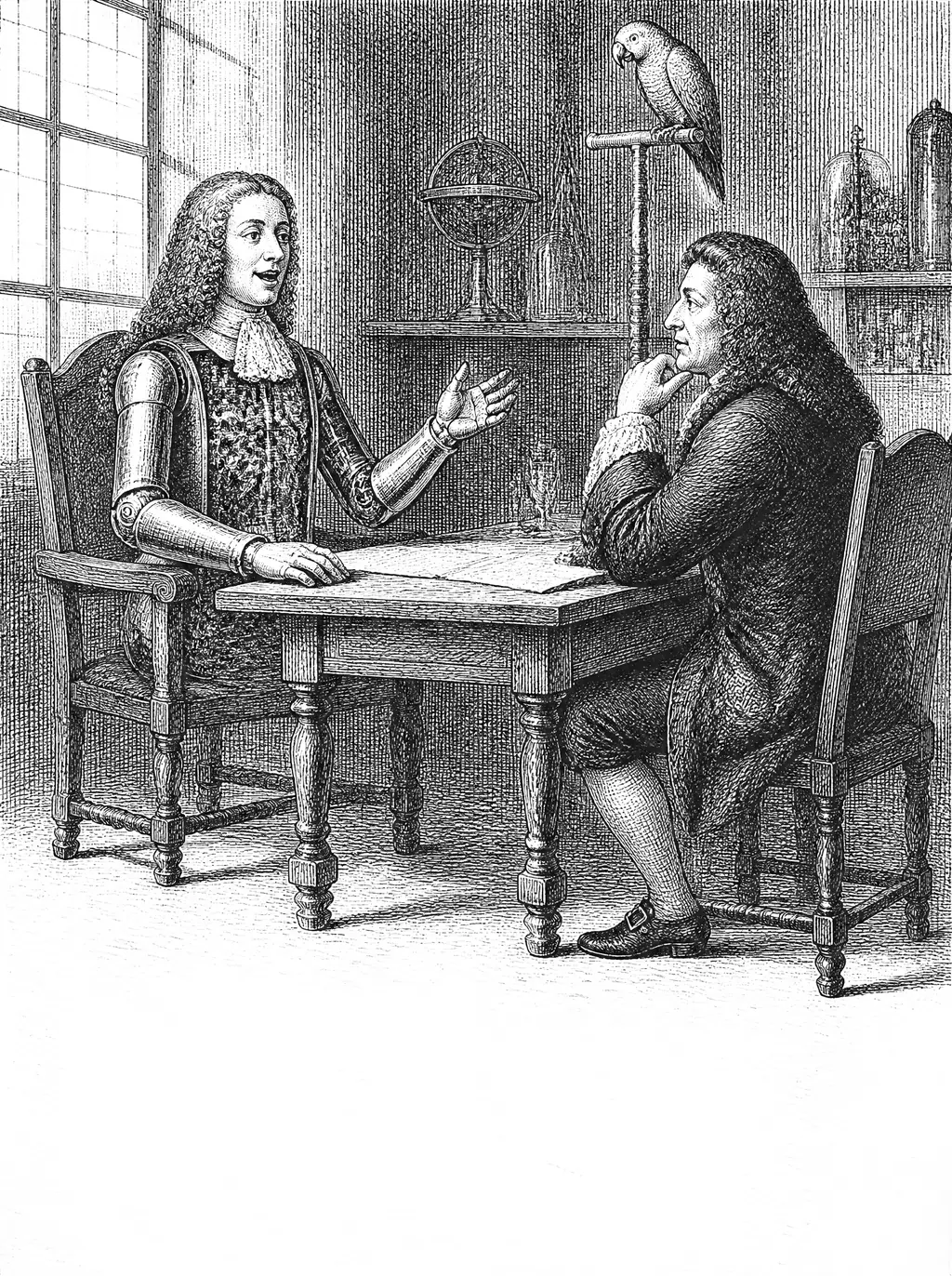
Descartes's Test for a Thinking Machine
A machine built to fool you
Descartes imagines a machine built to resemble a human body exactly, moving, reacting, even crying out convincingly when touched in the right place. He grants that such a device could imitate a great deal. Then he asks what, specifically, it could never manage to fake, no matter how cleverly it was built. His answer is not strength, or speed, or even skill. A machine could be built to do any one thing better than a person. What it could not do, he claimed, is answer. Say anything you like to it, and watch whether the reply fits. That single test, he thought, would expose every machine ever made.
The world it came from
Descartes published the Discourse on the Method in 1637, anonymously and in French, from the Dutch Republic where he had lived since 1628. Four years earlier he had withdrawn his physics, The World, when he heard of Galileo's condemnation. Part V of the Discourse gives the safe remainder: a mechanical account of the body, the heart, and the nerves, drawing on Harvey's discovery of circulation. Descartes had seen the hydraulic statues in royal gardens that moved when a visitor stepped on a hidden plate, and he took animals to be machines of that kind. His problem was to say where the mechanism stopped. If the body is a machine, what does a rational soul add? The language test is his answer.
The idea
Two tests would still reveal such a machine was not truly a person. First, it could never use words or signs arranged appropriately to declare its thoughts and reply to whatever is said in its presence, the way even a dull-witted person easily can. Second, it would fail at the sheer range of situations reason handles, since its organs, unlike reason, need a separate arrangement for every separate task. Descartes does not deny that a machine could speak. A machine could be made to say ouch when struck. What it cannot do is meet the open-ended demand of a conversation, where the next sentence could be about anything, and a fitting reply must be found.
How the reasoning runs
Start with a concession: a machine shaped like a monkey could not be told from a real monkey, since animals are machines anyway. Now build one shaped like a person. Step one: a machine acts only through the arrangement of its parts, and each arrangement fits one situation. Step two: reason is a universal instrument, ready for any situation. Step three: so the machine must run out of arrangements somewhere, and a person never does. Language is where the gap shows fastest, because a question can be about anything. The machine may have a word ready for a blow, but not for whatever you happen to say next. Conclusion: reason is not a product of matter, and the rational soul is something added to the body.
Seen in life
You open an AI assistant at midnight and type something nobody has ever typed before: a question about your grandmother's recipe, a bug in your code, and whether the two are connected. The reply fits. It is coherent, on topic, and adapted to the odd thing you asked. By Descartes's first test, that should be impossible for a machine. Notice what happens next in your own head. You do not conclude the assistant has a soul. You conclude that fitting replies can be produced by an arrangement of parts after all, if there are enough of them. That is exactly the move Descartes said could never be made. Either he was wrong about machines or wrong about what conversation proves.
Why it matters
This is one of the earliest attempts to specify a concrete test for genuine thought rather than simply asserting that machines cannot think. Descartes locates the decisive evidence in flexible, appropriate language use, precisely the same territory a famous twentieth-century test would return to, using almost exactly this same intuition about conversation as proof of mind. It also fixes the shape of every later debate. Descartes made a bet: fitting replies to open questions cannot come from mechanism. Turing accepted the test and bet the other way on the outcome. Searle kept the test's failure and denied its meaning. Every argument about whether a chatbot understands is a quarrel about a paragraph Descartes wrote in 1637.
“They could never use words or other signs arranged in such a manner as is competent to us in order to declare our thoughts to others.”
From the source
Descartes states the first test directly: “They could never use words or other signs arranged in such a manner as is competent to us in order to declare our thoughts to others... but not that it should arrange them variously so as appositely to reply to what is said in its presence, as men of the lowest grade of intellect can do.” The passage comes from Part V of the Discourse, in John Veitch's nineteenth-century translation. Descartes goes straight on to the second test. A machine, he says, acts by the disposition of its organs, and would need a particular disposition for each particular action, so it must fail in some situation where reason would not. He adds that even the dullest human passes, and the cleverest animal does not.
The pushback
Modern machines now produce fluent, contextually appropriate language at a scale Descartes could not have imagined, which raises exactly the question his test was meant to settle: does passing this conversational bar actually prove understanding, or only prove that the bar itself was never as decisive a test as he assumed it to be. There is an older problem too. Descartes argued from what he could not imagine a mechanism doing, and that is an argument from ignorance. He had never seen a mechanism with a billion parts. His second test fares no better. It assumes one organ per task, but a mechanism that learns its arrangements from examples needs no such thing, and he offered no reason to rule that out.
The reply
A Cartesian has two ways to answer. The first accepts the test and takes the result seriously: if a machine really does reply appositely to anything, then by Descartes's own standard it has reason, and the surprise is that reason turned out to be mechanical. The second keeps the conclusion and drops the test: the machine only appears to declare its thoughts, because it has none to declare. That is Searle's road, and it costs Descartes his evidence, since declaring thoughts was supposed to be how we tell. The honest position is that Descartes gave a criterion and a conviction, and the two have come apart. His second test, the range of reason, still bites where machines fail in ways no person would, but that gap narrows every year.
Where it went next
La Mettrie took Descartes's animal machines and in 1747 extended them to humans in Man a Machine, exactly the move Descartes had built the test to block. Turing's 1950 imitation game is the same test with a scoreboard and the opposite prediction. Chomsky credited Descartes in 1966 with seeing what he called the creative aspect of language use, the fact that ordinary speakers produce and understand sentences they have never met. Joseph Weizenbaum's ELIZA in 1966 showed how little conversation it takes to convince a person, which turned the test's weakness into a research finding. Searle's Chinese Room in 1980 argued that passing the test proves nothing. Large language models have now made Descartes's paragraph a live experiment rather than a thought experiment.
Where this leads
The Turing test proposes essentially the same experiment three centuries later, formalized into a game: if a machine's conversation cannot be reliably distinguished from a person's, on what grounds, if any, could you still confidently deny that it actually thinks? The Chinese Room is the other heir, and it takes Descartes's side of the bet while rejecting his test. Searle grants that a machine could reply appositely to anything said in its presence and denies that this shows understanding. Read the three together and the shape of the argument is clear: Descartes proposed conversation as the mark of mind, Turing agreed and expected machines to pass, and Searle argued that passing was never the point.