Symposium · Philosophy of Mind · Pl. 15Alan Turing · 1912–1954
Can Machines Think?
A question too slippery to answer
Turing opens his paper with the question everyone wanted asked and no one could cleanly settle: can machines think? He decides the word think is too loaded with unstated assumptions to argue about directly, and proposes replacing it with something concrete enough to actually test, borrowed from an old parlor game about guessing a hidden player's identity. He is blunt about why. Settle the meaning of think by asking what people mean, he says, and you might as well run an opinion poll. He wanted something a machine could pass or fail, on a given day, in front of witnesses. That demand, more than any answer, is what changed the field.
The world it came from
Turing wrote Computing Machinery and Intelligence in 1950 at the University of Manchester, where one of the first stored-program computers had run in 1948. He had defined the abstract computing machine in 1936 and spent the war at Bletchley Park breaking German ciphers. The paper answers real opponents. The neurosurgeon Geoffrey Jefferson had declared in a 1949 lecture that no machine could equal a brain until it wrote a sonnet from felt emotion. Others reached for Gödel's theorem, for theology, or for Ada Lovelace's remark that a machine does only what it is told. Turing lists nine such objections and answers each. Four years later he was dead, after a conviction in 1952 for homosexuality and the hormone treatment imposed as punishment.
The idea
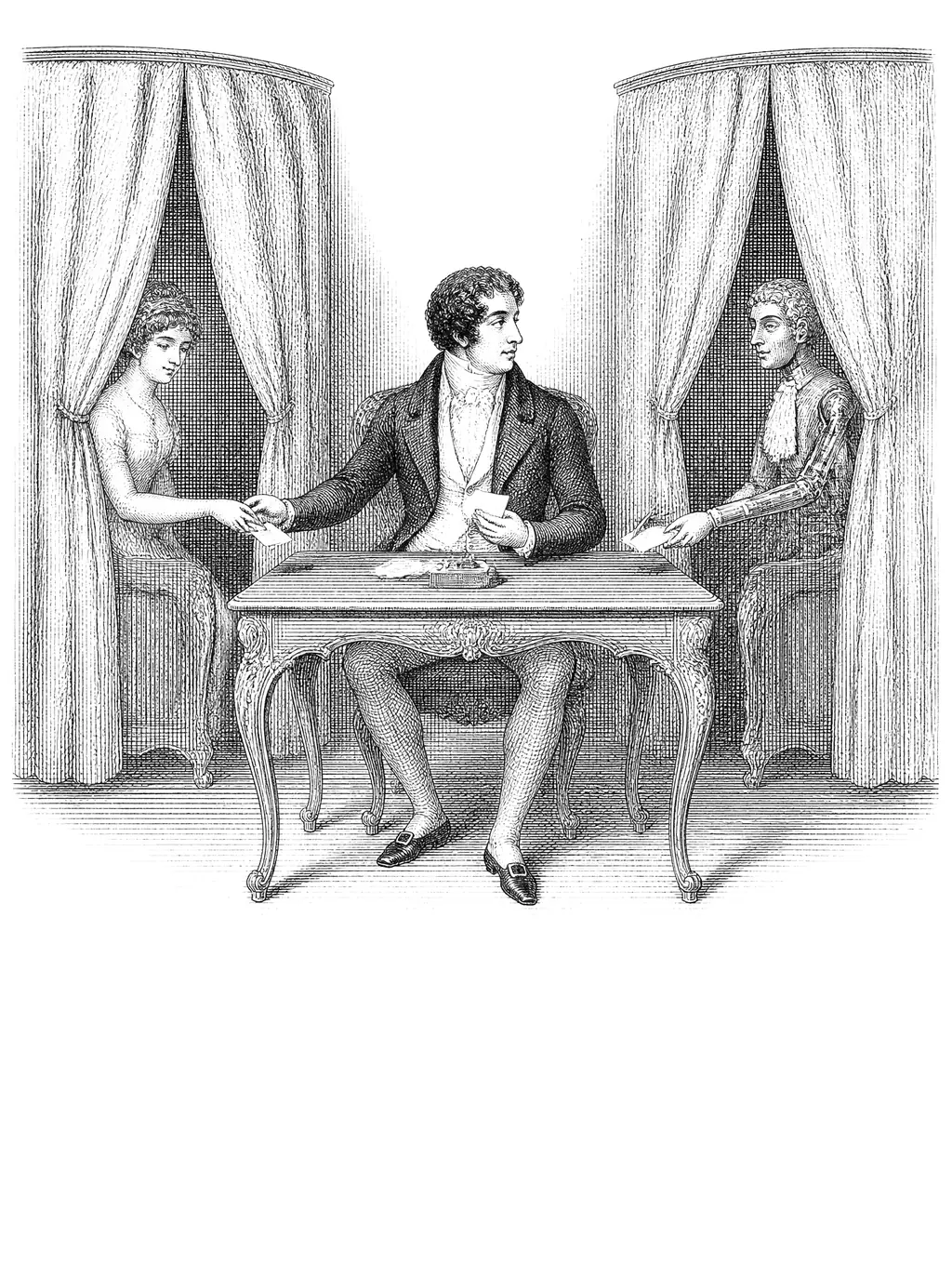
In the imitation game, a human judge holds a text conversation with two hidden participants, one human and one machine, and must guess which is which. If a machine can regularly fool the judge into guessing wrong, Turing proposes treating that as a meaningful answer to whether it can think, sidestepping the harder metaphysical question of what thinking really, ultimately is. The original parlor game had a man and a woman, with the man trying to pass as the woman by written answers alone. Turing swaps the man for a machine and keeps everything else. Text only, so voice and appearance drop out. Any topic, so the machine cannot prepare. The judge, not the machine, decides.
How the reasoning runs
Step one: the question can machines think is too vague to settle, so replace it with one that has a definite outcome. Step two: the replacement must isolate thinking from everything irrelevant to it, which is why the game uses a teletype and forbids the judge from seeing or hearing the players. Step three: conversation is the right medium because it can range over anything, so a machine cannot pass by mastering one narrow trick. Step four: if a machine holds up in that setting as well as a person does, every observable ground we have for crediting thought to other people applies to it too. Conclusion: the game is a fair test. Turing then predicts that by the end of the century denying that machines think will sound odd.
Seen in life
You have been typing to a customer support agent for twenty minutes. The replies are polite, quick, and slightly too even. At some point you find yourself dropping a joke into the chat to see what comes back. That is the imitation game, run by you, without a scoreboard. Turing predicted the situation exactly: a text channel, a hidden partner, and a judge trying to catch a machine out. What he did not predict is that the game would run in reverse. Websites now ask you to prove you are human by picking out traffic lights, because the machines pass the conversation test and people fail the image test. Sixty years on, the judge is often the one under suspicion.
Why it matters
This reframes an apparently unanswerable metaphysical puzzle as a concrete, checkable behavioral test, letting the question of machine intelligence be investigated empirically rather than debated forever in the abstract. It has shaped how artificial intelligence gets discussed and evaluated ever since, for better and for worse, well past its original, narrower proposal. It also settles a fairness question about people. Turing's answer to Jefferson was that the only evidence you have for anyone else's thought is behavior. Demand more from a machine and you demand what you never had for your neighbor. That argument does not prove machines think. It shows that whoever denies it owes a reason that would not also strip thought from everyone but themselves.
“Can machines think?”
From the source
Turing opens his 1950 paper with the single question that gives the whole essay both its shape and its lasting fame: “Can machines think?” He immediately proposes replacing that question with a more testable version built around what he calls the imitation game. The paper ran in the philosophy journal Mind, not in an engineering journal, and much of it is a series of replies to objections. Its last section is about learning. Instead of programming an adult mind, Turing suggests, build a machine like a child and educate it, with rewards and punishments, so that it grows into the competence the game demands. He guesses that an ordinary judge would be fooled about a third of the time after five minutes by the year 2000.
The pushback
Fooling a judge in conversation proves only that a system produces convincing output, critics argue, not that anything resembling genuine understanding sits behind it, a gap the Chinese Room thought experiment would later try to make vivid and impossible to ignore, decades after Turing's original proposal. Two further objections cut deeper. The test measures how human a machine seems, not how intelligent it is: a machine that answers arithmetic instantly and never misspells would fail for being too good. And the test depends on the judge. Joseph Weizenbaum's ELIZA fooled people in 1966 with pattern-matched questions, which shows judges are easy to fool, and that the game measures human credulity at least as much as machine thought.
The reply
Turing saw the humanness objection and conceded it. He offered the game as a sufficient condition, not a necessary one: a machine that fails could still think in ways the test cannot see, and he said so. On understanding, his reply to Jefferson stands: the demand for inner feeling leads to solipsism, since you can never verify it in anyone. The credulity point is harder. Turing did not specify the judges, and the game is only as good as they are. A defender can say that with skeptical, expert judges and long conversations the test regains its force, and that ELIZA would not last a minute with such a panel. True, but then the test is a family of tests, and Turing never said which one counts.
Where it went next
Weizenbaum's ELIZA in 1966 gave the first field result: people confide in a program that only reflects their words back. Searle's Chinese Room in 1980 became the standard argument that passing proves nothing about understanding. The Loebner Prize ran an annual restricted version from 1991 to 2019 and mostly rewarded evasive chatbots. A 2014 claim that a program posing as a Ukrainian teenager had passed was widely rejected. Large language models in the 2020s made the question ordinary: millions of people now hold conversations that would have passed Turing's five-minute bar, and the argument has moved to whether the bar was ever the right one. Turing's closing proposal, a child machine trained by reward, describes the method that eventually built them.
Where this leads
The Chinese Room argues directly against treating Turing's own famous test as sufficient proof of anything much at all, describing a system that could pass it perfectly while, its own author insists, understanding nothing at all behind the convincing performance. Descartes's test for a thinking machine is the ancestor. In 1637 Descartes proposed the same criterion, fitting replies to whatever is said, and predicted no machine would ever meet it. Turing took the criterion and reversed the prediction. Read the three in order and you watch one idea change hands: conversation as the mark of mind, first offered as proof that machines cannot think, then as the way to show that they can, then as a performance that shows nothing either way.