Symposium · Philosophy of Mind · Pl. 6Thomas Hobbes · 1588–1679
The Heart Is Just a Spring
A body built like a watch
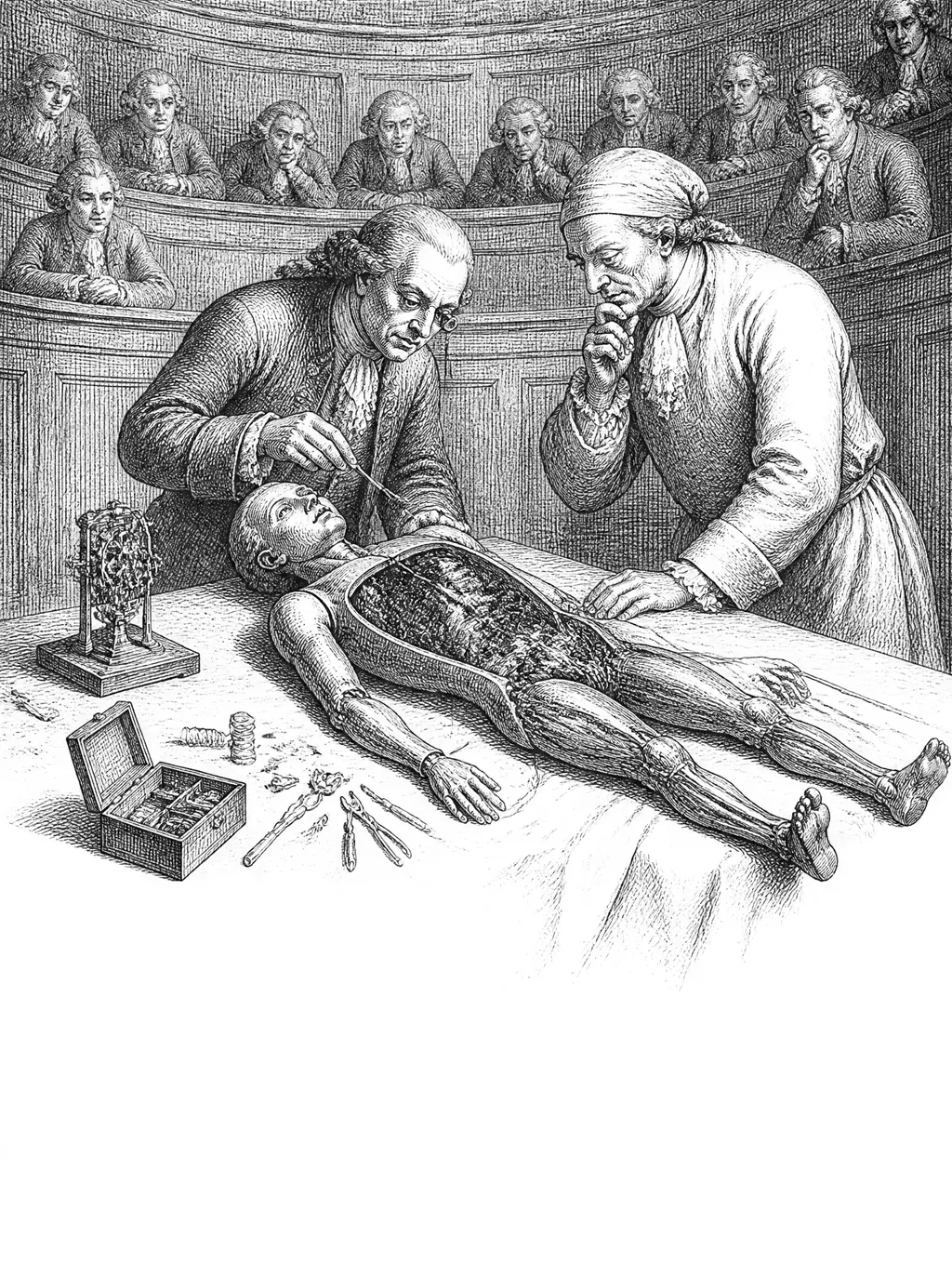
Hobbes opens his masterwork on politics with a claim that has nothing to do with government yet, a claim about the machinery of a living body. He looks at a beating heart, firing nerves, and moving joints, and sees the same kind of thing an engineer sees in a well-built clock: parts in motion, causing further motion, nothing hidden or extra required. He then makes the move that gives the book its title. If a body is a machine, then a state, which is a body made of bodies, is a machine too, an artificial man built by human art in imitation of nature's. The Leviathan on the title page is that machine, and the first thing Hobbes needs is a mechanics of the parts.
The world it came from
Hobbes was born in 1588, the year of the Armada, and wrote Leviathan in Paris in the late 1640s, in exile from the English Civil War, publishing it in 1651. He had met Galileo in 1636 and taken from him the idea that motion, not rest, is the natural state of bodies and needs no explanation. He admired William Harvey, whose 1628 book had shown the heart to be a pump. In 1641 he had written the Third Set of Objections to Descartes's Meditations, insisting that thought is a motion in matter, and Descartes had brushed him off. Hobbes's problem was to build a science of politics on a science of bodies, and that required a body, and a mind, with no exemptions from mechanics.
The idea
Life is but a motion of limbs, the beginning whereof is in some principal part within. If that is true, there is no reason not to call any self-moving machine, an automaton, artificially alive in exactly the same sense. The heart is a spring, the nerves are strings, the joints are wheels, giving motion to the whole body the way a watchmaker's parts give motion to a watch. Hobbes carries the same account into the head. Sense is motion in the organs, pressed on them from outside. Imagination is sense decaying after the object is gone. A train of thought is one motion leading to another. And reason, he says in a later chapter, is nothing but reckoning, adding and subtracting the names of things.
How the reasoning runs
Step one, from Galileo: nothing moves except by something already in motion, and a body in motion continues until something stops it. Step two: life is visibly motion, of limbs, blood, and breath, beginning from an inner part. Step three: a watch is also motion beginning from an inner part, the spring. So the living body and the automaton differ in workmanship, not in kind. Step four: sense is the pressure of external bodies on the organs, carried inward as motion; imagination is that motion continuing after the pressure stops; thought is a sequence of such motions. Step five: the phrase incorporeal substance is therefore a contradiction, like round quadrangle, because substance means body. Conclusion: whatever thinks is a body, and there is nothing else for it to be.
Seen in life
You ask a language model to work through a problem and watch it produce an answer, one word after another. Ask what it is doing and the engineer will tell you: it is computing, adding and multiplying numbers at enormous scale, with no other kind of process anywhere in the system. Hobbes wrote that reason is nothing but reckoning, and he meant it literally: to think is to add and subtract. Notice your own reaction. Either you conclude that reckoning was never enough for thought, and something is missing from the machine, or you conclude that Hobbes was right and thought was reckoning all along. Every argument about whether the model understands is a replay of that choice, made with the same vocabulary Hobbes supplied in 1651.
Why it matters
This is a founding statement of philosophical materialism about the mind: no separate mental substance is required to explain thought, sensation, or life, only sufficiently complex matter arranged and moving in the right way. Everything Descartes needed a second, non-physical substance to explain, Hobbes proposes to explain with one substance alone. The claim also carries the whole book. If people are machines driven by motion toward what helps them and away from what harms them, then politics can be a science of those motions, and the state can be designed like an engine. Hobbes's argument for the sovereign begins in the mechanics of desire and fear. Take the materialism away and the rest of Leviathan loses its foundation.
“Life is but a motion of limbs, the beginning whereof is in some principal part within; why may we not say, that all automata have an artificial life?”
From the source
Hobbes opens the Leviathan with the claim directly: “Life is but a motion of limbs, the beginning whereof is in some principal part within; why may we not say, that all automata have an artificial life? For what is the heart, but a spring; and the nerves, but so many strings; and the joints, but so many wheels.” The passage is the first paragraph of the Introduction. It continues that art goes further still and imitates the rational work of nature, man himself, in the great Leviathan called a commonwealth, whose sovereignty is an artificial soul. Chapter I then begins with sense as the pressure of objects on the organs, and Chapter V gives reason as reckoning. The materialism is not a digression. It is the first premise.
The pushback
If thought really is only matter in motion, how does Hobbes explain the felt, subjective quality of experience, the redness of red or the pain of pain, using only springs and wheels as his vocabulary? Critics have pressed this exact gap against materialist theories of mind ever since, arguing that motion alone never obviously adds up to felt experience. Leibniz gave the objection its lasting image. Imagine a machine that thinks, enlarged so that you could walk into it as into a mill. Inside you would find parts pushing parts, and nowhere anything that explains a perception. Descartes was blunter in his reply to Hobbes: to say thought is motion because both belong to the same subject is like saying the earth is the sky because both are called nature.
The reply
Hobbes would answer Leibniz that the mill objection looks for perception as one more part among the parts, and that is the mistake. Perception is not a wheel you would find; it is the motion of the wheels, considered as it happens in the thing that is moving. Nobody expects to find the spinning in a spinning top as a separate component. To Descartes he replied that a subject of thought must be something, and the only somethings we know are bodies. Both replies hold their ground and neither closes the gap. Hobbes says that sense is motion but never says why some motions are felt and most are not, and the question Leibniz asked in the mill is the question still asked of every physical theory of mind.
Where it went next
Locke, a cautious admirer, suggested in 1690 that God might have given matter the power to think, and was attacked for it by Bishop Stillingfleet from 1696 until the bishop's death in 1699. La Mettrie's Man a Machine in 1747 took the title Hobbes had implied and applied it without apology. Joseph Priestley defended a materialist Christianity in the 1770s on similar grounds. In the twentieth century Ryle's attack on the ghost in the machine and the identity theory of Place and Smart carried Hobbes's program forward without much citing him. The claim that reason is reckoning had a separate afterlife: historians of artificial intelligence, John Haugeland among them, have called Hobbes the grandfather of the field, since a computer is a reckoning machine and nothing else.
Where this leads
What is it like to be a bat? presses on precisely this gap centuries later, arguing that a complete physical description of a system, however exhaustively detailed, may still leave out what its experience is actually like from the inside. The Chinese Room takes Hobbes's own definition of reason and turns it against him. Searle grants that a computer reckons, adding and subtracting symbols by rule, and argues that reckoning is exactly what understanding is not. If reason were nothing but reckoning, the man in the room would understand Chinese, and Searle says he does not. Between Hobbes and Searle lies the whole question of whether a calculating machine can be a mind.