Symposium · Logic & Paradoxes · Pl. 3Chrysippus · c. 279 – c. 206 BC
If the Gods Used Dialectic
From runner to reasoner
Chrysippus came to philosophy relatively late, after training as a long-distance runner, and threw himself into Stoic logic with an intensity that produced, by ancient report, more than seven hundred books, some covering the very same topic multiple times as he kept refining and correcting his own earlier arguments. Diogenes Laertius also preserves the school's own verdict: if there had been no Chrysippus, there would have been no Stoa. The logic was the reason.
The world it came from
Chrysippus came from Soli in Cilicia to Athens and studied under Cleanthes, Zeno's successor, and also, by Diogenes's account, with the Academic sceptics Arcesilaus and Lacydes. He became head of the Stoa around 230 BC. The school was under attack. Arcesilaus's Academy denied that anything could be known with certainty and aimed its arguments at the Stoic claim that some impressions are self-evidently true. Chrysippus answered by making Stoic logic rigorous enough to survive cross-examination, writing, by ancient count, more than seven hundred books, many on logic alone. He also inherited a live debate from the Dialectical school of Diodorus Cronus and Philo about what makes an if-then statement true, and gave his own answer.
The idea
Chrysippus built on Zeno's Stoicism by developing propositional logic in real technical depth, studying how whole statements, not just terms inside them, combine through if-then, and, and or into valid patterns of inference. His reputation for this work grew so large that people said if dialectic existed among the gods, it would look exactly like his. The unit of Stoic logic is the assertible, a whole statement that is true or false, and the rules govern how such statements combine.
How the reasoning runs
Chrysippus reduced valid inference to five basic forms, the indemonstrables. Read p and q as whole statements. One: if p then q; p; therefore q. Two: if p then q; not q; therefore not p. Three: not both p and q; p; therefore not q. Four: either p or q; p; therefore not q. Five: either p or q; not p; therefore q. The Stoic textbook instance is the first: if it is day, it is light; it is day; therefore it is light. Every other valid argument, the school claimed, could be broken down into these. Notice what is absent. There are no terms, no every or some, no subject and predicate. The variables stand for complete sentences, and the connectives, if, and, or, not, do all the work.
Seen in life
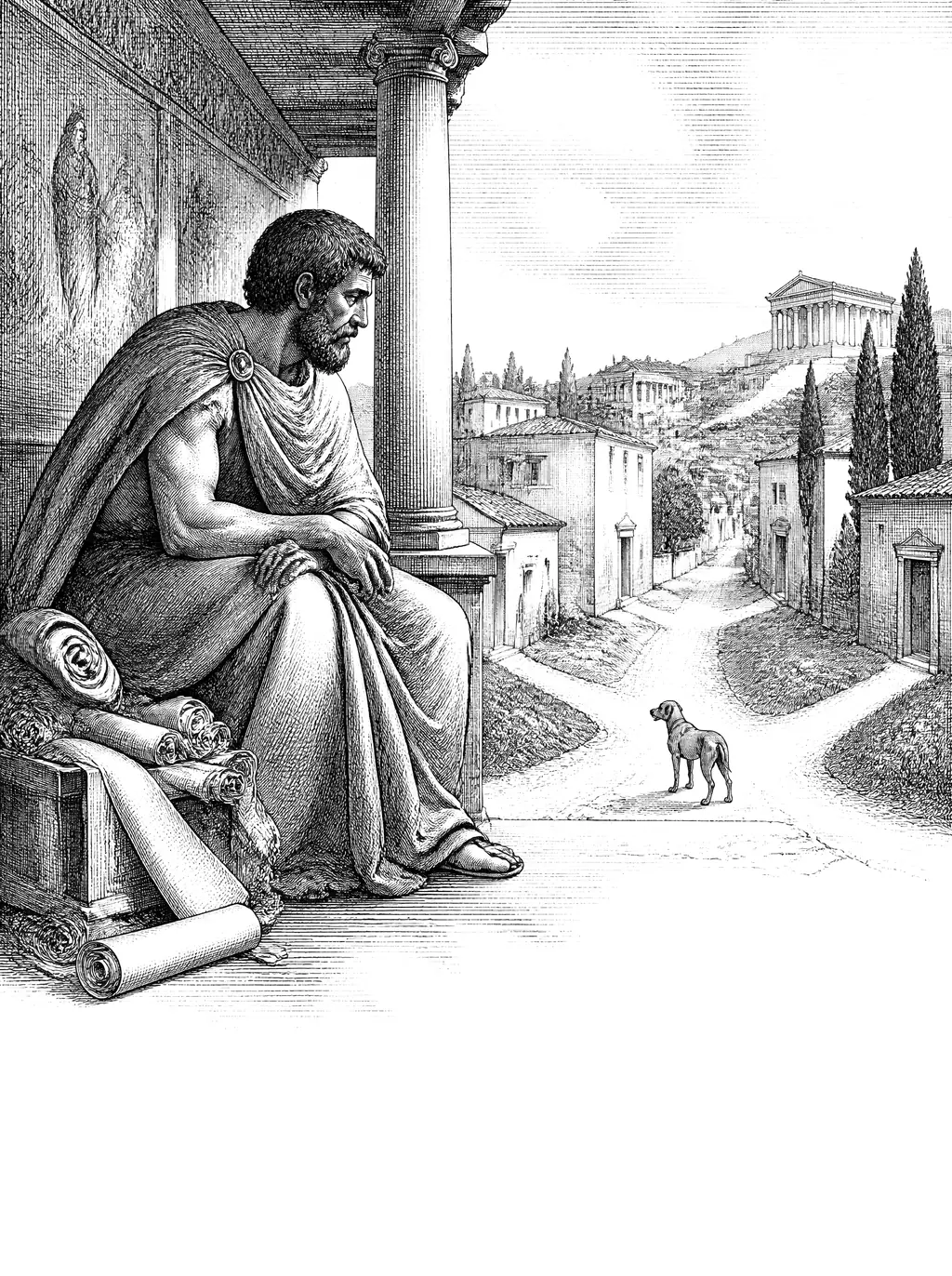
You are debugging a login failure. Either the password is wrong or the server rejected the session. You check the password and it is correct. So the server rejected the session. That is the fifth indemonstrable, run by a person under mild stress. If the token had expired, the log would show a timeout; the log shows no timeout; so the token did not expire. That is the second. Every if statement in the code, every troubleshooting flowchart, every checklist that says if the light is red, do this, is Chrysippus's logic in use, and none of it needs Aristotle's every and some. The Stoics said even a dog at a fork in the road runs the fifth form, sniffing two paths and taking the third without sniffing.
Why it matters
Where Aristotle's logic mainly analyzed the internal structure of individual statements, subjects and predicates, Chrysippus and the Stoics worked out how entire propositions combine and interact, an approach that anticipates the propositional logic taught in introductory logic courses today, built from whole statements linked by if-then, and, and or rather than from terms alone. The two traditions answer different questions. Aristotle asks what follows from the way classes overlap; Chrysippus asks what follows from the way sentences connect. Modern logic needs both and puts the Stoic half first.
“He had such a high reputation as a dialectician, that most people thought that if there were such a science as dialectics among the Gods, it would be in no respect different from that of Chrysippus.”
From the source
Diogenes Laertius records the reputation directly: “He had such a high reputation as a dialectician, that most people thought that if there were such a science as dialectics among the Gods, it would be in no respect different from that of Chrysippus.” Diogenes adds the school's own claim that without Chrysippus there would have been no Stoa, and the story of the runner who came late to philosophy. He lists titles: on the Liar, on conditionals, on the indemonstrables, on the sorites, well over a hundred works on logic alone, and records the complaint that Chrysippus padded his books with long quotations from the poets. The praise about the gods is worth noticing for what it praises: a method rather than a doctrine.
The pushback
Doesn't a reputation this glowing risk being more legend than fact, especially given how little of Chrysippus's actual seven hundred books survive for anyone to check directly against the praise? Almost none of his original writing exists intact; nearly everything known about his logic comes filtered through later summaries and quotations, exactly like the very sentence praising him. A second objection: even granting the fragments, the five indemonstrables look thin beside Aristotle's full theory of the syllogism. A logic with five rules and no quantifiers cannot say that every number has a successor.
The reply
The fragments are better than the objection suggests. Sextus Empiricus, Galen, and Diogenes preserve the five indemonstrables and the Stoic theory of the conditional in enough detail to reconstruct, and charred papyri from Herculaneum contain pieces of Chrysippus's own Logical Questions. Jan Łukasiewicz showed in 1934 that Stoic logic was a propositional calculus, and Benson Mates's Stoic Logic of 1953 laid out the system. On the second objection, thinness is the point. A logic of whole statements is complete for what it covers, and Frege's 1879 system, which does handle every number, is built with the Stoic connectives underneath the quantifiers. Aristotle and Chrysippus were doing two halves of one job, and the ancients, who saw them as rivals, could not have known that.
Where it went next
Stoic logic lost the ancient argument. Aristotle's syllogism became the logic of the schools, and the Stoic system survived mainly in the hypothetical syllogisms Boethius passed to the Middle Ages. Its rediscovery came late: Peirce noticed the Stoics in the nineteenth century, Łukasiewicz in 1934 identified their system as propositional logic, and Mates gave the full account in 1953. By then Frege and Boole had rebuilt the same thing without knowing it. The connectives Chrysippus studied are now the gates in every processor, and modus ponens, the first indemonstrable, is the single rule at the heart of rule engines and proof assistants. Every if statement ever compiled is Stoic.
Where this leads
Logic as an instrument shows the rival tradition Chrysippus was implicitly arguing against, Aristotle's own school treating logic as a general-purpose tool built from terms and syllogisms rather than from the whole propositions Stoic dialectic preferred to work with instead. Live according to nature, the Stoic ethical rule, sits on the same root. The school divided philosophy into logic, physics, and ethics and compared it to an egg or an orchard, with logic as the shell or the fence. The reasoning was there to protect the life.