Symposium · Logic & Paradoxes · Pl. 1Aristotle · 384–322 BC
Logic as an Instrument
Not a subject, a set of tools
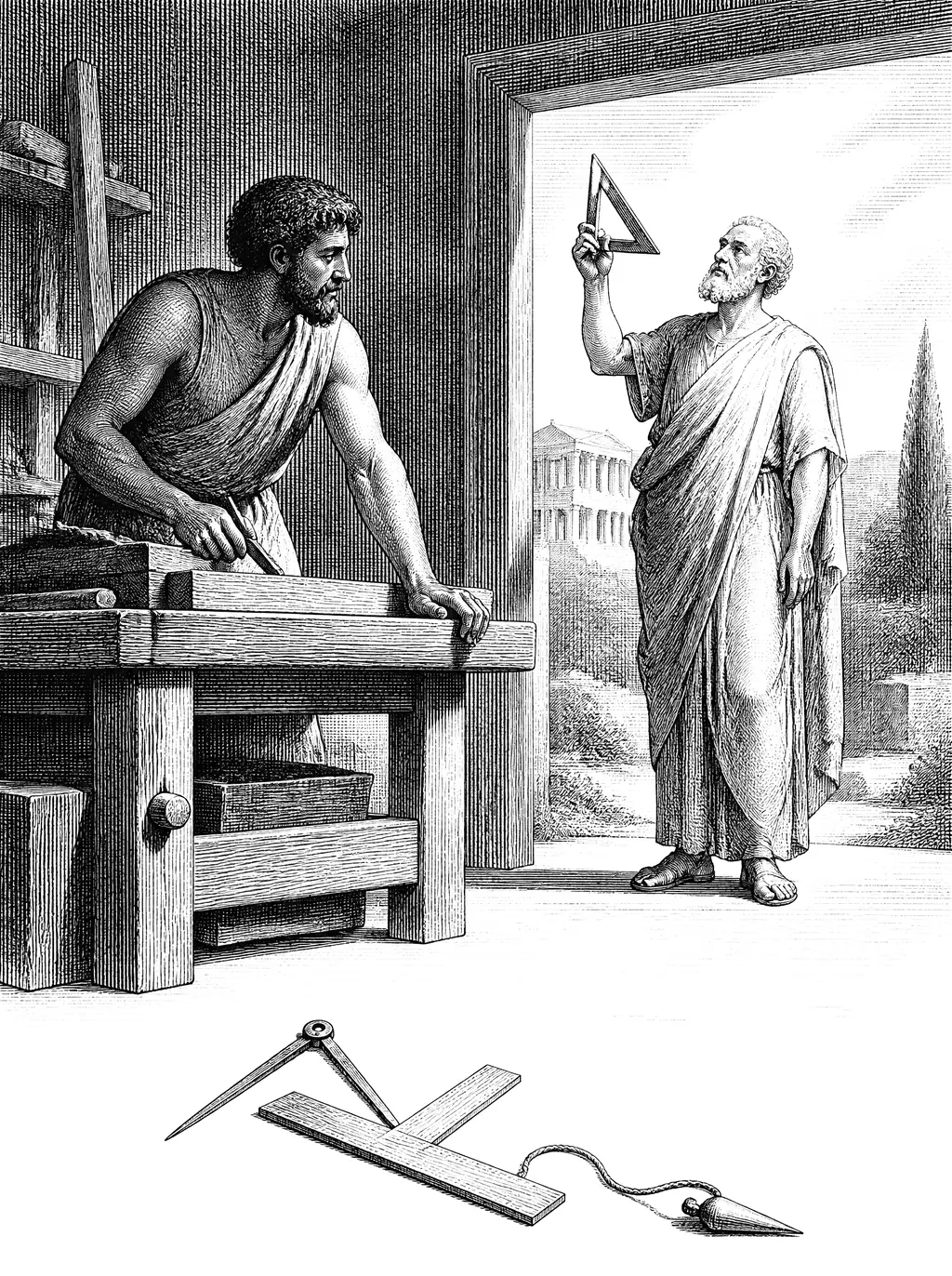
Most fields Aristotle investigated, animals, the heavens, the good life, are subjects with their own content to master. Logic, in his hands, was something categorically different: not a body of facts about the world, but the instrument for reasoning correctly about any subject whatsoever, which is why his logical works were later gathered under the name Organon, meaning instrument or tool. The word was not his. Later editors used it for the six works on reasoning: the Categories, On Interpretation, the two Analytics, the Topics, and the Sophistical Refutations. But the idea behind the label is entirely his.
The world it came from
Aristotle was born in Stagira in 384 BC, spent twenty years in Plato's Academy, tutored Alexander of Macedon, and opened his own school in Athens, the Lyceum, in 335. Athens had a thriving trade in argument. Sophists taught young men to win disputes, and Plato's dialectic pursued truth by question and answer, but nobody had written down what makes an argument valid rather than merely persuasive. Aristotle did, and said at the end of the Sophistical Refutations that he had found nothing on the subject to build on. His followers, defending him against the Stoics, who counted logic as a part of philosophy, insisted it was instead a tool, and Diogenes Laertius's summary records that Peripatetic view.
The idea
Logic is not a single division of philosophy turning on one special point, but rather an instrument for every art brought to a high degree of accuracy. With reference to discovery, it furnishes topics and works on method; with reference to judgment, the prior and posterior analytics, letting us examine principles and the conclusions properly deduced from them. The claim is that logic has no subject matter of its own. It does not tell you about animals or numbers or virtue. It tells you what follows from what, in any subject, and how to check that it does.
How the reasoning runs
The core instrument is the syllogism, and it works on form. Take: every M is P; every S is M; therefore every S is P. Fill it: every mammal is warm-blooded; every whale is a mammal; therefore every whale is warm-blooded. Now swap the terms for anything, planets, debts, kings, and the pattern still delivers. That is what makes it a tool rather than a fact. Compare a pattern that fails: every P is M; every S is M; therefore every S is P. Fill it: every cat is a mammal; every dog is a mammal; therefore every dog is a cat. True premises, false conclusion, so the form is worthless whatever you pour into it. The Prior Analytics sorts the valid forms from the rest.
Seen in life
You are reading a support dashboard. Every refund request goes into queue B, the process document says. This ticket is in queue B. Someone concludes it must be a refund request and routes it to finance. You have just watched the invalid form from the previous screen: every refund is in B, this is in B, therefore this is a refund. Queue B also holds address changes. Nothing about tickets or finance told you the step was bad; the shape of the argument did, and the shape is the same whether the subject is tickets, whales, or cats. That is what Aristotle meant by an instrument. You can check the reasoning without knowing anything about the department.
Why it matters
Treating logic as an instrument rather than a subject reframes its whole purpose: not to teach true facts about some particular corner of reality, but to supply the standards any claim in any field has to meet to count as properly reasoned at all. This is why the same logical rules apply equally to biology, ethics, and mathematics. It also explains why logic can be taught once and used everywhere. A student who learns which forms are valid does not need to relearn them for medicine or for law. The rules travel, and that portability is the whole reason to separate them from the subjects they serve.
“Logic... not a single division, turning on one special point, but being rather an instrument for every art brought to a high degree of accuracy.”
From the source
Diogenes Laertius summarizes Aristotle's own account of logic's place: “Logic... not a single division, turning on one special point, but being rather an instrument for every art brought to a high degree of accuracy... omitting nothing which can bear upon discovery, or judgment, or use.” Diogenes is compressing a later dispute. The Stoics said logic was one of the three parts of philosophy, with physics and ethics. Aristotle's followers said it was not a part but the instrument by which the parts are studied, and the word Organon eventually named the collected logical works. The summary lists two uses: discovery, served by the Topics, which stocks a debater with lines of argument, and judgment, served by the Analytics, which tests whether a conclusion has really been proved.
The pushback
If logic is a neutral instrument, usable for reasoning about literally any subject, why does Aristotle's own logic rest on assumptions, like every meaningful statement being either true or false, that later logicians found were not actually neutral at all, but substantive choices with real alternatives? That is one objection. A second is narrower: the syllogism only handles statements of the form every, some, and none, with one subject and one predicate. Arguments about relations, such as every number has a successor, or about several objects at once, slip through it entirely.
The reply
Take the second objection first, because it is the one history settled. Aristotle's syllogistic is now seen as a small fragment of a larger logic. Frege's notation of 1879 handled relations and multiple quantifiers, and the syllogism sits inside it as a special case. The first objection is fairer. Aristotle himself saw that not every statement is neatly true or false: in On Interpretation he worried about tomorrow's sea battle, whose outcome is not yet settled. Modern logic has many-valued and intuitionistic variants that drop bivalence. But the instrument idea survives the loss of any particular rule. Whatever logic you choose, it is still chosen for its neutrality across subjects, and that is the point Aristotle's followers were making.
Where it went next
Boethius translated the logical works into Latin, and for a thousand years they were the logic curriculum of Europe and, through Arabic, of the Islamic world. Kant wrote in 1787 that logic had not advanced a step since Aristotle. Francis Bacon borrowed the label for his Novum Organum of 1620, a new instrument for science. Then the instrument was rebuilt: Boole in 1847 made logic algebra, and Frege in 1879 gave it quantifiers and relations. Aristotle's term logic lives on in a narrower place. Description logics, used to build ontologies and the reasoners behind them, classify things by every and some over categories, which is the Organon's own vocabulary running on a machine.
Where this leads
If the Gods Used Dialectic shows the rival Stoic school, led by Chrysippus, building their own thoroughly competing logical instrument from entirely different materials, whole propositions and their many possible combinations, rather than relying on Aristotle's terms and his syllogisms alone. The golden mean sits on a different shelf but comes from the same workshop. Aristotle used the instrument he built to reason about the good life, and the ethics shows what happens when the tool is applied to a subject that resists exactness. He says as much: demand only the precision the subject allows.