Symposium · Aesthetics · Pl. 3Clive Bell · 1881–1964
Significant Form
What could possibly unite them all
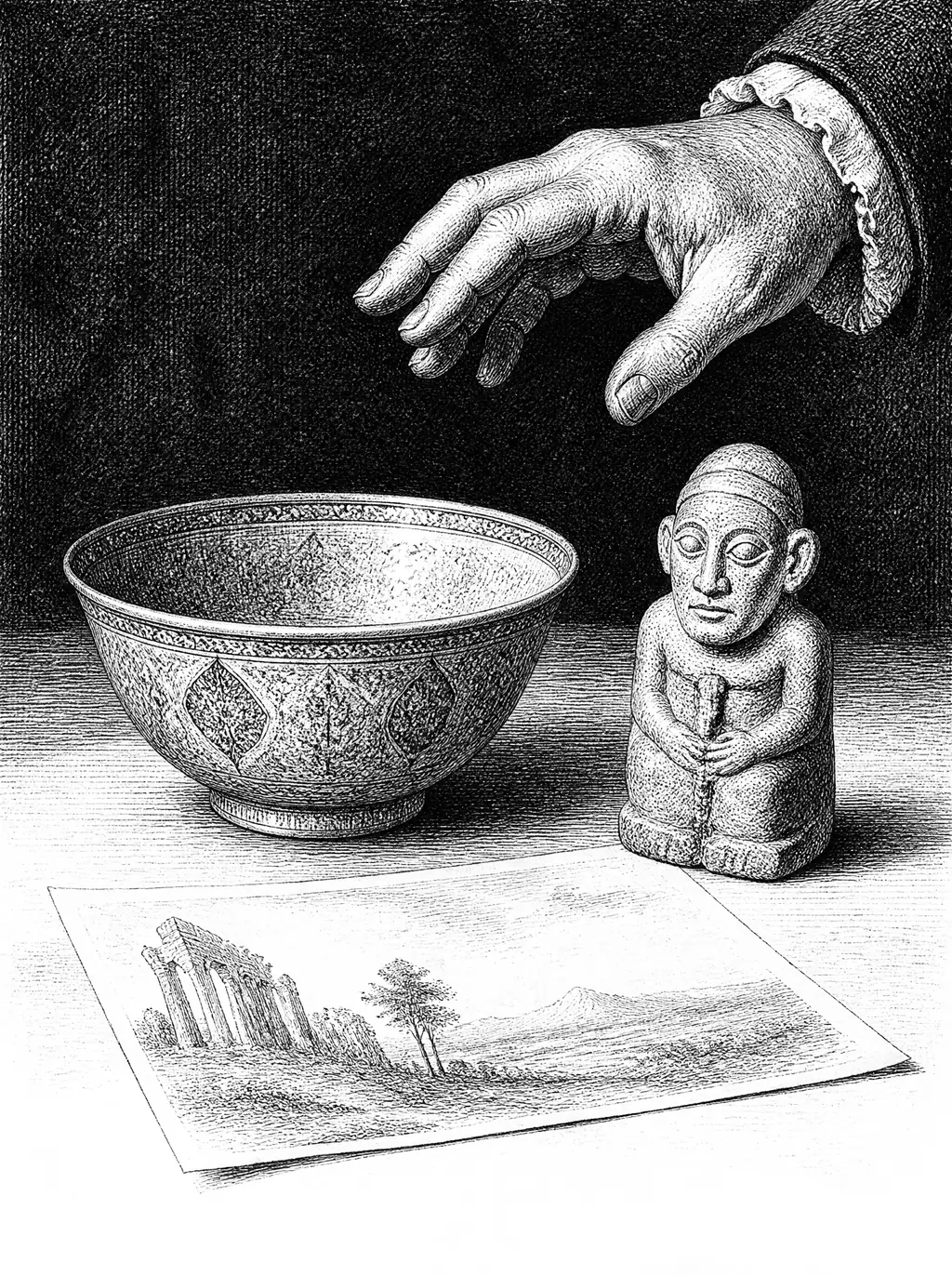
Bell surveys wildly different objects, Mexican sculpture, Persian bowls, Giotto's frescoes, Cézanne's landscapes, and asks what single quality unites them as art. It cannot be subject matter, since the objects depict nothing alike. It cannot be technical skill or conventional beauty either, since plenty of skillful, pretty work leaves him cold. Bell was thirty-two, and he had just helped hang two London exhibitions that put Cézanne, Gauguin, Van Gogh, and Matisse in front of an English public that mostly laughed. He needed a definition of art that would let those pictures in. His answer was to find what the laughers had missed: not what the pictures showed, but how their lines and colours held together.
The world it came from
Clive Bell published Art in 1914, months before the war. He was a Cambridge-educated critic married to the painter Vanessa Bell, and part of the Bloomsbury circle with her sister Virginia Woolf. In 1910 and 1912 his friend Roger Fry had staged the two Post-Impressionist exhibitions at the Grafton Galleries, and the reviews called the work childish, diseased, and fraudulent. The critics' standard was the Victorian one: a painting was judged by its subject, its finish, and its sentiment. Bell had also absorbed G. E. Moore's Principia Ethica at Cambridge, with its claim that good is a simple, unanalysable quality known by direct intuition. Significant form is that idea carried into the gallery, built to defend Cézanne.
The idea
Only one answer seems possible—significant form. In each, lines and colours combined in a particular way, certain forms and relations of forms, stir our aesthetic emotions. Bell concludes that this formal relation among lines and colors, not subject matter, skill, or conventional beauty, is the one quality every genuine work of visual art actually shares. Two claims travel together. There is a distinct feeling, the aesthetic emotion, which is unlike every other feeling and which anyone sensitive can recognise in themselves. And there is a property of objects, significant form, that provokes it. Representation is irrelevant; at best it is harmless, at worst a distraction. To appreciate a painting you bring nothing from life but a sense of form and colour and a knowledge of three-dimensional space.
How the reasoning runs
Bell reasons from a shared experience. First, some objects provoke in sensitive people a particular emotion, distinct from the pleasure of a pretty face or a sad story. Call it the aesthetic emotion. Second, the objects that provoke it are wildly various, from Sung pottery to a Poussin, so whatever they share cannot be subject, style, or period. Third, what they do have in common is arrangement: lines, colours, and masses set in relations that move us. Fourth, if the emotion is one and the cause must be one, that arrangement is the cause. Bell names it significant form and defines art as whatever possesses it. Everything else in a painting, its story, its likeness, its moral, is beside the point and often gets in the way.
Seen in life
You are scrolling and stop at a photograph of a stairwell. There is nothing in it, no person, no event, just a curve of concrete, a slab of shadow, and one yellow rail cutting across at the right angle. You cannot say why you stopped, and you cannot say why it is better than the sunset three posts up. Bell would say you have just felt the aesthetic emotion, and the sunset gave you something else, a pleasant association with holidays. Now imagine the same stairwell with a celebrity on it. It gets ten times the likes and loses the thing that stopped you. On Bell's account the likes are measuring the subject and you were responding to the form.
Why it matters
This gave modern art criticism a formal, subject-independent standard for judging visual art, one that could defend abstract and non-representational painting on its own terms rather than measuring it against how faithfully it depicted recognizable objects. Bell's theory helped legitimize the early twentieth century's dramatic turn away from representation. It also gave ordinary viewers permission to trust a reaction they could not explain. If the emotion is the evidence, you do not need to know the iconography or the artist's biography to be right that a picture works. And it gave a reason to look again at objects that had never counted as art at all: a bowl, a carpet, a mask, a bridge.
“Only one answer seems possible—significant form... Significant Form is the one quality common to all works of visual art.”
From the source
Bell names the quality directly after surveying his examples: “Only one answer seems possible—significant form... Significant Form is the one quality common to all works of visual art.” The aesthetically moving forms, he writes, are the ones he calls significant form. Everything else about a painting, he argues, is secondary to this single formal fact. The passage opens the first chapter of Art, headed 'The Aesthetic Hypothesis'. Bell is explicit that he is offering a hypothesis, not a proof, and that its only test is whether it fits the reader's own experience of works of art. He also admits in the same chapter that he cannot say what makes a form significant, only that some forms are.
The pushback
Isn't naming a quality significant form just relabeling the mystery rather than explaining it, since Bell never gives a firm rule for which forms count as significant beyond the emotion they happen to provoke in a given viewer? Bell largely accepted this circularity, treating aesthetic emotion itself as the only real evidence significant form is present. A second objection is that representation is not separable from form. The lines and colours of a Giotto are lines and colours of a mourning body, and you see the arrangement as an arrangement of grief. Strip the subject and you have changed the form. And a third: Bell's aesthetic emotion is suspiciously like the taste of a small Bloomsbury circle, elevated to a law.
The reply
Bell's defence of the circle is that every theory of art starts from someone's experience, and his at least names its starting point. Whether the emotion is real is something you can check in yourself; whether it is distinct from other pleasures is harder, and he never showed it was. On the inseparability of form and subject, later formalists conceded ground. Bell's own friend Roger Fry admitted that representation can contribute to design, and Bell himself softened the claim in later writing. The objection that the emotion is class taste has no clean answer, only the counter-observation that people with no art training do respond to arrangement, and that Bell's theory predicts they should. What survives is the method: look at the relations first, and let the story come second.
Where it went next
Bell and Fry's formalism became the house style of modernism. Alfred Barr's Museum of Modern Art hung pictures on white walls with sparse labels on exactly Bell's premise, that the form should speak without the story. Clement Greenberg made formalism the theory of American abstraction, dropping the aesthetic emotion but keeping the idea that painting's proper subject is its own flat surface and colour. Philosophers took the definition apart: Morris Weitz argued in 1956 that art cannot be defined by any single property, and George Dickie later proposed that art status comes from institutions, not forms. Arthur Danto's response to Warhol's Brillo boxes was aimed straight at Bell. Yet significant form is still what a gallery visitor says when a picture works and they cannot say why.
Where this leads
Beauty is pleasure objectified shows Santayana reaching a structurally similar conclusion from the opposite direction, tracing beauty back to a subjective feeling projected outward onto an object, rather than locating it, as Bell does, in an objective formal quality the object supposedly possesses on its own. The enemy of art is the humdrum is the direct rebuttal. Dewey, writing twenty years after Bell, refused to cut form from subject or the gallery from the street, and argued that an experience is aesthetic when it is whole, whatever it contains. Bell narrows art to one property found in objects; Dewey widens it to a quality found in living. Read both to see the century's argument in miniature.