Symposium · Aesthetics · Pl. 12George Santayana · 1863–1952
Beauty Is Pleasure Objectified
A pleasure wearing a disguise
When you call a sunset beautiful, it feels as though you are reporting a fact about the sky itself, the same way you might report its color or its size. Santayana argues this feeling is a kind of useful illusion: the beauty is really your own pleasure, mistaken for a property of the object producing it. He does not think you are being foolish. The projection is automatic and, in a way, correct: the sky really is what is causing the pleasure, and the pleasure really is inseparable from looking at it. What he denies is that beauty would be there if nobody were. Take away every observer and the sunset keeps its colour and loses its beauty.
The world it came from
George Santayana was born in Madrid in 1863, raised in Boston from the age of nine, and taught philosophy at Harvard from 1889. The Sense of Beauty, published in 1896, grew out of a course on aesthetics and was his first book. The Harvard of the 1890s was the Harvard of William James, whose Principles of Psychology had just made the study of feeling and attention scientific, and Santayana wrote aesthetics as a branch of psychology, not metaphysics. He was also reacting against two traditions: the German idealists who made beauty a glimpse of the Absolute, and the Victorian moralists, Ruskin above all, who made it a form of truth or virtue. He wanted an account that was naturalistic, honest about pleasure, and free of sermons.
The idea
In a strict and ultimate sense, then, Beauty is pleasure regarded as the quality of a thing. Beauty is not an intrinsic property of objects like their weight or their chemical makeup; it is a pleasure we feel, that we then mistakenly experience as though it belonged to the object itself rather than to our own response to it. Santayana fixes the definition with three marks. Beauty is a value, so it is a matter of feeling, not fact. It is a positive value, pleasure rather than the absence of pain. And it is objectified: unlike the pleasure of a warm bath, which you feel as yours, the pleasure of a melody is felt as belonging to the melody. That last mark is what separates beauty from the merely agreeable.
How the reasoning runs
Santayana argues by elimination and then by description. First, beauty cannot be a fact about the object alone, because a world with no one to perceive it would contain no beauty, only shapes. Second, it cannot be a judgment of truth or usefulness, because we call things beautiful that are false and useless. So beauty is a value, a species of pleasure. Third, ask which species. Some pleasures stay attached to the self: the taste of food, the relief of rest. Others are experienced as qualities of the thing: the grace of a line seems to be in the line. Only the second kind we call beauty. Therefore beauty is pleasure objectified, the pleasure we feel projected onto its cause and read there as a property.
Seen in life
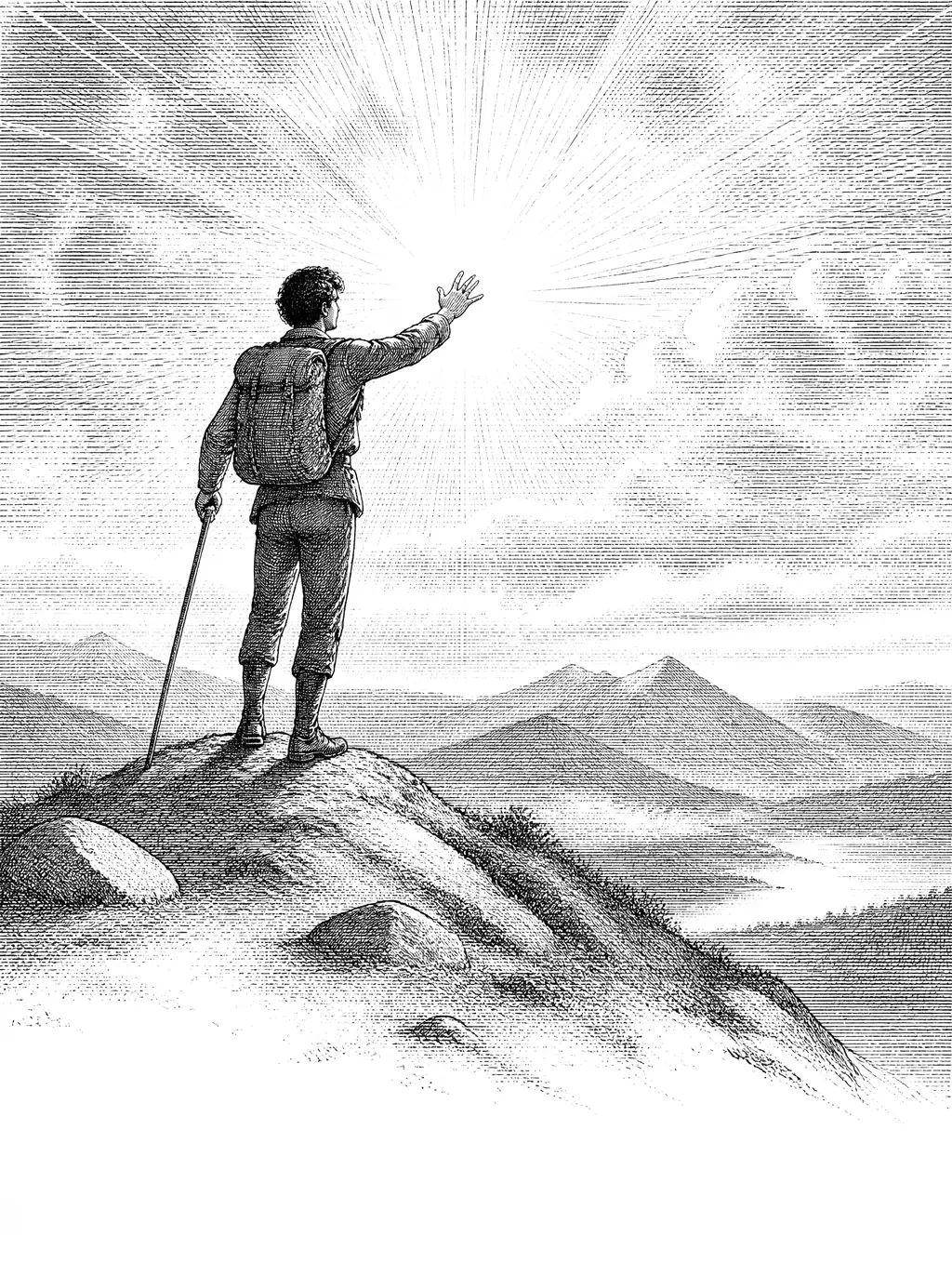
You send a friend a photo of the valley you hiked, with the light coming through the cloud, and she replies with one word: nice. You are almost offended, as if she had disputed a fact. Santayana would say your reaction is the whole theory in miniature. You felt a pleasure so tightly bound to the scene that it seemed to be the scene, and her flat reply landed as a denial of something out there. But the beauty was never in the valley in the way the rocks were. It was the shape your delight took while you looked. Her word is not wrong about the valley. It reports a smaller pleasure, or none, and that is all the disagreement there is.
Why it matters
This offered a middle path between saying beauty is purely subjective, a matter of taste with no shared standard, and saying it is purely objective, a fixed property anyone could measure directly. Santayana's account explains both why beauty feels real and external, and why people can still genuinely disagree about where it is found. It also honours pleasure without embarrassment. Ruskin and Tolstoy each tried to make beauty answer to truth or morality; Santayana lets it answer to delight, and then argues that delight, taken seriously, has its own discipline. The rest of the book sorts the sources of aesthetic pleasure into matter, form, and expression, so the theory becomes a map of where your enjoyment comes from.
“In a strict and ultimate sense, then, Beauty is pleasure regarded as the quality of a thing.”
From the source
Santayana states his central formula directly: “In a strict and ultimate sense, then, Beauty is pleasure regarded as the quality of a thing.” The rest of his book works out how sensation, form, and expression each contribute their own particular kind of pleasure to this one underlying process of objectification. The sentence closes the first part of The Sense of Beauty, headed 'The Nature of Beauty'. Santayana reaches it through a sequence of shorter definitions: beauty is value positive, intrinsic, and objectified. He adds, in the same passage, that the definition is an account of a feeling and not a formula for producing beautiful things, which he thinks no theory can supply.
The pushback
If beauty is really just pleasure wearing a disguise, why does calling something beautiful feel so different from simply saying it feels good, carrying claims about shared standards that a plain report of pleasure never makes at all? Santayana's answer is that objectification is not a mistake to correct but a real feature of aesthetic experience. A second objection cuts deeper. If beauty is only projected pleasure, then criticism is impossible: nobody can be wrong about what they enjoy, and the difference between a great painting and a pleasant one collapses into a difference in how many people happen to like each. Santayana's psychology seems to leave no room for saying that a taste can be educated, or mistaken.
The reply
Santayana meets the first objection directly: the sense of a shared standard is itself part of the projection. Because the pleasure is felt as a quality of the object, we expect others to find it there, and we argue as if a fact were at stake. That explains the feeling without conceding an objective property. On criticism he has more to say than the objection allows. Pleasures differ in source and stability; some depend on a passing association, others on the form of the thing, which anyone who attends can find. A trained eye has more sources of pleasure and is less at the mercy of accident. That gives criticism a job. What it does not give is a verdict true against every possible taste, and Santayana accepts that loss.
Where it went next
The Sense of Beauty was the first major work of aesthetics written in America, and it made the subject naturalistic and psychological for a generation. Santayana's later Reason in Art (1905) extended the approach. Among his Harvard students were T. S. Eliot, Wallace Stevens, and Walter Lippmann, who did not share his conclusions but absorbed his tone. Dewey's Art as Experience, three decades later, keeps the naturalism and drops the projection, locating aesthetic quality in the transaction rather than in a feeling misread as a property. Analytic philosophers revived the issue as the debate over aesthetic realism, and the projectivist option they argue about is Santayana's, usually without his name on it. His phrase 'pleasure objectified' remains the cleanest statement of that position.
Where this leads
Beauty without wanting anything shows Kant reaching a related but distinct conclusion decades earlier, agreeing that beauty is bound up with pleasure rather than any fact about matter, while insisting that the pleasure must be stripped of every trace of interest before it can count as taste at all. Significant form is the mirror image. Bell agrees with Santayana that a distinct emotion is the evidence, then insists the cause is a real property in the object, which Santayana denies. Put the three side by side: Kant says the pleasure must be disinterested, Santayana says it gets projected, and Bell says it tracks a form. One feeling, three stories about where it comes from.