Symposium · Aesthetics · Pl. 4Samuel Taylor Coleridge · 1772–1834
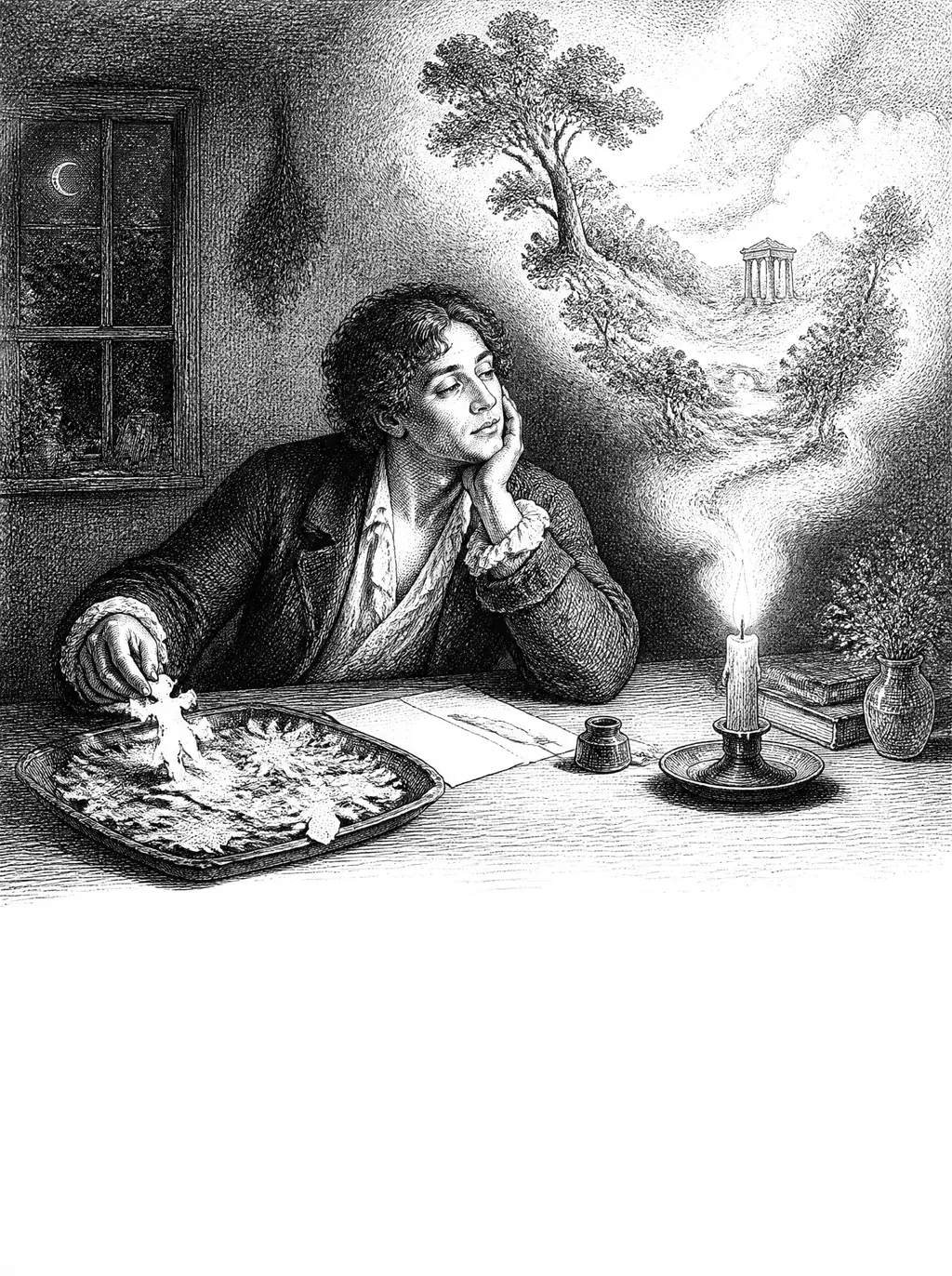
Imagination Against Mere Fancy
Two words treated as one, badly
Earlier English critics used imagination and fancy almost interchangeably, both loosely meaning creative mental power. Coleridge, disturbed by how much this blurred distinction cost literary criticism, spent a chapter of his critical autobiography carefully prying the two words apart into genuinely separate faculties, each doing a completely different kind of mental work. The chapter is famously strange. Coleridge builds toward the distinction through pages of German philosophy, then prints a letter from a 'friend', written by himself, begging him to stop, and breaks off with a bare two-paragraph summary. The definition that changed English criticism arrives as an apology for not giving it.
The world it came from
Coleridge published Biographia Literaria in 1817, at forty-four, broke, estranged from Wordsworth, and dependent on opium. The book began as a preface to his poems and grew into a defence of his life. Behind it lay a specific quarrel. Wordsworth's 1815 preface had drawn its own line between fancy and imagination, and Coleridge thought he had got it wrong. Behind that lay the empiricist psychology of Hobbes, Locke, and Hartley, on which the mind is a passive receiver that merely associates the sense impressions it stores. Coleridge had read Kant, Fichte, and Schelling after his stay in Germany in 1798 and 1799, and borrowed from them, sometimes without credit, an active mind that shapes experience. The distinction is his attempt to bring that mind into English poetry.
The idea
The primary imagination Coleridge holds to be the living power and prime agent of all human perception. The secondary imagination is an active force that dissolves, diffuses, and dissipates ordinary experience in order to recreate it into something genuinely new. Fancy, on the contrary, has no other counters to play with, but fixities and definites, merely rearranging ready-made pieces of memory. There are three faculties, not two. Primary imagination is the act by which everyone perceives a world at all. Secondary imagination is the poet's conscious echo of it, which breaks perception down and remakes it as a unified whole. Fancy shuffles fixed images by association, like a card game with a set deck. A poem can be clever, even delightful, on fancy alone. It cannot be alive.
How the reasoning runs
Start with perception. You do not receive the world as a finished picture; your mind assembles it from sensation. Coleridge calls that assembling act the primary imagination, and notes that it is creative, since nothing given in sensation is yet a unified object. Second: if ordinary perception is already an act of shaping, then a poet who reshapes perception is repeating the same act at a higher power. That is the secondary imagination, and its mark is unity: the poem's parts modify one another into a single living whole. Third: contrast a mind that only rearranges stored images unchanged. That is a different operation, memory freed from time and space, which he names fancy. So the two words name two acts, and only one makes anything new.
Seen in life
Read a pop lyric that piles up images: stars, diamonds, fire, gold, a heart like a highway. Nothing in it changes anything else; you could shuffle the lines and lose nothing. That is fancy, and it can be catchy. Now read the moment in a song where one image bends the whole thing, so that a kitchen table in the last verse means something the first verse did not, and you cannot say afterwards which line did it. Coleridge would say the second song did not add an image; it remade the ones it had. When you find yourself hearing a lyric again with the meaning changed by its ending, you are watching secondary imagination at work, and you cannot get it by adding more diamonds.
Why it matters
This gave English criticism a precise technical distinction between two mental faculties that earlier writers had used almost interchangeably, and it let critics separate merely clever, decorative poetry from work that genuinely reshapes how a reader perceives the world afterward. The split became one of the most influential moves in Romantic-era literary theory. Beneath the literary use is a claim about you. If perception itself is imaginative, then the difference between a dull day and a vivid one is not in the day. The poet's power is a heightened form of a power you exercise every waking second, and Coleridge's point is that it can be dulled by habit or trained by attention. Reading becomes a way of tuning the instrument you see with.
“Fancy, on the contrary, has no other counters to play with, but fixities and definites. The fancy is indeed no other than a mode of memory emancipated from the order of time and space.”
From the source
Coleridge draws the line sharply: “Fancy, on the contrary, has no other counters to play with, but fixities and definites. The fancy is indeed no other than a mode of memory emancipated from the order of time and space.” Imagination, by contrast, actively dissolves experience in order to recreate it fresh. The passage closes chapter thirteen of Biographia Literaria, the chapter Coleridge titled 'On the imagination, or esemplastic power'. He coined esemplastic from Greek roots to mean 'shaping into one', because no English word did the job. The full definition of the primary imagination that precedes it, a repetition in the finite mind of the eternal act of creation, ties the whole theory to theology.
The pushback
Is this distinction really doing philosophical work, or is Coleridge simply dressing up a difference between better and lesser poetry in impressive-sounding technical language borrowed from German idealism? Later critics have found the imagination-fancy split genuinely useful for close reading, even while granting that his own explanations of it remain notoriously difficult to pin down. A harder objection concerns the borrowing itself. Large stretches of the surrounding chapters are translated from Schelling without acknowledgement, and Coleridge's definition of primary imagination reads like Kant's synthesis of apperception in Anglican dress. If the distinction is second-hand, and the argument for it is missing because he never finished chapter thirteen, why credit Coleridge with a theory at all rather than a suggestive pair of paragraphs?
The reply
On the first charge, defenders point to what the distinction lets you do. It gives a reason why some poems feel assembled and others feel grown, and the reason is checkable: look for whether the parts change one another. That is more than a compliment in fancy dress. On the plagiarism charge the honest answer is that Coleridge did borrow, heavily and sometimes dishonestly, and that the theory still is his in one respect that matters. Schelling was doing metaphysics; Coleridge turned the active mind into a tool for reading a poem, and nobody in Germany had done that. What he never supplied is the demonstration. Chapter thirteen promises an argument and delivers a definition, so the distinction remains something you test on poems rather than something he proved.
Where it went next
Wordsworth's own preface had drawn the line first, and the two men's versions have been compared ever since. I. A. Richards built Coleridge on Imagination (1934) around the distinction and made it a foundation of practical criticism at Cambridge. Through Richards it reached the New Critics, whose talk of organic unity and the poem as a living whole is Coleridge translated into classroom method. M. H. Abrams, in The Mirror and the Lamp (1953), made the active, lamp-like mind the defining Romantic idea and gave Coleridge the credit. Critics of the 1980s, in turn, attacked organic unity as an ideology that hides a poem's contradictions. The word esemplastic never caught on; the distinction did.
Where this leads
Not by art, but by power divine shows Plato reaching for a related idea over two thousand years earlier, treating poetic creation as a kind of possession rather than an ordinary craft, though Coleridge, unlike Plato, locates the power inside the poet's own active mind rather than outside it entirely. The image of a great soul is the other ancestor. Longinus said sublimity is the mark of a large mind on the page, and Coleridge is saying something close: the unity you feel in a great poem is the trace of one shaping act. Plato sends the power in from outside, Longinus finds it in the writer's character, and Coleridge names the faculty.