Symposium · Aesthetics · Pl. 8Plato · c. 428–348 BC
Not by Art, but by Power Divine
A gift that will not transfer
Ion is a prize-winning reciter of Homer, dazzling audiences with speeches about battles and heroes he has never seen. Socrates asks him to speak just as well about Hesiod or Archilochus, poets covering strikingly similar ground, and Ion goes blank. A real expertise, Socrates points out, ought to travel across its whole subject, not vanish the moment the poet's name changes. Ion admits it cheerfully. When another poet is discussed he dozes off; when Homer is mentioned he wakes and has plenty to say. He has just come from Epidaurus with first prize and is on his way to compete in Athens. He is not a fool. He is a professional who has never asked what his profession is.
The world it came from
The Ion is one of Plato's shortest and probably earliest dialogues, written in the decades after Socrates' execution in 399 BC. Its setting is Athens, where Ion, a rhapsode from Ephesus, has just won at the festival of Asclepius. Rhapsodes were the celebrities of Greek culture: performers in embroidered robes and gold crowns who recited Homer from memory to crowds of twenty thousand and interpreted him as they went. Homer was the education of Greece; boys memorised him, and generals cited him. Plato's problem was that this authority rested on nothing anyone could examine. If Homer taught generalship, why did the rhapsode not command armies? The dialogue is Plato asking what kind of knowing a poet's knowing is, with Socrates as the surgeon.
The idea
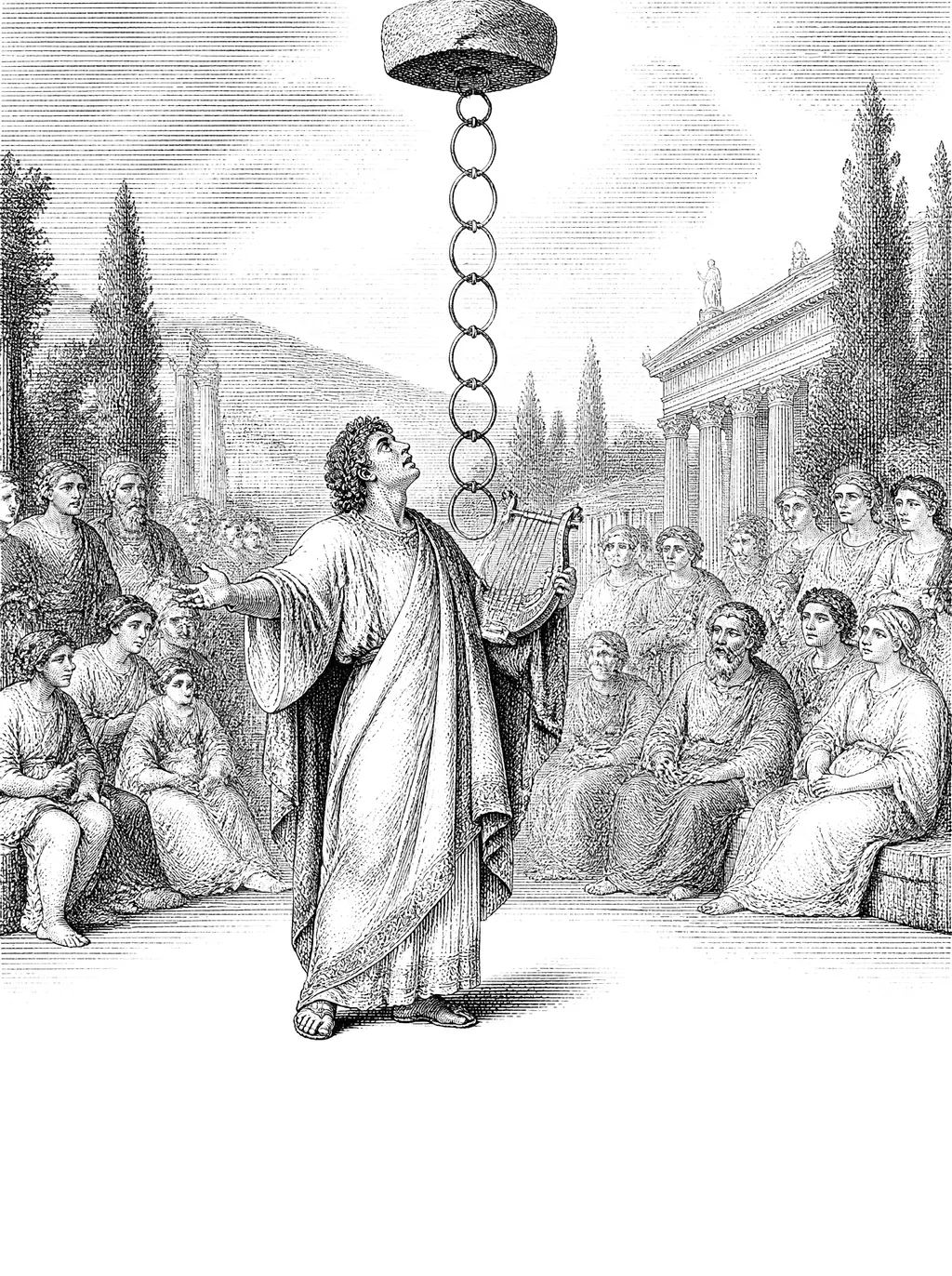
Socrates notices that Ion is helpless the moment talk turns to any other poet, even one covering identical subjects. A genuine skill would transfer across subject matter the way a doctor's knowledge does. Since Ion's gift does not transfer, Socrates concludes it isn't a skill at all, but a kind of possession running through him from the Muse. Socrates offers an image. The Muse is a magnet, and the poet is the first iron ring hanging from it, the rhapsode the second, the audience the third. The force passes down the chain, and each ring holds the next only while the stone holds it. Poets are light, winged, holy things who cannot compose until they are out of their senses.
How the reasoning runs
The argument is a dilemma built from two tests. First test: every art is a whole, so a person with an art can judge everything in its domain, as a doctor judges all cases of health. Ion can judge Homer and only Homer. So his gift is not an art of poetry. Second test: within Homer, every passage concerns some art, chariot driving, medicine, fishing, prophecy, generalship, and in each case the expert in that art, not the rhapsode, is the better judge of whether Homer speaks correctly. So Ion has no art of the subjects either. What is left? Something that works without knowledge, that seizes rather than teaches. Socrates names it divine possession, and Ion, offered the choice between being a cheat or being inspired, takes inspired.
Seen in life
There is a session musician who can play anything on the record but cannot tell you what a chord is, and a singer who can wreck a room with one song and go blank in the interview when asked how. You have seen the clip: the interviewer wants a method, the artist shrugs and says it just came. Plato's Socrates would be delighted. That shrug is the whole dialogue. The thing that came did not come from a body of knowledge the artist could examine and hand on, or the artist could say how. Either it is something the artist does not understand, which is what Ion admits, or the interview is a place where the magnet has let go. Ion, who is honest, picks the first.
Why it matters
This challenges the idea that great poets and performers succeed through teachable expertise, proposing instead that inspiration works more like a magnetic chain: the Muse moves the poet, the poet moves the rhapsode, the rhapsode moves the audience, and none of them is fully in control of what passes through them along the way. It also plants a suspicion that has never gone away. If the poet speaks without knowing, then the authority Greece gave Homer, and any culture gives its artists, is authority over things they may not understand. Plato is not denying the power. He is separating power from knowledge, and asking you to notice how often you have let the first stand in for the second.
“For not by art does the poet sing, but by power divine.”
From the source
Socrates delivers the verdict plainly: “For not by art does the poet sing, but by power divine.” Had Homer's gift been an ordinary craft, Socrates argues, it would have equipped him to speak knowledgeably on every subject he touched, not merely the narrow handful his poetry happens to cover so brilliantly. The line comes from the central speech of the Ion, in Benjamin Jowett's translation, where Socrates explains the magnet. He offers Tynnichus of Chalcis as proof: a mediocre poet who wrote one paean everyone sings, which the god, Socrates says, chose to give through the worst of poets to show that the poems are not human but divine.
The pushback
Isn't this a strange way to praise poetry, denying poets the very expertise they seem so plainly to display in performance? Later readers have taken the theory either as a serious account of creative inspiration, or as one of Plato's characteristic ironies, using apparent flattery to quietly strip poetry of any real claim to knowledge. A second objection attacks the tests. Why should an art have to be transferable across every poet? A critic can be an expert in one author, as a doctor can specialise in one organ. And the claim that only the charioteer can judge Homer's chariot passage confuses two things, whether the driving is accurate and whether the verse is good. Ion loses because Socrates has defined art so that only knowledge of subject matter counts.
The reply
The Platonic reply is that the second objection concedes the point. If the rhapsode's expertise is expertise in how the verse works rather than in what it says, then he should be able to say so, and Ion cannot; he keeps claiming to know what Homer knows. Plato's Socrates is not denying that there could be a craft of poetry, only that Ion has it or that Homer's authority rests on it. On the specialist point the tradition is weaker. Aristotle answered by writing the Poetics, a craft of poetry with its own domain, and that is the real reply: the dialogue's dilemma was a false one. Where the Ion still bites is on authority. Even granted a craft of verse, nothing in it makes the poet wise about war.
Where it went next
The Ion gave Europe its image of the inspired poet. Longinus's greatness of soul, the Renaissance furor poeticus of Ficino, and the Romantic poet as Aeolian harp all descend from the magnet. Shelley's Defence of Poetry (1821) is a reply to Plato that borrows his own picture and drops the irony. Coleridge's chapter on imagination is an attempt to move the power from outside the poet to inside. In the twentieth century, Freud's unconscious and the Surrealists' automatic writing were possession with the god removed. Goethe translated the dialogue. It also begins the argument about whether critics need to be practitioners, and it stands at the head of every discussion of talent that cannot explain itself.
Where this leads
Art is a shadow of a shadow shows Plato taking a far less generous view of poets elsewhere, ranking their work three removes from reality rather than crediting it to divine possession, a tension between the two dialogues that readers of Plato have never fully managed to resolve. The image of a great soul is the tradition's most generous answer to the Ion. Longinus keeps Plato's premise, that greatness comes from somewhere the writer cannot fully control, and turns it into praise: the sublime is the trace of a large mind, not the absence of one. Where Socrates sees a hollow ring in a chain, Longinus sees the mark of the magnet.