Symposium · Philosophy in Fiction · Pl. 4Dante Alighieri · 1265–1321
Not Made to Live Like Brutes
A voice inside the flame
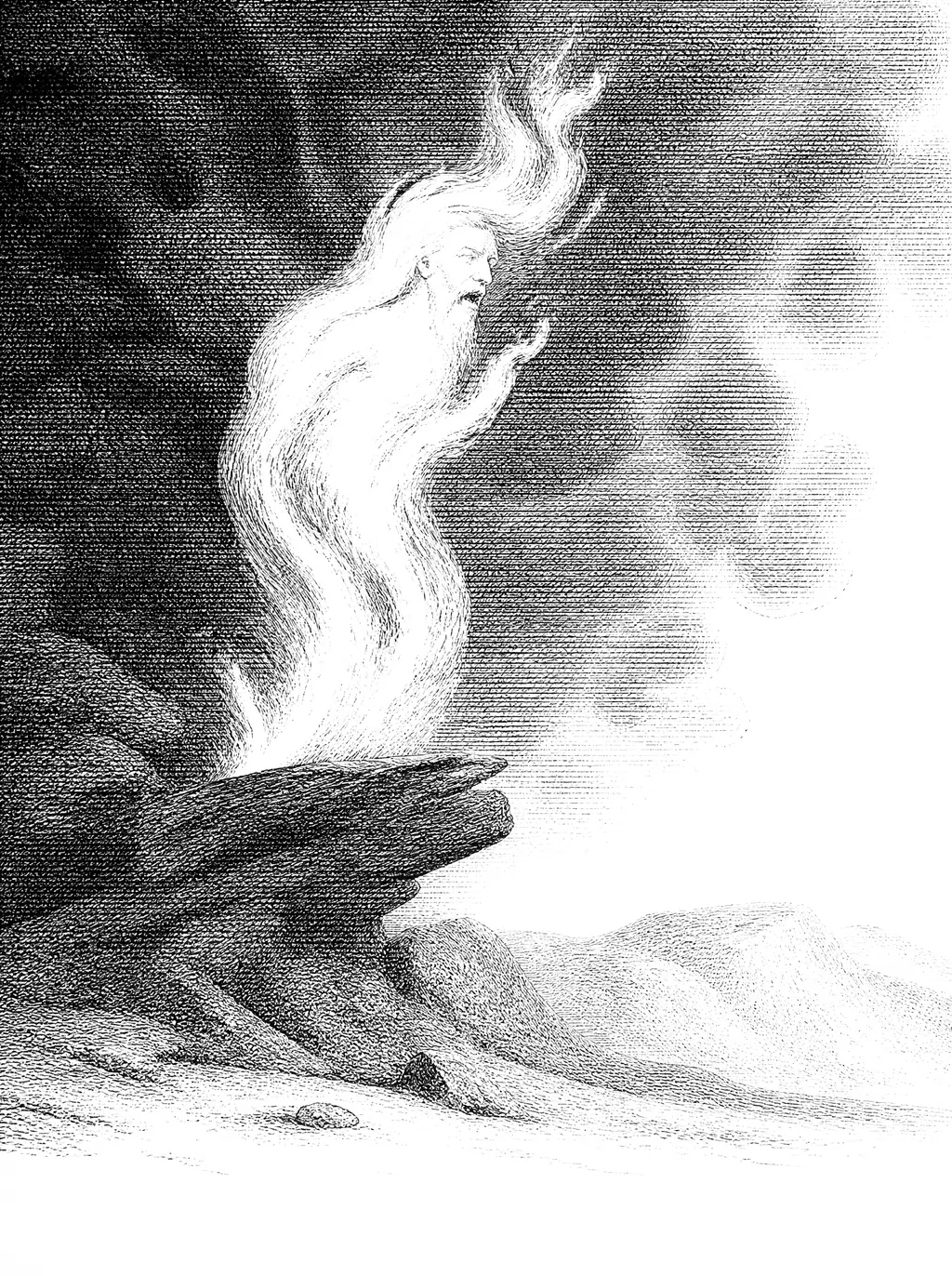
In the eighth circle Dante sees a double flame moving across the ditch and asks who is inside it. Virgil warns him that these Greeks may not answer a Tuscan, and speaks for him. The taller horn of the fire begins to wave and shape itself into a voice, and Ulysses tells the last part of his story, which is in no Greek source: not the return to Ithaca, but a final voyage past the Strait of Gibraltar into the empty ocean. He tells it without repentance. It is the most admired speech in the Inferno and it is the confession of a damned man.
The world it came from
The character is Ulysses, and the work is the Inferno, the first part of Dante's Commedia, written in exile and circulating by about 1314. Dante had been expelled from Florence in 1302 under sentence of death and never returned. He knew no Greek and had not read Homer; his Ulysses comes through Virgil, Ovid, and Cicero, where the hero is already a byword for cunning and dangerous eloquence. The Pillars of Hercules marked the medieval limit of legitimate seafaring, and in Dante's lifetime Genoese brothers had sailed past them and vanished. He put the sin of Ulysses among the false counsellors.
The idea
Ulysses argues that a human being is defined by the appetite to know, and that refusing the appetite is a demotion to the animal. Old age, family, and the duties owed to a kingdom are all set aside for one more crossing, and the reason offered is not glory or wealth but experience of the world and of human vice and virtue. Dante makes the case as strong as language allows, then drowns the ship. The idea under examination is whether the pursuit of knowledge has a limit that is not merely a limit of ability, and whether crossing it is heroism or presumption.
How the reasoning runs
Ulysses reasons to his crew in four moves. You have already crossed a hundred thousand perils to reach the West, so you are not men who turn back. What remains of your lives is a small watch, too small to spend cautiously. You were born of a seed that separates you from beasts, and the mark of that seed is virtue and knowledge. Therefore refusing this voyage would be a betrayal of your own kind. It is a valid argument from premises the crew already hold, delivered by a speaker who knows exactly which premises to name. That is precisely why Dante files it as fraudulent counsel.
Seen in life
A researcher has the funding, the technique, and one experiment that no committee has quite approved. The case for doing it writes itself: knowledge is good, caution is cowardice, and the people counselling delay have never made anything. Everyone who has worked near a frontier has heard that speech, and has usually agreed with it. Dante's contribution is not to say the speech is wrong. It is to point out that the speaker is also persuading twelve other people to get into the boat, that they will not come back either, and that the eloquence which made the case irresistible is the part that will be judged.
Why it matters
Every civilisation that has the means eventually faces a version of the pillars: the voyage, the reactor, the edited genome, the model nobody can interpret. Dante is one of the first writers to state the case for going through in a voice strong enough that the reader wants to go, and then to insist that wanting it is not an argument. He does not resolve the tension, and the poem is better for it. Six centuries later Ulysses is quoted approvingly by explorers and scientists who have not noticed, or have decided not to care, where the flame is burning.
“Consider ye the seed from which ye sprang; / Ye were not made to live like unto brutes, / But for pursuit of virtue and of knowledge.”
From the source
In Canto 26 of the Inferno, in Longfellow's translation, Ulysses recalls the moment at the strait where Hercules set his landmarks so that no man should venture further. He turns to his aged crew and tells them not to deny themselves, in the small vigil of sense remaining to them, the knowledge of the unpeopled world behind the sun. Then the appeal itself: “Consider ye the seed from which ye sprang; / Ye were not made to live like unto brutes, / But for pursuit of virtue and of knowledge.” They made wings of their oars for the mad flight, sailed five months, sighted a dark mountain, and a whirlwind out of the new land turned the ship three times and closed the sea over them.
The pushback
The obvious complaint is that Dante has stacked the deck. He invented the voyage, chose the punishment, and then wrote the speech so well that readers side with the sinner against the poem. If the pursuit of knowledge really is what raises us above brutes, the punishment looks like theology overruling the evidence the poet himself supplied. A second objection: Ulysses is not damned for curiosity at all. He sits among false counsellors, punished for the Trojan horse and for the tongue that persuades others into ruin, which makes the whole reading about the limits of knowledge a later invention.
The reply
The second objection is the stronger and mostly correct, and it improves the first. Dante does not condemn wanting to know. He condemns a use of speech that moves other people past a limit for the speaker's own hunger, and the voyage is the evidence rather than the charge. That reading also explains why the flame speaks: the tongue that did the work is the thing burning. On the charge of stacking the deck, Dante would answer that a temptation drawn weakly proves nothing, and that a reader who finishes the canto wanting to sail has understood the danger exactly as intended.
Where it went next
Tennyson's Ulysses, in 1833, rewrote the speech without the punishment and gave the Victorians a hero of restless striving; the line about seeking a newer world descends straight from this canto. Primo Levi recited the passage from memory in Auschwitz and built a chapter of If This Is a Man around trying to translate it for a French prisoner, which turned it into a text about the survival of humanity itself. Borges, T. S. Eliot, and Osip Mandelstam all returned to it. The canto is now standard reading in debates about scientific limits, usually quoted by the side that wants to sail.
Where this leads
Zarathustra's tightrope is the same figure with the theology removed: a crossing that dignifies the one who attempts it, and no ground underneath. Read them together to see what Dante's Hell was doing, which is supplying a floor that Nietzsche then takes away. Don Quixote is the comic inversion. Ulysses persuades sane men to sail into a real ocean and drowns them; Quixote persuades nobody and charges an imaginary enemy alone. And Aquinas supplies the cosmos Dante is working inside, where the limits on human knowing are set by a real order rather than by nerve.