Symposium · Philosophy in Fiction · Pl. 12Miguel de Cervantes · 1547–1616
The Nobility of Illusion
The lady who salts pork
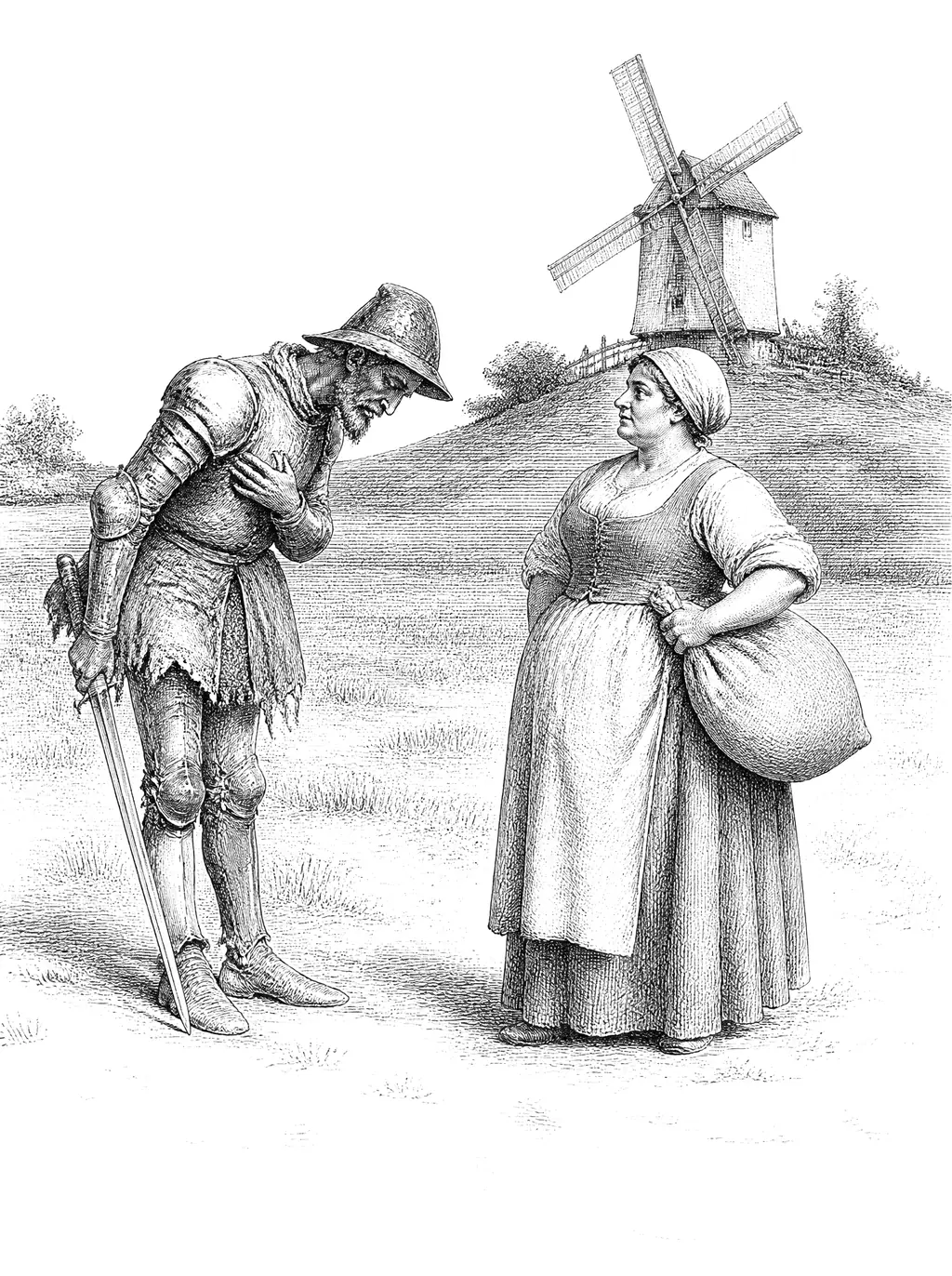
Halfway through the first book, Sancho Panza finally says it. He knows the peerless Dulcinea del Toboso. Her name is Aldonza Lorenzo, she is a strapping farm girl who can pitch a bar as well as any lad in the village, and her voice carries across a field. Don Quixote does not deny a word of it. He answers with a lecture on how poets name their mistresses, concedes that most such ladies were never real, and then states his own position, which is not that Sancho is mistaken but that being mistaken is not the point.
The world it came from
The character is Alonso Quixano, a poor gentleman of La Mancha who renames himself Don Quixote; the work is the first part of Cervantes's novel, published in Madrid in 1605. Cervantes was fifty-seven, had lost the use of a hand at Lepanto, had spent five years as a slave in Algiers, and had been jailed twice as a failing tax collector. Spain was exhausted, its chivalric self-image outliving its power. The chivalric romances he mocks were the bestsellers of the age. The passage about Dulcinea sits in Part One, chapter twenty-five, in the Sierra Morena, where Quixote has decided to run mad on purpose in imitation of a book.
The idea
Quixote's answer separates two things usually welded together: whether a belief is accurate and whether holding it makes a person better. He does not claim Dulcinea exists as described. He claims that it is enough for him to think and believe that Aldonza Lorenzo is beautiful and virtuous, and that on the strength of that thought he will behave like a man with something to be worthy of. The illusion is not a mistake he is trapped in; it is a commitment he maintains, chosen because of what it makes possible in him. Truth is set aside in favour of what the belief produces.
How the reasoning runs
First, a knight requires a lady, not for her sake but because devotion is what organises courage and restraint into a life. Second, the poets who supplied literature with Amaryllis and Phyllis mostly invented them, and nobody thinks the poems are worse for it. Third, therefore the function of the lady does not depend on the lady existing as described. Fourth, Quixote is free to supply that function himself, and does. The conclusion, which he states outright, is that it suffices him to think and believe. Sancho's correction is accurate and irrelevant, because it answers a question about the world when the claim was about a stance toward it.
Seen in life
A mediocre club has a founding story about itself, half of which is embroidered. Members train harder because of it. A new arrival looks up the records, finds the famous season was ordinary, and tells everyone. He is right, and the room deflates, and the training slackens for a year. Quixote would not dispute a single record. He would ask what the truth-telling was for, and whether the teller had anything to put in the place of what he removed. The novel does not settle whether the arrival should have kept quiet. It only insists that the deflation is a real cost with real consequences.
Why it matters
The question underneath is whether we owe our beliefs to the evidence alone. Pragmatists say a belief is partly answerable to what it does; evidentialists say that thinking well means never believing beyond the case. Quixote is the most memorable evidence for one side and the most damaging evidence against it, since the same commitment that gives an old man courage and courtesy also gets shepherds beaten and Sancho tossed in a blanket. The novel refuses the tidy version in which the dreamer is simply admirable. It asks who pays for the dream, and answers, mostly other people.
“so it suffices me to think and believe that the good Aldonza Lorenzo is fair and virtuous”
From the source
In Part One, chapter twenty-five, Sancho has just identified Dulcinea as Aldonza Lorenzo. Quixote replies with the roll call of invented mistresses, the Amaryllises and Phyllises and Galateas that fill the ballads and the barbers' shops, and asks whether Sancho supposes any of them were ladies of flesh and blood. They were invented, he says, to furnish a subject for verses and to let the poets pass for lovers. Then his own case: “so it suffices me to think and believe that the good Aldonza Lorenzo is fair and virtuous.” As for her pedigree, it hardly matters, since nobody will inspect it, and he for his part reckons her the most exalted princess in the world.
The pushback
The obvious reply is that this is not nobility, it is self-deception with better prose, and the novel supplies the receipts. Quixote frees galley slaves who promptly rob him and stone Sancho; he destroys a barber's basin, an innkeeper's wineskins, and a puppet theatre; the beatings he takes are funny only because the book is cruel. A second objection cuts deeper. If a belief is worth holding because of its effects, anyone can justify anything by pointing at the character it builds, and there is no way left to tell an inspiring conviction from a comfortable lie.
The reply
Cervantes concedes the damage; it is on almost every page, and the deathbed scene concedes even more, since Quixano recovers his wits, renounces the books, and dies within days of becoming sane. But the concession runs both ways. The novel does not present the recovery as a happy ending, and Sancho, the realist, begs him to get back on the horse. The defensible position is narrower than the slogan: an illusion held about oneself, at one's own cost, that produces courtesy and courage, is not the same thing as a false belief about the world imposed on others. Quixote keeps crossing that line, and the book keeps counting.
Where it went next
The Romantics turned the joke inside out, reading Quixote as a tragic idealist in a debased world, and that reading now dominates. Unamuno made him a saint of Spanish faith; Dostoevsky called the novel the saddest book ever written and modelled Prince Myshkin on it. Turgenev's essay pairing Hamlet and Don Quixote fixed them as the two poles of the modern self, the one who thinks and the one who acts. Freud read Cervantes in Spanish for pleasure. The adjective quixotic, which means impractical in English, has lost every trace of the argument the character actually made.
Where this leads
Hamlet's claim that thinking makes a thing good or bad is the same manoeuvre in a colder key: relocate the property from the object into the appraiser. Quixote does it deliberately and for a purpose, which is the difference between a doctrine and a discipline. Wilde's claim that life imitates art is the argument at its most cheerful, with the discipline dropped and the invention celebrated. And Sartre's bad faith is the prosecution case, naming the moment when a chosen story about yourself becomes a way of not having to look at what you are.