Symposium · Philosophy in Fiction · Pl. 15Friedrich Nietzsche · 1844–1900
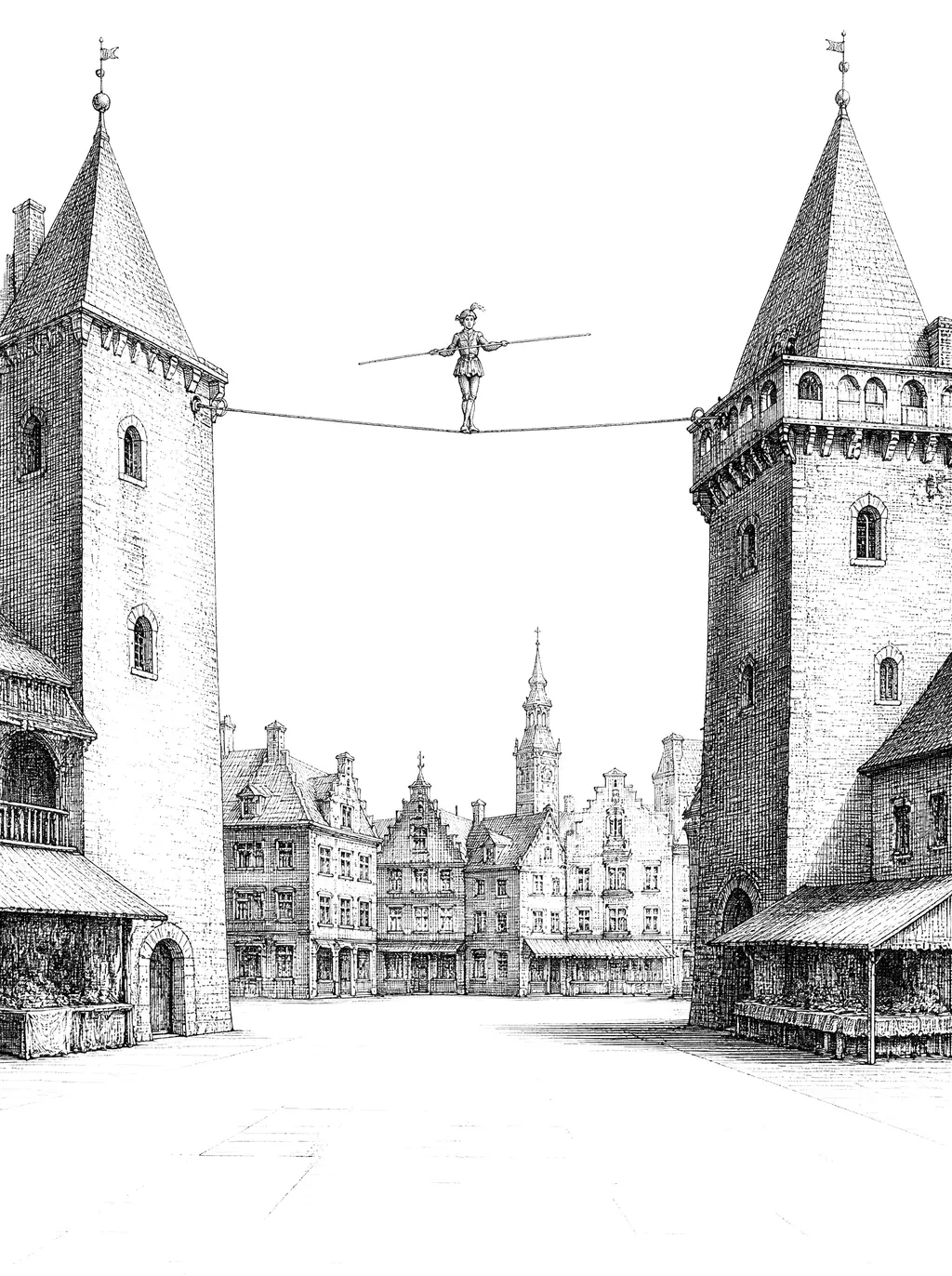
A Rope Over an Abyss
The rope and the walker
Zarathustra comes down from the mountain and finds a crowd in a market town waiting for a rope-dancer. He uses the occasion: a human being, he tells them, is a rope stretched between the animal and something beyond, a rope strung over an abyss. Crossing it is dangerous, standing still on it is dangerous, and looking back is dangerous. The crowd think he is the warm-up act. Then the real rope-walker starts across, a jester leaps over him, and he falls at Zarathustra's feet and dies. The metaphor is illustrated and refuted in the same scene.
The world it came from
The character is Zarathustra, Nietzsche's invented prophet, borrowed from the Persian Zoroaster and given the opposite errand; the work is Thus Spoke Zarathustra, whose first part was written in ten days at Rapallo early in 1883 and published that year. Nietzsche was thirty-eight, had resigned his Basel chair for ill health, and had just been rejected by Lou Salomé. He wrote the book as scripture, in mock-biblical German that Thomas Common's translation renders with hath and thou. The prologue follows directly from the announcement of the death of God: the old rope was anchored at both ends, and now one anchor is gone.
The idea
A human being is not a kind of thing but a transition. What deserves respect in us is not any state we have reached but the crossing itself, and the crossing has no floor beneath it. Zarathustra puts the value squarely on the going-over rather than the arrival, which is why he says what is great in man is that he is a bridge and not a goal. The image is chosen for its cost. A rope over an abyss is the position of something that cannot stop, cannot settle, and cannot be secured, and any account of human dignity that starts here has to do without safety.
How the reasoning runs
The argument is compressed into the picture, and it runs like this. Value used to be anchored outside us, in God or in a natural order that told us what a human being is for. That anchor is gone. If value now has to be found inside the human, it cannot lie in the human's current state, because that state is what Zarathustra spends the book despising. So it must lie in movement away from that state. But movement toward what? There is no fixed far post, only a direction. Therefore the honest image is not a bridge between two towers but a rope with an abyss underneath, and the walking is all the ground there is.
Seen in life
Someone leaves a settled career at forty for work that may not exist in five years. The people who love them ask what the plan is, meaning where the far end of the rope is fastened, and there is no honest answer. What there is instead is a direction and a refusal to go back. Zarathustra's point is that the question is malformed: the questioner assumes that a life is validated by arriving somewhere, and the walker's whole position is that arriving is not available to anyone. The danger in the image is not falling. It is stopping in the middle, which the picture makes just as fatal.
Why it matters
The rope is Nietzsche's answer to the vacancy left by the death of God, and it is the answer most people actually inherit, whether or not they have read him. It survives in every self-help account of growth, every startup slogan about the journey, and every argument that a person is a project rather than an essence. What usually gets dropped in transmission is the abyss. Nietzsche is not describing a rewarding process of self-improvement with a safety net of meaning underneath. He is saying there is nothing under the rope, and that this is the condition on which anything great becomes possible.
“Man is a rope stretched between the animal and the Superman—a rope over an abyss.”
From the source
In section four of the Prologue, with the crowd waiting for the rope-dancer, Zarathustra looks at them and begins: “Man is a rope stretched between the animal and the Superman—a rope over an abyss.” A dangerous crossing, he goes on, a dangerous wayfaring, a dangerous looking-back, a dangerous trembling and halting. What is great in man is that he is a bridge and not a goal; what is lovable in man is that he is an over-going and a down-going. Then the litany of what he loves: those who know how to live only as down-goers, the great despisers, the arrows of longing for the other shore, and the ones who sacrifice themselves to the earth.
The pushback
The first objection is that a metaphor is not an argument. Nothing follows about human nature from the fact that a striking image can be made of it, and the image quietly assumes the very thing at issue, that there is somewhere better to get to. The second objection comes from the scene itself: the rope-walker falls and dies, and Zarathustra carries the corpse away on his back. If the picture is meant to be inspiring, the book seems to be sabotaging it within a page. A reader may fairly ask whether Nietzsche believed his own figure.
The reply
The falling walker is deliberate, and it is the reply. Zarathustra tells the dying man he has made danger his calling and there is nothing contemptible in that, then buries him himself rather than leaving him to the crowd. The image is not a promise of success; it is a description of the stakes, and a corpse belongs in it. On the charge that a metaphor proves nothing, Nietzsche would agree and count it as praise. He thought systems were autobiographies with the personality hidden, and preferred a picture that shows its cost to an argument that conceals one.
Where it went next
The rope passed almost immediately into the vocabulary of German youth movements, then into existentialism, where Heidegger's being-toward-possibility and Sartre's self-making are recognisable descendants. Common's Superman, which is what English readers met first, sent the figure into comic books in 1938 and permanently muddied it; later translators use overman. The line is now quoted on gym walls and in commencement speeches, usually without the abyss. Serious readers have gone the other way: Walter Kaufmann's postwar rehabilitation used the prologue to argue that Nietzsche's target was self-overcoming rather than domination, and that reading still holds the field.
Where this leads
The overman is the far end that the rope points toward, and reading the two together shows how little Nietzsche will say about it, which is deliberate rather than evasive. God is dead is the event that cut the old anchor and made the abyss visible; without it the rope image is merely stirring instead of necessary. Eternal recurrence is the test that replaces the missing judge: if there is no arrival, the only question left about a crossing is whether you would consent to make it again, exactly as it was, without end.