Symposium · Epistemology · Pl. 3René Descartes · 1596–1650
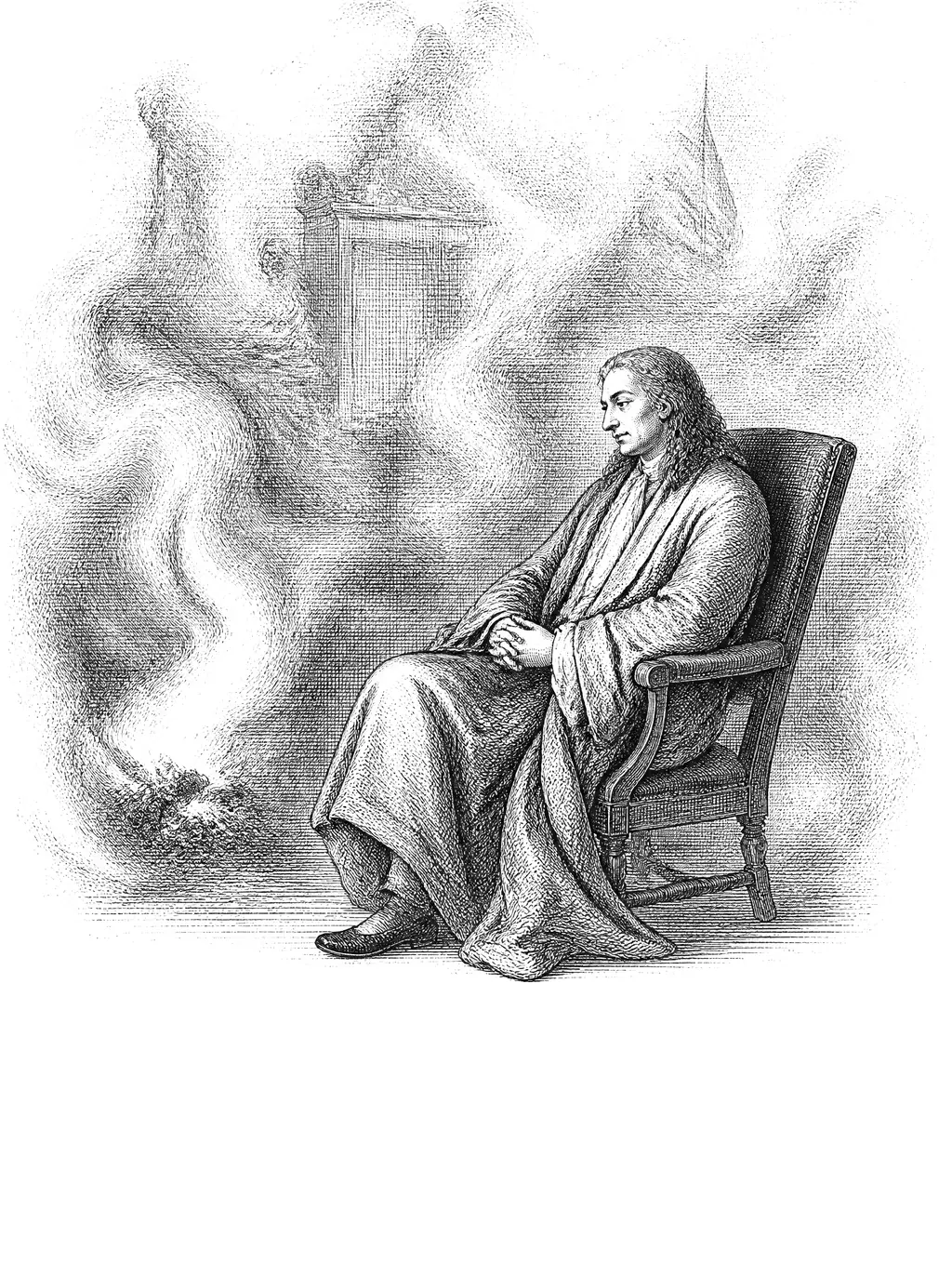
Cogito Ergo Sum
The one thing that would not break
After imagining a demon powerful enough to fake the entire world, Descartes searched the wreckage for anything left standing. Every belief about the outside world could, in theory, be a trick. But the demon deceiving him still needed a him to deceive, and that requirement turned out to be the one thing no amount of trickery could remove. He compares himself to Archimedes, who asked for one fixed point from which to move the earth. The cogito is that point. It is small, it is strange, and it proves far less than people think. But it holds, and Descartes was willing to trade the whole world for one thing that held.
The world it came from
Descartes first stated the thought in French, in the Discourse on Method of 1637: je pense, donc je suis. The Meditations of 1641 recast it in Latin without the therefore, as a discovery made in the act: I am, I exist. The famous three-word form appears in the Principles of Philosophy of 1644. He had settled in the Netherlands for peace and wrote for two audiences at once: the Sorbonne theologians, to whom he dedicated the Meditations, and the new physicists, for whom he wanted a foundation that did not depend on Aristotle. Before publishing he circulated the manuscript for objections. Hobbes, Gassendi, and the theologian Antoine Arnauld replied, and Arnauld noticed that Augustine had said something very similar twelve centuries earlier.
The idea
However thoroughly you doubt, the doubting itself is proof that something is doing the doubting. You cannot coherently doubt that you are thinking while you are thinking, since the doubt is itself an act of thought. From that single, minimal fact, that a thinking thing exists right now, Descartes rebuilds a foundation solid enough to support everything else he wants to know. Notice how little the fact contains. It does not say you have a body, a past, or a future. It does not even say you will exist a moment from now. It says only that whenever this thought is thought, a thinker is present. Everything else, Descartes admits, still has to be earned.
How the reasoning runs
Suppose the demon deceives me about everything. First, to be deceived, I must exist; a deception with no victim is not a deception. Second, suppose instead that I doubt whether I exist. Doubting is thinking, and thinking needs a thinker, so the doubt confirms what it questions. Third, this holds for any thought whatever: to affirm, deny, will, imagine, or sense is to think, and to think is to be. Fourth, so the proposition I am, I exist is necessarily true each time I think it. Fifth, ask what this I is. So far, only a thing that thinks; the body is still under the demon's suspicion. Therefore the first certain truth is a thinking thing, present now, and nothing more.
Seen in life
You come up from anesthesia. Before you know where you are, before you can name the day or recognize the ceiling, before you remember the surgery or your own name, there is something. A kind of grey attending. Then a voice, and the room assembles itself around that first flicker, piece by piece: hands, the taste of plastic, a nurse, a name. Descartes's claim is that the flicker came first and everything else was built on it, and that the order was not an accident of the drugs. The world can be removed and put back. The thing it is put back for cannot be, because removing it would require it to be there to be removed.
Why it matters
This gave philosophy something rare: a claim that survives literally any possible deception, because the deception itself would prove it. Whatever else turns out to be false, illusion, dream, or demon's trick, the fact that a thinking subject is currently present to be fooled cannot be talked away, which makes it an unusually secure place to start building knowledge back up. It also moved the center of philosophy. Before Descartes the first question was about the world and God; after him it was about the mind and what the mind can know. That turn inward shaped three centuries, from Locke to Kant to Husserl, and the arguments against it, from Hume to Wittgenstein, are still arguments with him.
“I may lay this down as a principle, that whenever this sentence I am, I exist, is spoken or thought of by me, it is necessarily true.”
From the source
Having found the one thing the demon could not touch, Descartes states the discovery as a settled principle in the Meditations: “I may lay this down as a principle, that whenever this sentence I am, I exist, is spoken or thought of by me, it is necessarily true.” The reasoning just before it is compressed. Let the deceiver deceive as much as he can, Descartes writes, he can never make me nothing so long as I think I am something. Then he asks what he is, and works through the old answers. A man? That leads to animals and rationality, too tangled. A body? Doubtful. Only thought cannot be separated from him. He is a thing that thinks: doubts, understands, affirms, denies, wills, imagines, senses.
The pushback
Critics point out that the cogito proves only that thinking is happening, not that a stable, continuous self is doing it, which is a much thinner conclusion than Descartes seems to build on top of it. Hume later pressed exactly this gap, arguing introspection finds only a flow of perceptions, never a solid thinker sitting behind them the way Descartes assumed. Lichtenberg sharpened the point into an aphorism: one should say it thinks, the way one says it rains. The I is smuggled in by grammar. Nietzsche went further, calling the cogito a bundle of assumptions: that thinking needs a thinker, that the thinker is me, that I know what thinking is. Every one of those, he said, is a habit, not a proof.
The reply
Descartes's defenders answer that the objection attacks a claim he did not make in the Meditations. The text says a thinking thing exists while it thinks; it does not, at that point, claim the thing is a soul, or persists, or has a settled nature. Those come later and rest on further arguments, including a proof of God that has its own troubles. As for Lichtenberg's it thinks, the reply is that even an it is something, and something present is all Descartes needed. That answers the charge of overreach but not the charge of grammar. Whether thinking can occur with no subject at all is a question the cogito assumes rather than settles, and Descartes never argues it. He may simply have found it too obvious to defend.
Where it went next
Locke, Berkeley, and Hume all began where Descartes began, inside the mind, and quarreled about what was there. Kant tried to keep the I think as the form of all experience while denying it was a substance. Husserl's Cartesian Meditations of 1931 restarted phenomenology from the cogito. Sartre took the pre-reflective cogito as the ground of freedom. On the other side, Gilbert Ryle mocked the thinking thing as a ghost in the machine, and Jaakko Hintikka argued in 1962 that the cogito is a performance, true because saying it makes it so, not a syllogism. Antonio Damasio's Descartes' Error blamed him for separating reason from the body. The three words are still the most famous sentence in philosophy.
Where this leads
Bundle theory of self takes Descartes's minimal starting point and pushes straight past it, asking whether there is really a persisting self behind all that thinking at all, or only the thinking itself, one bare perception endlessly chasing the next one down. Hume repeated Descartes's experiment, looking inward for the thinker, and reported that the room was empty except for the furniture. The method of doubt is the other bookend. Descartes tore everything down so that this one stone could be tested against the hardest possible strain, and the cogito is what the demon left behind. Read the demon first and the cogito after, in that order, because that is the order in which the certainty was earned.