Symposium · Aesthetics · Pl. 11John Ruskin · 1819–1900
To See Clearly Is Poetry
Defending Turner by defending the eye
Ruskin wrote Modern Painters to defend J. M. W. Turner against critics who found his landscapes formless and exaggerated. His defense turns on a surprising claim: Turner's apparent wildness is actually superior accuracy, the product of seeing nature more truthfully than painters trained to reproduce comfortable, familiar conventions instead. Ruskin was twenty-four when the first volume appeared, and he spent pages describing how clouds actually form, how water actually breaks, how a mountain's rock actually folds. The point was not pedantry. He wanted to show that the painters everyone admired had painted clouds from memory and habit, while Turner had painted the sky.
The world it came from
John Ruskin published the first volume of Modern Painters in 1843, anonymously, as 'a Graduate of Oxford'. He was the son of a wealthy sherry merchant and had grown up drawing, collecting minerals, and travelling the Alps. The book answered a hostile review of Turner in Blackwood's Magazine. It grew over seventeen years into five volumes, and the line about seeing comes from the third, published in 1856. By then Ruskin had also written The Stones of Venice and championed the Pre-Raphaelites, young painters who followed his instruction to go to nature and reject nothing. The academic tradition he fought taught landscape by copying Claude and Poussin; the picturesque taught tourists to view scenery through tinted glass. Both, he thought, were ways of not looking.
The idea
The greatest thing a human soul ever does in this world is to see something, and tell what it saw in a plain way. Hundreds of people can talk for one who can think, but thousands can think for one who can see. Real artistic greatness, on this view, lies less in clever composition than in the rare, disciplined honesty of accurate perception. Ruskin's ranking is deliberate. Talking is common, thinking is rarer, and seeing is rarest, because habit, vanity, and convention all get between the eye and the thing. To see a leaf as it is, and not as the word 'leaf' tells you it should be, takes more discipline than any argument. That is why he calls plain seeing poetry, prophecy, and religion in one.
How the reasoning runs
Ruskin's case runs like this. First, what a painter puts on canvas is what the painter saw, so the quality of the painting is bounded by the quality of the seeing. Second, most people, painters included, do not see; they recognise. The mind supplies a stock image of a cloud or a tree, and the eye stops looking once the label is attached. Third, this is hard to overcome, because the labels are useful and the looking is slow. So genuine seeing is rare, rarer than clear thought. Fourth, when it happens, the result looks strange, because it differs from the labels everyone else is using. Therefore Turner's strangeness is evidence of accuracy, not of wildness, and truth to nature, not conventional grace, is the standard of art.
Seen in life
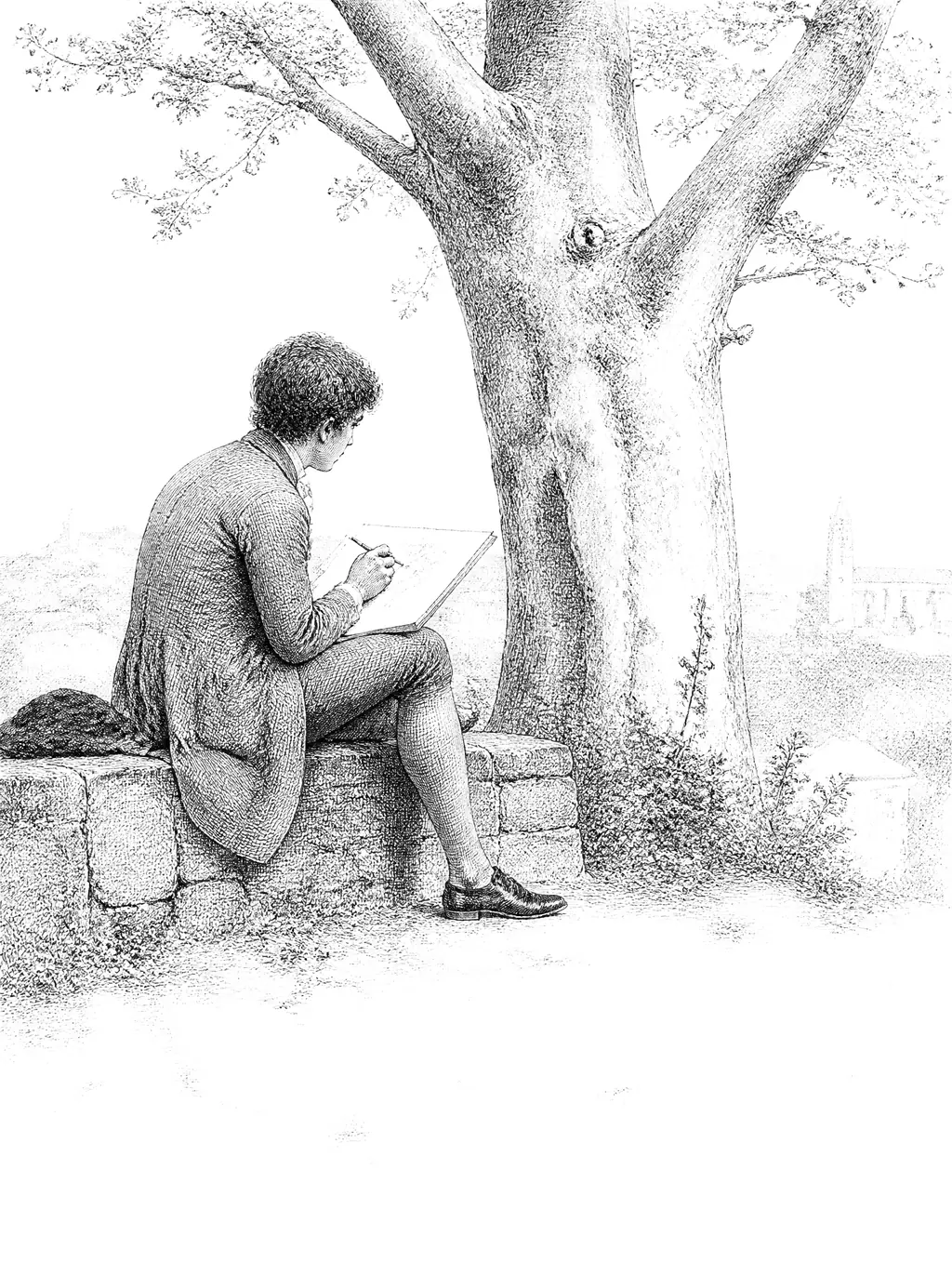
You have walked the same street to work for three years. Ask yourself the colour of the third house on the left, or what the bark on the plane trees does where the branches fork. You cannot say. You have passed it a thousand times and seen it perhaps twice. Now take out a pencil and try to draw the trunk. Within a minute the tree becomes difficult, particular, and strange, nothing like the tree your mind had filed. Ruskin taught drawing to working men for exactly this reason. The drawing was not the point. The point was the ten minutes in which you stopped recognising and started seeing, and afterwards the street is not the same street.
Why it matters
This reoriented art criticism around perception itself as the primary artistic achievement, treating faithful, attentive seeing as harder and rarer than imaginative invention. It gave a rigorous philosophical backbone to Ruskin's broader campaign for truth to nature, and to his lifelong insistence that painters earn the right to interpret only after learning to look. It also moved the question out of the studio. If seeing is the greatest thing a soul does, then it matters how a society trains its eyes, what it builds, and what work leaves people too tired to look. Ruskin followed the thought from painting into architecture, then into economics, and never saw a break in the line.
“The greatest thing a human soul ever does in this world is to see something, and tell what it saw in a plain way.”
From the source
Ruskin states the ranking without hedging: “The greatest thing a human soul ever does in this world is to see something, and tell what it saw in a plain way. Hundreds of people can talk for one who can think, but thousands can think for one who can see.” He calls clear seeing poetry, prophecy, and religion, all in one. The passage comes from the chapter 'Of Modern Landscape' in Modern Painters volume three, published in 1856, a few chapters after the famous attack on the pathetic fallacy, the habit of poets who project their feelings onto things and call the foam cruel or the sea angry. The seer of the highest order, Ruskin says, feels strongly and still sees truly. The plain report is the hard part.
The pushback
Doesn't this undervalue imagination and invention, treating the artist as a mere accurate recorder rather than a genuine creator shaping something new out of raw material? Ruskin would likely reply that accurate seeing is itself an extraordinary imaginative discipline, since most people's perception is clouded by habit, convention, and the constant temptation to see only what they expect. A harder objection: there is no such thing as plain seeing. Every act of looking selects, and every report uses a vocabulary that was learned. Ruskin's own Turner, the supposed model of accuracy, painted sunsets that nobody has ever measured in the sky. And Wilde would add that Ruskin's 'truth to nature' was itself a fashion, taught by Ruskin, that a generation then saw the Alps through.
The reply
Ruskin never claimed the eye is a camera. His second volume is a theory of imagination, and he insisted that Turner's greatest pictures combine the truth of a hundred observations into one scene no camera could take. Accuracy, for him, means fidelity to what is there, not to any single view of it. That answers part of the objection. The rest stands. Ruskin did teach a way of seeing, and the Pre-Raphaelites painted his prescriptions as faithfully as any academician had painted Claude's. He half-conceded the point himself, in his later writing on the relation of art to the mind of the age. What survives is the practical claim: whatever seeing is, most people do less of it than they could, and the difference is trainable.
Where it went next
Ruskin's readers were more various than his critics. Marcel Proust translated him and learned from him how to write a hawthorn bush. William Morris took the chapter 'The Nature of Gothic' and built the Arts and Crafts movement on it. Gandhi read Unto This Last on a train and changed his life. In painting, the injunction to go to nature fed the Pre-Raphaelites directly and the Impressionists at a distance. The word 'seeing' in art education, from the Bauhaus preliminary course to Betty Edwards's Drawing on the Right Side of the Brain, keeps Ruskin's distinction between seeing and recognising. Critics of the picturesque and of the tourist gaze, from Susan Sontag on, are still fighting his fight.
Where this leads
The enemy of art is the humdrum shows John Dewey, writing decades later, reaching for a related idea from a different direction, arguing that the quality prized in great art is not confined to trained perception of nature but available in any experience carried through with full, undivided attention. Art is a shadow of a shadow is the older quarrel. Plato scorns the painter for copying appearances at one remove from truth. Ruskin agrees that copying is not the point, then turns the tables: the painter who truly sees is closer to the thing than the philosopher who only has a word for it. Same suspicion of the lazy copy, opposite verdict on the eye.