Symposium · Ethics · Pl. 3Peter Singer · b. 1946
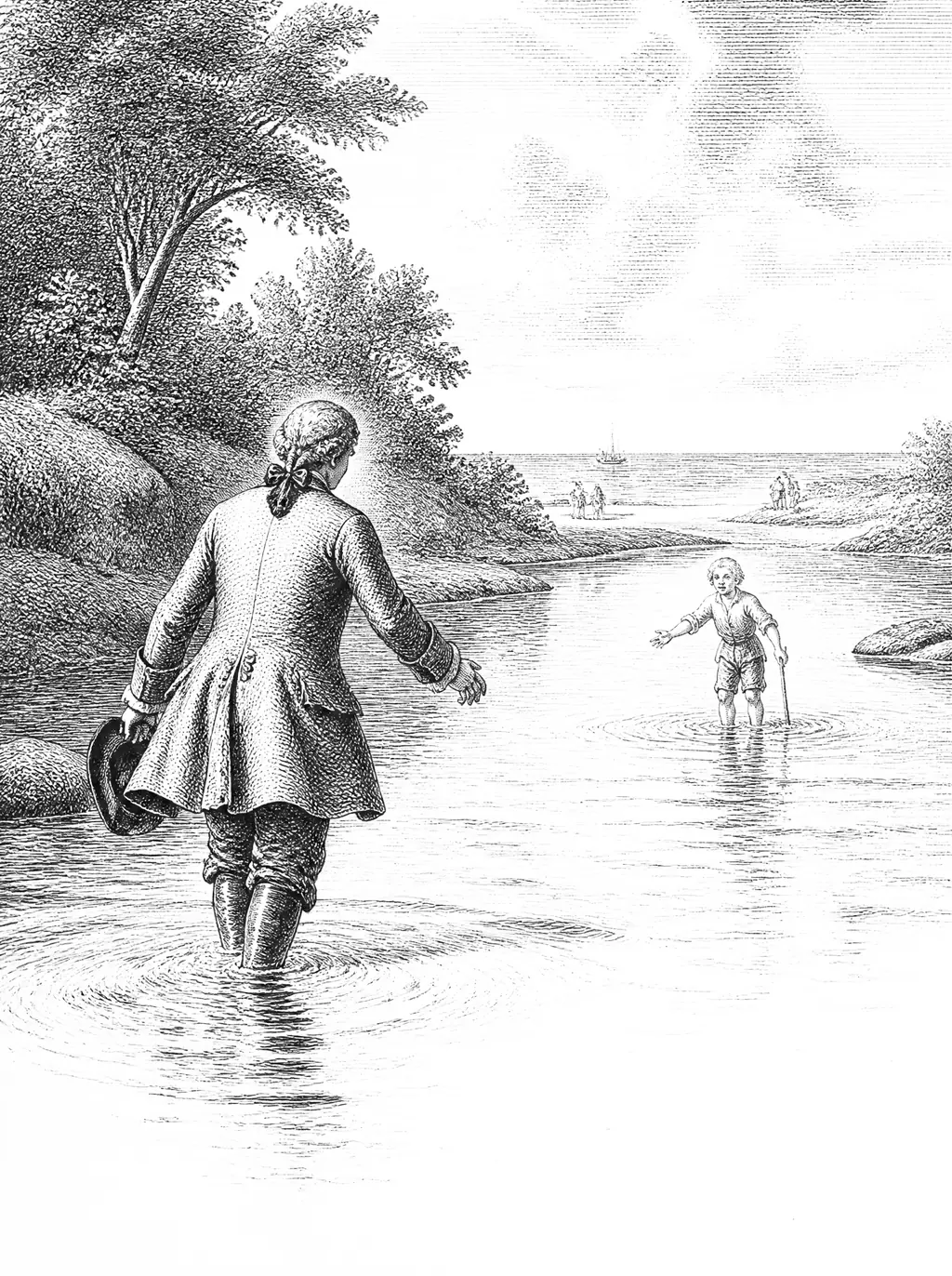
The Drowning Child
Muddy clothes, an easy choice
Singer asks you to imagine walking past a shallow pond and seeing a small child drowning in it. Almost everyone agrees you should wade in and pull the child out, even though it will ruin your clothes, because muddy clothes are nothing next to a child's life. The obligation feels obvious, immediate, and completely uncontroversial in that exact moment. Now Singer changes one thing at a time. The child is a stranger. Still obvious. Other people are walking past and doing nothing. Still obvious. The child is not in front of you but on the other side of the world, and the cost of saving her is the price of the shoes. Singer's claim is that nothing that changed was a moral reason.
The world it came from
Singer wrote Famine, Affluence, and Morality in November 1971, when he was twenty-five and teaching at Oxford. That year a cyclone and then a civil war had driven some nine million refugees from East Bengal into India, where they were dying of hunger and cholera in camps. The rich countries had sent, Singer noted, a fraction of what was needed; Britain had given less to the refugees than it was spending on the Concorde. He was the child of Viennese Jews who had fled to Australia in 1938, and three of his grandparents had died in the camps. The essay appeared in 1972 in the first volume of Philosophy and Public Affairs, a new journal founded on the belief that philosophers should say something about the newspapers.
The idea
If it is in your power to prevent something very bad from happening, without sacrificing anything of comparable moral importance, you ought to do it. Singer argues that physical distance and unfamiliarity change nothing morally relevant about this obligation: a child dying of preventable poverty on the other side of the world creates the same duty as a child drowning at your feet, once you actually follow the logic through. He offers the principle in two strengths. The strong version says give until the next gift would cost you something as important as what it buys. The weak version says give until the next gift would cost you anything morally significant at all. Singer thinks the strong version is right and that even the weak one would change the world.
How the reasoning runs
Premise one: suffering and death from lack of food, shelter, and medical care are bad. Premise two: if you can prevent something bad without sacrificing anything of comparable importance, you ought to. The pond is offered as proof that you already accept this. Premise three: by giving money to effective relief, you can prevent such suffering at a cost that is not comparable, since a new coat weighs nothing against a life. Conclusion: you ought to give, and to keep giving, up to the point where the cost becomes comparable. Singer then removes the escapes one by one. Distance is not a reason. The number of other people who could help is not a reason. That the duty is unusual is not a reason.
Seen in life
You are choosing between two phones. The one you want costs three hundred more than the one that would do everything you need. You will buy it, and nothing bad will happen to you, and you will forget the decision by the weekend. Singer's argument is not that you are a monster. It is that a bed net costs a few dollars and that three hundred dollars, placed with an organization that distributes them, prevents malaria in enough children that one of them, statistically, lives who would otherwise have died. You will never see her. She is the child in the pond, and the phone is the shoes. The only thing that stops the comparison from being obvious is that she is not making any noise.
Why it matters
This closes a gap most people never examine between what they would obviously do for someone directly in front of them and what they actually do for a stranger they will never meet, despite having comparable power to help in both cases. If the argument holds, most people in wealthy countries are, by their own stated values, doing far less than they believe morality actually requires of them. It also collapses the comfortable division between duty and charity. Giving to famine relief has always been counted as generous, admirable, and optional. Singer's argument says it is none of those. It is what you owe, in the way that pulling the child out is what you owe, and the word charity has been hiding that for a long time.
“I ought to wade in and pull the child out.”
From the source
Singer describes the initial case plainly: “If I am walking past a shallow pond and see a child drowning in it, I ought to wade in and pull the child out.” He then argues distance changes nothing about the underlying obligation. The passage comes early in Famine, Affluence, and Morality, just after he has stated the principle it illustrates. Getting his clothes muddy, he says, is insignificant, while the death of the child would presumably be a very bad thing. He then names the two features of the case that people treat as morally relevant and denies both: it makes no difference whether the person I can help is a neighbor's child ten yards away or a Bengali whose name I shall never know, ten thousand miles away.
The pushback
Critics argue this demands an unrealistic, almost unlimited level of sacrifice, since there is always more suffering somewhere that more of your money could address, with no natural stopping point built into the argument. Singer accepts the demanding conclusion rather than softening the premise, arguing that the discomfort of the conclusion is not, by itself, evidence that the reasoning behind it is wrong. A second objection says the pond and the famine differ in structure, not distance. The pond is a one-off rescue with a clear end; the famine is a standing condition produced by institutions, and a duty to keep bailing a flood that policy could stop looks like the wrong duty. Thomas Pogge argued that the rich owe the poor justice for the rules they impose, not rescue.
The reply
To the demandingness charge Singer replies, so what: a theory that told you the moral life was comfortable would be suspect for that reason. He has also been practical about it, later proposing a sliding scale of giving that most people could meet, while insisting that the scale is a concession to human weakness. To the structural objection he partly concedes. Reforming the institutions that keep people poor may be the better use of your effort, and the argument does not say otherwise; it says that doing nothing is not among the options. What the reply does not do is dissolve the discomfort. Singer's own view is that the discomfort is accurate, and that a philosophy which removed it would have stopped doing its job.
Where it went next
The essay became one of the most reprinted in the history of philosophy and is taught in nearly every introductory ethics course in the English-speaking world. Peter Unger pushed the argument further in Living High and Letting Die in 1996. Singer restated it for a general readership in The Life You Can Save in 2009, the year Toby Ord founded Giving What We Can and the effective altruism movement began, with GiveWell, founded two years earlier, supplying the evidence on which charities actually save lives per dollar. Thousands of people now give ten percent of their income on the strength of a pond that never existed. Critics of the movement, from development economists to political theorists, are still arguing with a twenty-five-year-old in Oxford.
Where this leads
The greatest happiness principle supplies the deeper logic behind Singer's case: if what matters morally is the total balance of suffering and well-being, geographic distance was never going to be a morally relevant factor in the calculation to begin with. The categorical imperative gets to a similar place by another road. Kant's fourth example is the person who decides never to help anyone, and Kant says such a maxim cannot be willed as universal law, since that person would be willing away the help he might one day need. Read the two beside the pond and notice that the utilitarian and the Kantian, who agree on almost nothing, both conclude that the person walking past is wrong.