Symposium · Ethics · Pl. 13Philippa Foot · 1920–2010
The Trolley Problem
Pull the lever
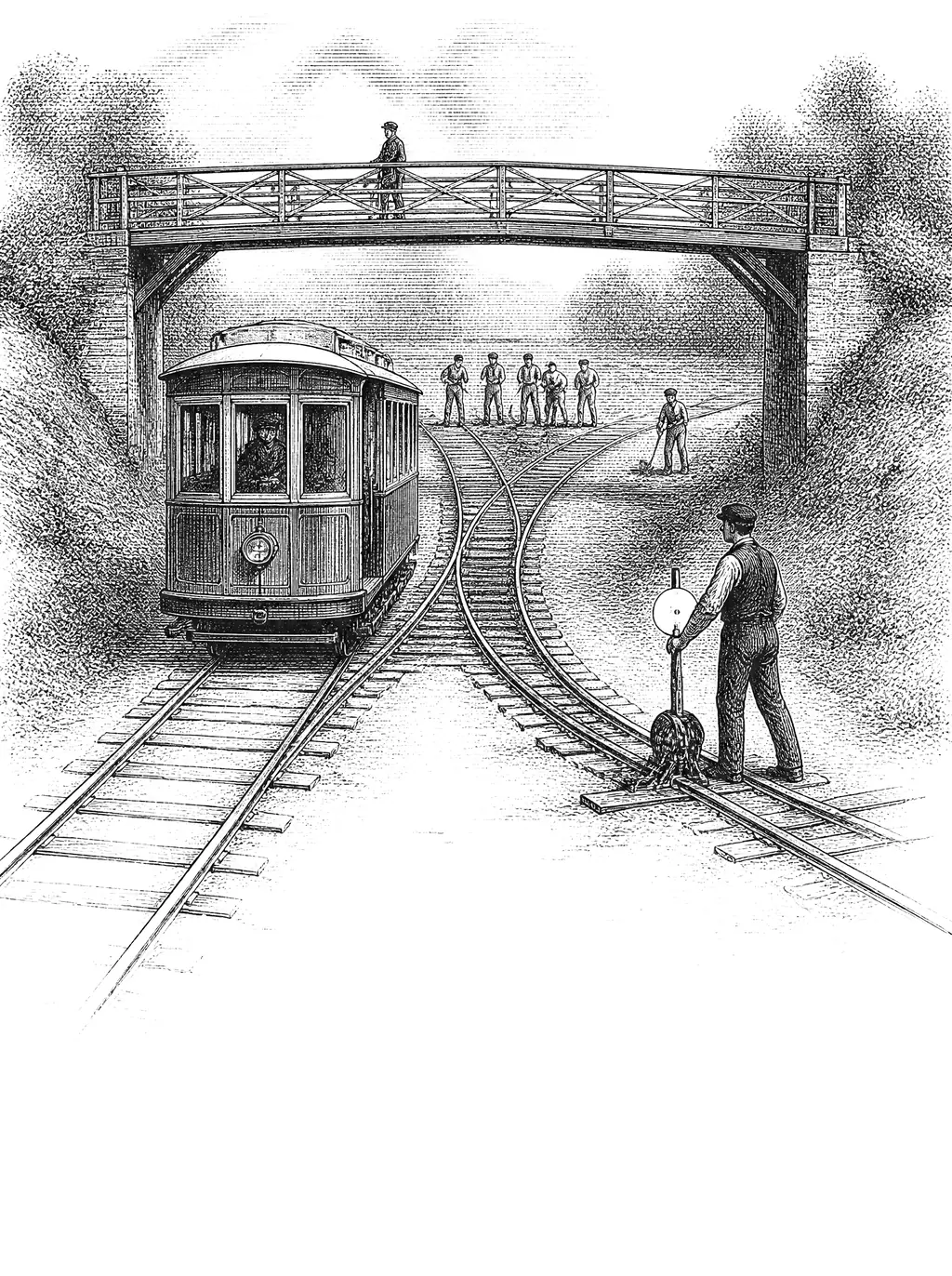
A runaway trolley is about to kill five workers on the track ahead. You are standing by a lever that can divert it onto a side track, where it will kill one worker instead. Almost everyone asked says pull the lever. Change one detail of the story, and that near-unanimous answer falls apart. Put you on a footbridge above the track, next to a man heavy enough to stop the trolley if pushed, and the numbers stay the same: one dies, five live. Most people now refuse. The trolley problem is the puzzle of what changed, and whether the change can be defended or is only a flinch.
The world it came from
Philippa Foot taught at Somerville College, Oxford, alongside Elizabeth Anscombe, Iris Murdoch, and Mary Midgley. In 1945 she saw the newsreels from the death camps and decided the fashionable view that moral claims only express feelings could not be right; some things are simply wrong, and philosophy had to say why. Her 1967 paper on abortion and the doctrine of double effect tested that doctrine, the Catholic principle that a harm foreseen differs from a harm intended. The tram driver appears there as one case among several, next to a judge asked to frame an innocent man to stop a riot. Foot's question was why the driver may steer and the judge may not, when both trade one life for five.
The idea
Philippa Foot's original case is the driver at the wheel, with no lever and no bystander: five deaths ahead, one death on the side track, and steering feels clearly right, better one death than five. Later writers add the bystander at the lever, and then a second version: push a large stranger off a bridge to physically stop the trolley, same five saved, one killed. Foot's own explanation was not double effect but a distinction between negative duties, not to harm, and positive duties, to help. The driver must kill one or kill five; either way he violates a negative duty, so he minimizes. The judge, and the pusher on the bridge, would violate a negative duty to satisfy a positive one, and Foot held that negative duties carry more weight.
How the reasoning runs
First, fix the intuitions: steering is permitted, pushing is not, and a surgeon may not kill one healthy patient to distribute organs to five. Second, note that a pure count of lives cannot explain the pattern, since the numbers match in every case. Third, propose a distinction and test it. Double effect says the pusher intends the man's death as a means while the driver merely foresees it. Foot found this too weak, since the driver who steers toward one also uses the side track knowing what it holds. Her alternative: the driver is choosing between two ways of killing, the surgeon between killing and failing to save. Fourth, whatever distinction survives every case is the one doing the moral work.
Seen in life
You run the intensive care unit on a night when one ventilator is left. A patient on it is unlikely to survive; three in the corridor probably would. Nobody asks you to push anyone off a bridge. But taking the machine from the first patient to save the three feels different from never having put her on it, though the count of the dead is the same. That difference is the trolley problem in a hospital gown. Triage protocols exist because clinicians could not settle it case by case at three in the morning. Whatever rule your hospital adopted, it took a position on whether withdrawing is killing or letting die, and it took it long before you walked in.
Why it matters
The math is identical in both versions, yet most people who approve of steering refuse to push. The trolley problem exists to make that gap visible and force a reason for it, rather than let the inconsistency sit unnoticed. Whatever principle explains the gap has to do real work outside toy examples too. It marks the line between killing and letting die, which runs through end-of-life medicine. It marks the line between harming as a means and harming as a side effect, which runs through the law of war. And it tests whether utilitarian arithmetic is the whole of morality or only part of it. Each answer has real consequences for how we build rules and who they let die.
“five men are working on one track and one man on the other”
From the source
Foot's 1967 paper sets the scene in one plain sentence: “five men are working on one track and one man on the other.” The scenario appears almost in passing, inside a paper actually about a different question, before it went on to outlive the essay that introduced it. In Foot's version the driver of a runaway tram can only steer from one narrow track onto another. Anyone on the track he enters is bound to be killed. She sets this next to a judge who can prevent a mob from killing five hostages only by framing and executing an innocent man, and asks why steering seems permitted while framing seems monstrous. The rest of the paper argues about what the difference is.
The pushback
Critics call the whole genre a parlor trick: real moral decisions rarely involve strangers, a single lever, and outcomes you can be certain of in advance, so intuitions trained on toy trolleys may not transfer cleanly to messier real dilemmas like triage, war, or self-driving cars. A harder objection targets the method itself. The problem treats the gut reactions of people asked about trolleys as data that any theory must fit. But the reaction against pushing may be nothing more than squeamishness about touching, a reflex evolution installed for reasons that have nothing to do with what is right. If so, the theories built to honor that reflex are elaborate explanations of a bias.
The reply
Defenders answer the parlor-trick charge by pointing out that the artificiality is the point. Strip away uncertainty and personal ties, and what is left is the structure, which is the only thing a principle can be about. Real cases add noise, not a different moral logic. The bias objection is harder, and Foot's tradition answers it only in part. A reflex can still track something real, in the way that disgust tracks contamination. And the negative-duty distinction is not only a feeling; it appears in the law of every society and in the way we hold people responsible for what they do rather than what they allow. Whether that settles the matter or merely repeats the intuition in a louder voice is still open.
Where it went next
Judith Jarvis Thomson gave the problem its name in 1976, moved the driver off the tram and put a bystander at a switch, and in 1985 added the man on the footbridge. Frances Kamm spent a career mapping the variants. In 2001 Joshua Greene put people in a brain scanner while they considered the cases and found that the footbridge version lit up emotional regions the switch version did not, launching a field of moral psychology. When self-driving cars arrived, engineers and regulators found themselves reading Foot; MIT's Moral Machine project collected millions of trolley verdicts from around the world. The problem became a meme, a punchline, and a staple of first-year ethics, which is a strange afterlife for a footnote about abortion.
Where this leads
Kant's categorical imperative offers one way to explain the driver-versus-bridge gap: using a person merely as a means, by pushing them, differs in kind from causing their death as a side effect of saving others, even when the body count matches exactly. Humanity as an end states that thought in its sharpest form and is the formula most trolley discussions end up reaching for. The greatest happiness principle stands on the other side of the track: if only the sum matters, then pushing is not merely allowed but required, and the reluctance you feel is a bias to be trained away. The trolley is the place where these two families of ethics meet and cannot both be right.