Symposium · Ethics · Pl. 2Immanuel Kant · 1724–1804
The Categorical Imperative
One step too soon
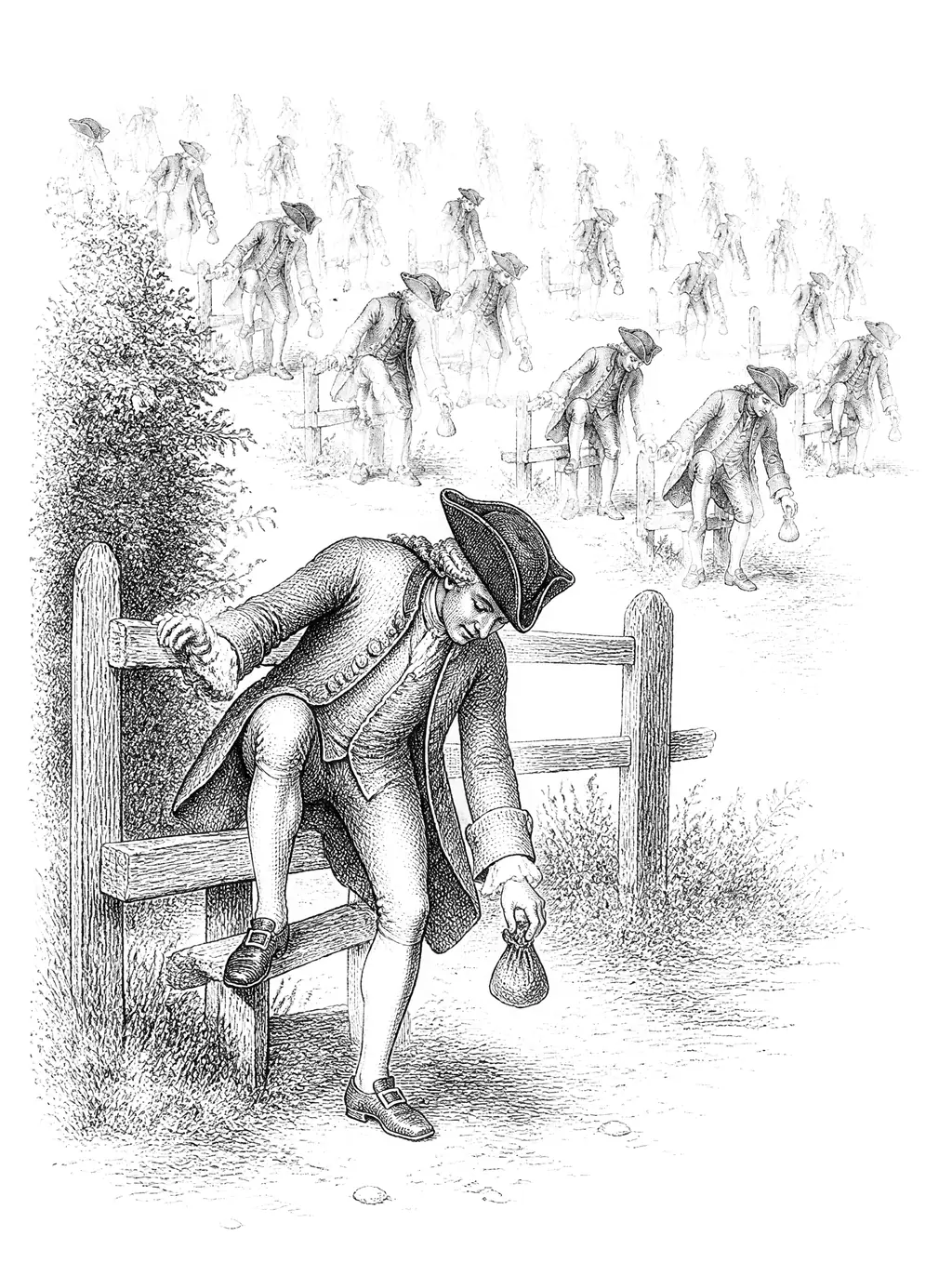
You already ask yourself 'what if everyone did this?' before cutting in line or skipping a debt. Kant thought that instinct was the whole of morality in miniature, and that most people stop reasoning one step before the question actually finishes doing its work. The missing step is not to imagine whether a world of line-cutters would be unpleasant. It is to ask whether such a world could exist at all. A line that everyone cuts is not a line. A promise that everyone breaks when convenient is not a promise, and nobody would accept one. The test is not about consequences. It is about whether your rule survives being everyone's rule, or eats itself.
The world it came from
Kant published the Groundwork of the Metaphysic of Morals in 1785, in Königsberg, under Frederick the Great, a king who allowed argument so long as it did not disturb obedience. Kant was sixty-one. He had spent the previous decade on the Critique of Pure Reason, which limited what reason could know, and now he wanted to show what reason could command. The rival accounts of morality all rested on something outside reason: on feeling, in Hume and the British moralists; on God's will, in the theologians; on happiness, in nearly everyone else. Kant thought each of those made duty conditional on a fact that might change. He wanted a principle that would bind any rational being anywhere, and that an ordinary person already used without knowing its name.
The idea
The categorical imperative asks you to act only on a rule you could will to become a universal law, one that everyone, everywhere, could follow at the same time without contradiction. If the rule breaks down or defeats its own purpose once everyone follows it, the action fails the test and is wrong. Kant calls the rule a maxim: the principle you are actually acting on, stated honestly, with its purpose included. The imperative is categorical because it does not depend on what you want. If you want to be trusted, keep your promises is hypothetical; drop the want and the command lapses. Keep your promises, full stop, is what the test yields, and it holds whether or not you care about trust.
How the reasoning runs
Begin with what a moral command must be like. It must bind you regardless of your desires, or it would be advice, not duty. Second, a command that does not draw its force from any desire can draw it only from the form of law itself, from being a rule that holds for everyone. Third, so the only test available is whether your maxim can be a law for all. Fourth, run the test. Some maxims cannot even be conceived as universal: a false promise, universalized, destroys promising, so the maxim contradicts itself. Others can be conceived but not willed: a world where no one helps anyone is possible, but you cannot will it, since you will sometimes need help. Both failures mark a duty. What passes is permitted.
Seen in life
You find a wallet with two hundred in cash and a driving licence. Nobody saw. State your maxim honestly: when I can keep found money without being caught, I keep it. Now make it everyone's law. In that world, found money is never returned, so nobody who loses a wallet expects it back, and the concept of lost property has become a lottery for whoever walks by. You could probably live in that world. Then ask the harder question: could you will it, knowing that you also lose things? Kant says you cannot, because you are not willing a rule for others while exempting yourself; you are willing it for you. Hand the wallet in. The test did not consult your feelings.
Why it matters
This gives you a duty-based test for right and wrong that does not depend on outcomes, mood, or who happens to be watching. Lying only works because most people tell the truth; will a world where everyone lies, and the trust that makes lying useful in the first place collapses along with it. It also explains why the excuse everyone reaches for, that just this once will not hurt, is not an excuse. The wrong of the exception is not the harm it does but the exemption it claims: you are treating yourself as the one person the rule does not bind. Kant's test catches exactly that move, which is the move almost every wrong act begins with.
“Act only on that maxim whereby thou canst at the same time will that it should become a universal law.”
From the source
Kant states the whole rule in a single sentence: “Act only on that maxim whereby thou canst at the same time will that it should become a universal law.” — Fundamental Principles of the Metaphysic of Morals, translated by Thomas Kingsmill Abbott, 1785. The sentence appears in the second section of the Groundwork, after Kant has argued that there can be only one categorical imperative. He follows it with four examples: a man contemplating suicide, a man who needs money and considers a false promise, a man who lets his talents rust, and a man who refuses to help anyone. The first two maxims cannot be conceived as laws; the last two cannot be willed.
The pushback
Critics point out the test can be gamed by describing your rule narrowly enough: 'lie only on a Tuesday to a stranger named Bob' universalizes without any contradiction at all. Kant's defenders answer that the maxim has to describe your actual reason for acting, not a loophole built solely to dodge the test. Hegel pressed a deeper version: the test is an empty formalism. Any maxim can be universalized without contradiction if you do not already care about the institution it would destroy; a world without promises is not self-contradictory, only unpleasant. Mill added that the moment Kant shows the unpleasantness, he is arguing from consequences. And the murderer at the door, asking where your friend is hiding, seems to show that an exceptionless rule against lying is monstrous.
The reply
To Hegel, Kant's defenders reply that the contradiction is not in the world but in the will. A false promiser wills that promising exist, so that he can exploit it, and wills that it not exist, since his maxim universalized abolishes it. That is a contradiction in what he wants. To Mill they answer that Kant is not counting harms but showing that the maxim depends on its own exception. The murderer at the door is harder. Kant himself, in 1797, said you may not lie even then, and most Kantians think he was wrong. Christine Korsgaard argued that the murderer has forfeited the conditions of honest dealing. That saves the theory at the cost of admitting that Kant did not apply it well.
Where it went next
Hegel's critique set the terms of German ethics for a century. Schopenhauer mocked the imperative as theology in disguise. In the twentieth century it came back through Rawls, who called his theory Kantian and turned the universal-law test into the veil of ignorance, and through R. M. Hare, whose universal prescriptivism is Kant's test rebuilt in the philosophy of language. Jürgen Habermas turned it into discourse ethics: a norm is valid if all affected could accept it in free argument. Onora O'Neill and Christine Korsgaard made Kant readable again. Derek Parfit's On What Matters in 2011 argued that Kant's formula, properly stated, converges with rule consequentialism. The test is also what every child means by the words, but what if everybody did that.
Where this leads
The trolley problem is a natural stress test for this idea: does pushing a stranger off a bridge treat him only as a means to an end, in a way that steering a trolley toward him does not, even though both actions end his life? The dichotomy of control is an older cousin from a different family. Epictetus and Kant agree that the only thing wholly in your power, and so the only thing that can be judged, is your will; they disagree about almost everything else. Humanity as an end is Kant's own second formula, the one he thought said the same thing as this one in words you could feel. Read them in order, and watch one law try on two shapes.