Symposium · Philosophy of Religion · Pl. 5Ecclesiastes · c. 3rd century BC (scholarly dating)
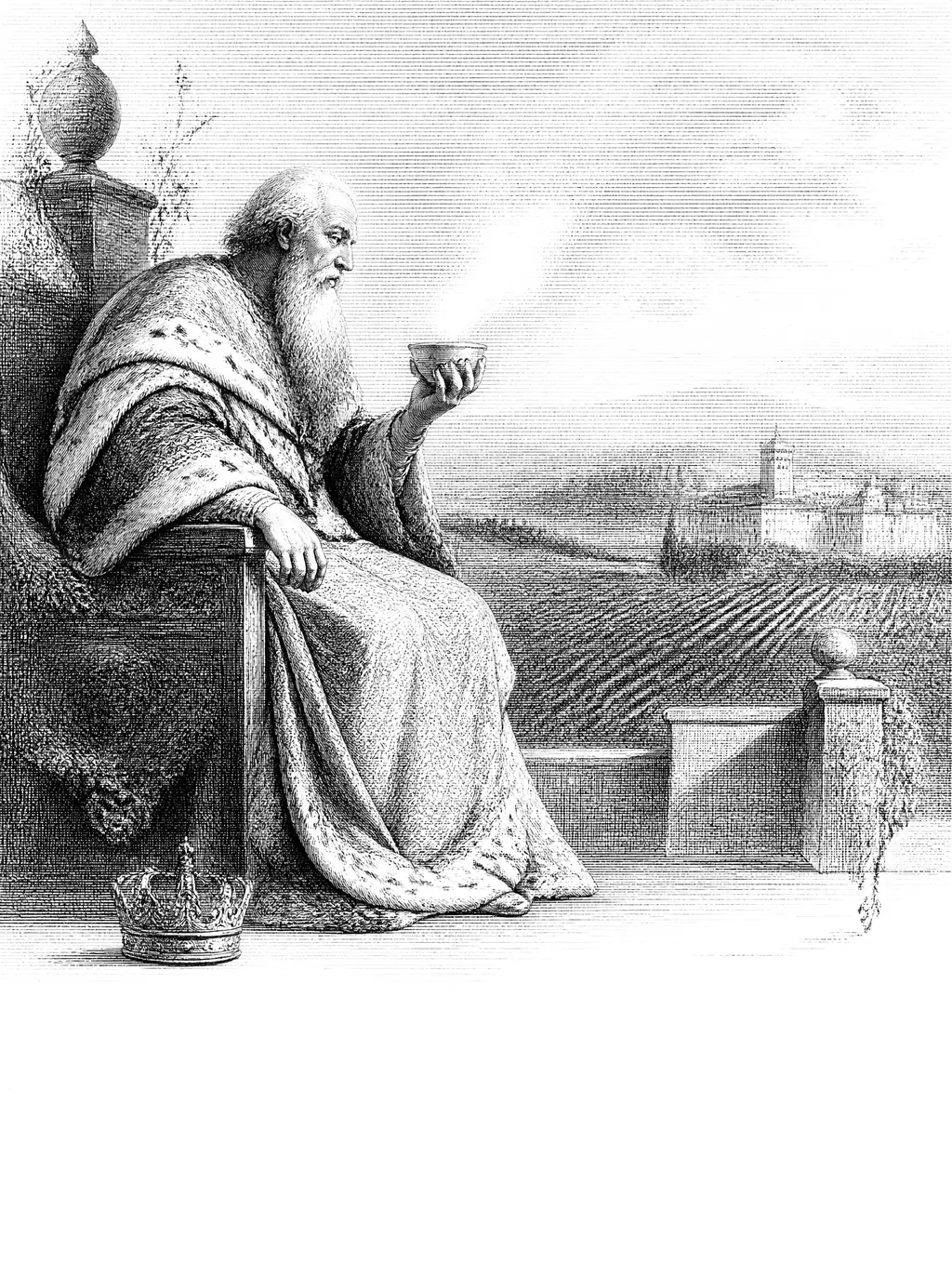
Vanity of Vanities
A king who tried everything
Ecclesiastes is framed as the reflections of a king who denied himself nothing, building houses, planting vineyards, gathering wisdom and wealth and pleasure without restraint. Rather than a record of triumph, the book reads as a sober audit, tallying up what all that accumulated success actually amounted to in the end. The Hebrew word behind vanity is hevel: vapour, breath, mist. The Preacher is not saying that life is worthless. He is saying that it will not hold still long enough to be grasped.
The world it came from
Ecclesiastes belongs to the wisdom books of the Hebrew Bible, next to Proverbs and Job. The speaker calls himself Qoheleth, the one who gathers or addresses an assembly, and presents himself as a son of David ruling in Jerusalem, which tradition read as Solomon. Most scholars now date the book to the Persian or early Hellenistic period, roughly the fourth or third century BC, partly on the evidence of its language, which includes Persian loanwords. That places it in a Jerusalem under foreign rule, where a small province's scribes had met Greek trade and perhaps Greek thought. Its place in the canon was debated by the rabbis, who worried about its contradictions. It was kept.
The idea
Vanity of vanities, saith the Preacher, vanity of vanities; all is vanity. Every human effort under the sun, on this account, from wisdom to labor to pleasure, ultimately amounts to a breath, something that vanishes the moment you try to hold onto it, and grants no lasting advantage the grave will not eventually erase entirely. The refrain is under the sun. Everything measured on that horizon comes to breath. The Preacher does not deny that something lies above the sun; he denies that a person can reach it by accumulating anything below it.
How the reasoning runs
The book proceeds as an experiment. Qoheleth sets himself to test each candidate for lasting gain. Wisdom: the wise die like fools and are forgotten as fast. Pleasure: he tries every kind and finds it a chasing after wind. Labour: whatever you build passes to an heir who did not earn it and may squander it. Wealth: the more you have, the more mouths there are to eat it, and you cannot take it out. Justice: the righteous and the wicked meet the same end. The premise doing the work is death, which erases every ledger. Given that premise, no advantage accumulates, so striving for one is vapour. What survives is small: eat, drink, enjoy your work, because the enjoyment is present and the profit is not.
Seen in life
You finish the project that consumed two years, the launch goes well, and by the following Tuesday there is a new project and nobody mentions the old one. You knew this would happen. It still lands like a small bereavement. The Preacher would say you have discovered hevel: not that the work was pointless, but that you were trying to store something in it that work cannot hold. His advice is oddly modern. Enjoy the meal at the end of the launch. Enjoy the colleague you built it with. Those were real and are gone, and they were the point. The profit you were chasing, the standing, the permanent record, was never available to anyone, king or intern.
Why it matters
This gave scripture its own internal voice of stark, unresolved doubt about the value of striving and achievement, refusing the easier and more comforting religious answer that virtue and hard work reliably pay off in the end. It let generations of later readers find their own weariness with ambition already spoken in ancient, canonical words. It also gave a religious tradition permission to be honest about death and disappointment without leaving the faith to do it. The book's presence in the canon says that the weary verdict is not blasphemy. It is one voice in the assembly, and it was kept.
“Vanity of vanities, saith the Preacher, vanity of vanities; all is vanity.”
From the source
The Preacher opens with the verdict that structures the entire book: “Vanity of vanities, saith the Preacher, vanity of vanities; all is vanity.” He goes on to survey wisdom, pleasure, labor, and wealth in turn, finding the identical hollow verdict waiting patiently at the end of every single one of them. The book's most quoted passage comes later: to every thing there is a season, a time to be born and a time to die, a time to plant and a time to pluck up. The conclusion returns to what can be held: to eat, to drink, and to enjoy the good of one's labour, which the Preacher calls the gift of God.
The pushback
Isn't total vanity too bleak a summary for a book that ultimately still counsels its reader to eat, drink, and find enjoyment in ordinary daily work, rather than collapsing entirely into despair or paralysis? The Preacher's conclusion is less a call to give up than an argument for modest, present contentment once grand ambition has honestly been abandoned. A second objection targets the ending. The final verses tell the reader to fear God and keep his commandments, because he will judge every deed. If a judgement is coming, then striving does pay off after all, and the whole audit was written under a false premise.
The reply
Defenders of the book read the enjoyment passages as its true conclusion, not a consolation prize. Contentment with the present is what remains once the profit motive is seen through, and that is a positive teaching, not a collapse. On the ending, most scholars think the last verses were added by an editor to make the book safe for the canon, a frame that pulls against the body. Others argue that fear of God and hevel are compatible: you keep the commandments because they are right, not because they buy an advantage, which is exactly the Preacher's point. Either way the book leaves the tension unresolved. It gives the reader the audit and the epilogue and does not say which to trust.
Where it went next
Ecclesiastes has been the favourite biblical book of people who are not sure they believe in the Bible. Jerome's commentary made it a manual of contempt for the world; Luther read it as a defence of ordinary vocation. Thomas Wolfe called it the greatest single piece of writing he knew. Tolstoy quoted it at length in A Confession as the voice of his own crisis. Hemingway took The Sun Also Rises from its first chapter, and Pete Seeger set chapter three to music as Turn! Turn! Turn!, which the Byrds made a number one record in 1965. Philosophers link it to Epicurus, to the Stoics, and to Camus, and the pairing with the absurd is now a standard one.
Where this leads
The absurd shows Albert Camus reaching, over two thousand years later, for a strikingly similar diagnosis through an entirely secular route, concluding that the universe offers no ultimate meaning to human striving, and asking what a person can honestly do once that hard, deflating verdict has finally been accepted in full. Where wast thou is the other wisdom book that refuses the easy answer. Job hears the world's scale from a storm and falls silent. The Preacher surveys the same scale from his palace and reaches for a cup of wine.