Symposium · Pragmatism · Pl. 5Ralph Waldo Emerson · 1803–1882
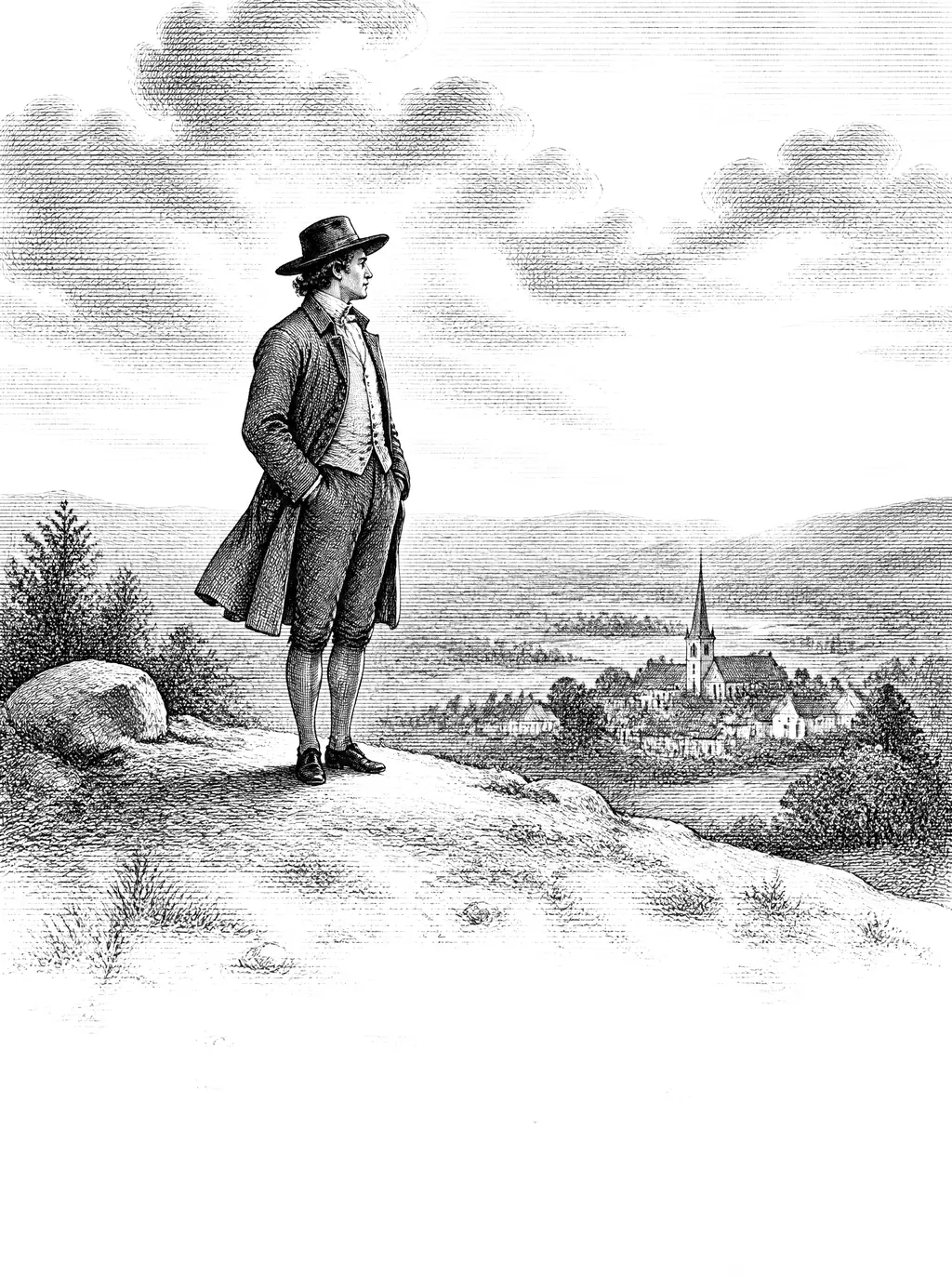
Trust Thyself
A private thought treated as suspect
Emerson observed that people routinely dismiss their own genuine convictions the moment they recognize them, only to later admire the identical idea once it comes back to them dressed in the authority of some famous thinker. His whole essay argues against that reflexive self-distrust, insisting that a person's own honest judgment deserves better treatment. You have felt the moment he describes. A thought occurs to you, you set it aside as too simple, and a month later you read it in a book and feel the small shame of recognition. Emerson wants you to notice that the thought was yours first, and to ask why you needed the book's permission.
The world it came from
Emerson published Self-Reliance in his Essays of 1841. He was thirty-seven, living in Concord, Massachusetts, nine years out of the Unitarian ministry he had resigned when he could no longer administer communion in good conscience. His first wife had died in 1831; his first son would die a year after the essay appeared. In 1838 his Divinity School Address had scandalized Harvard by telling its graduating ministers to preach from their own experience rather than from tradition, and he was not invited back for decades. The essay grew out of lectures given through the 1830s. The problem it answers is a young country's problem: how a people with no ancient culture of their own could stop deferring to Europe and think.
The idea
Trust thyself: every heart vibrates to that iron string. To believe your own thought, to believe that what is true for you in your private heart is true for all men, that is genius, Emerson argues, since a genuinely original mind is simply one confident enough to voice its own honest perception rather than waiting for permission from tradition or authority. Self-reliance is not self-regard. The self Emerson trusts is not your preferences or your mood; it is the faculty that perceives, which he thinks runs through everyone alike, so that trusting it is trusting something larger than you. That is why he can say the private conviction is true for all men. He is pointing at what the individual has access to.
How the reasoning runs
Step one: every person perceives directly, before any tradition tells them what they see. Step two: the perception is the only thing anyone has to offer; a repeated opinion adds nothing that its original perceiver did not already contribute. Step three: society, by rewarding conformity, trains people to distrust their perception and repeat instead, so that most speech is quotation. Step four: therefore the great thinkers were great precisely because they did not defer. To imitate them is to miss what made them worth imitating. Step five: consistency with your past self is just deference to another authority, and Emerson dismisses it as a hobgoblin. Conclusion: trust the perception, speak it, and accept that you will be misunderstood, as every original mind has been.
Seen in life
You are in a design review and the senior engineer proposes an architecture that seems wrong to you. You cannot yet say why; you only see it. The room agrees with him. The Emersonian move is not to shout him down. It is to refuse to discard your perception because it lacks a sponsor. Say it plainly: this looks wrong to me, here is what I see. You may be mistaken, and the review will show it. But watch what happens when you do not speak. Six months later a consultant says what you saw, and everyone nods. That is the moment Emerson describes, the thought coming back with alienated majesty, and the shame is instructive. The perception was as good the first time. What it lacked was your trust.
Why it matters
This gave American individualism one of its founding philosophical statements, treating self-trust not as arrogance but as the very foundation of intellectual and moral integrity. It profoundly shaped William James, a generation later, whose own emphasis on individual, first-hand experience over inherited system carried Emerson's self-reliance directly into pragmatism. Emerson belongs on this shelf for that reason. He was not a pragmatist, and the name did not exist in his lifetime. But James grew up in a house Emerson visited, spoke at his centenary in 1903, and took from him the conviction that experience, not system, is where philosophy must start. Dewey called him the philosopher of democracy the same year. The lineage runs through them.
“Trust thyself: every heart vibrates to that iron string.”
From the source
Emerson states the principle in its most compressed form: “Trust thyself: every heart vibrates to that iron string.” Just before this, he claims that to believe your own thought, and to trust that your own private conviction speaks for all people, is itself the very definition of genius. The essay then names the enemies of self-trust: society, which he calls a conspiracy against the manhood of its members; a foolish consistency, which he calls the hobgoblin of little minds; and travel, imitation, and the worship of the past. Its argument is delivered in sentences designed to be remembered, which is part of why it has been quoted by people Emerson would not have recognized.
The pushback
Doesn't unqualified self-trust risk licensing stubbornness, prejudice, and confident error just as readily as genuine insight, since plenty of deeply held private convictions turn out to be simply wrong once tested against evidence or other people's honest disagreement? Emerson's essay largely assumes a naturally virtuous, well-formed self, a premise not every reader has been willing to grant him. A harder objection comes from the pragmatists themselves. If truth is what a community of inquirers would settle on, as Peirce held, then the private heart is exactly the wrong court of appeal. Self-reliance looks like the method of tenacity, the first and worst of Peirce's four ways of fixing belief. On that reading Emerson is not an ancestor of pragmatism but the thing it was invented to correct.
The reply
The Emersonian reply is that self-trust is the beginning of inquiry, not its end. The perception you refuse to discard is a hypothesis, and Emerson expects it to be tested by being spoken; that is why the essay is about speech as much as belief. On this reading he is closer to Peirce's abduction than to tenacity: he is defending the guess against a culture that will not let it be made. James read him that way, and Dewey did too, finding in Emerson a democrat who trusted ordinary perception because he thought everyone had it. The reply is partial. Emerson never says how a self-trusting person should treat a contrary result. The pragmatists supplied the missing half: trust the perception, then let the world grade it.
Where it went next
Emerson's line runs into American philosophy through two doors. James took the primacy of first-hand experience and the suspicion of systems. Dewey took the democratic faith that ordinary people can think, and in 1903 called Emerson the philosopher of democracy. Nietzsche, who read Emerson in translation as a schoolboy, took self-trust further than Emerson would have followed. In the twentieth century Stanley Cavell argued that Emerson was a philosopher in the full sense and that American thought had been evading him; Cornel West's American Evasion of Philosophy in 1989 opened its history of pragmatism with Emerson rather than Peirce. Outside philosophy, Self-Reliance became a founding text of American self-help, usually with the demanding parts left out.
Where this leads
The willing devotion of a person to a cause shows Josiah Royce, writing decades later, championing what looks like the opposite value, loyal devotion to something larger than the private self, a tension between self-reliance and self-surrender that runs through much of the American philosophical tradition Emerson helped to found. The will to believe is where James took Emerson's inheritance. Emerson says trust the private conviction; James asks when you are entitled to, and answers: when the question is live, forced, and momentous, and evidence cannot decide. That is self-reliance with a rulebook. Read the two together and you can watch a sermon become an argument.