Symposium · Pragmatism · Pl. 13Josiah Royce · 1855–1916
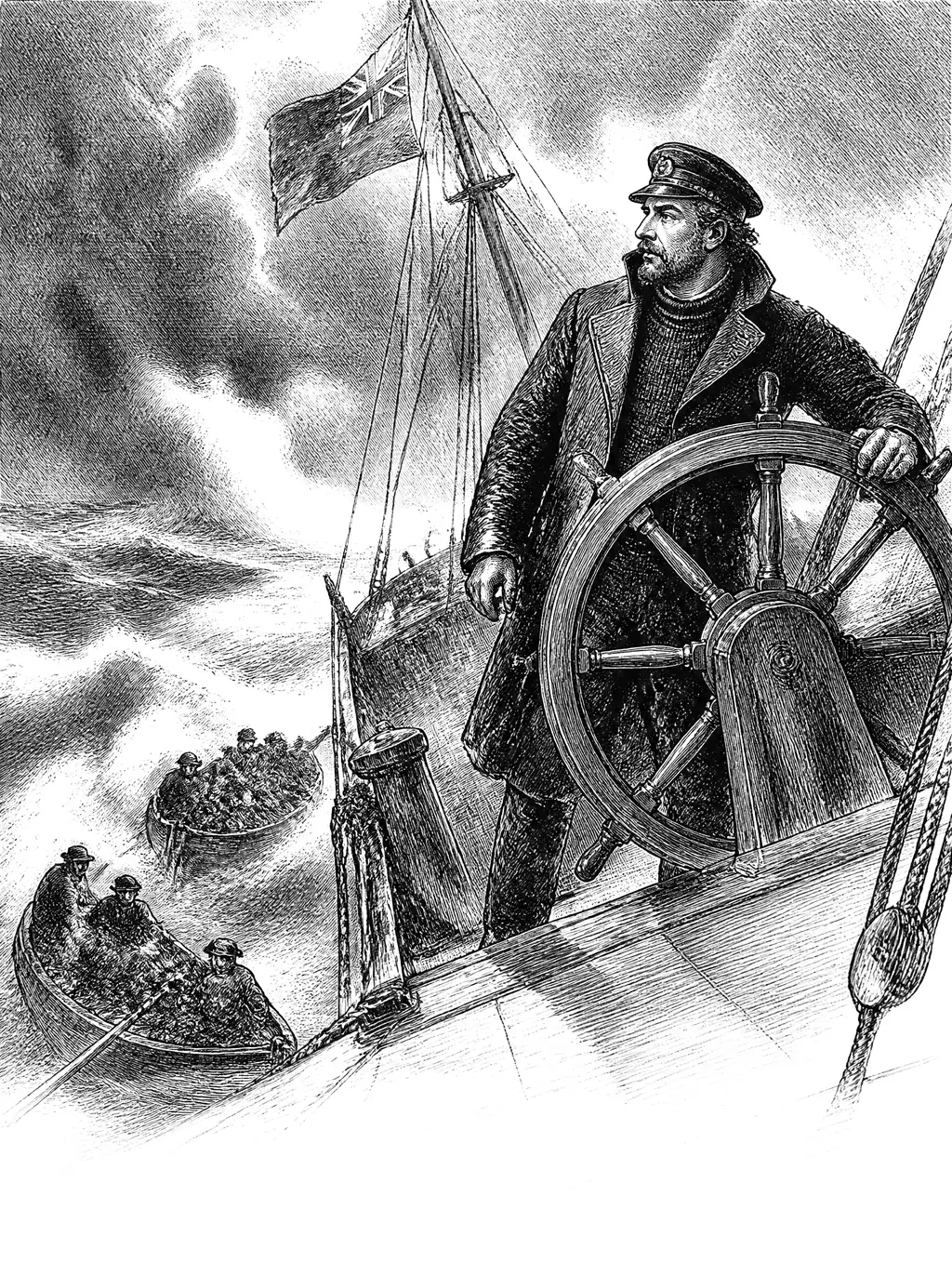
The Willing Devotion of a Person to a Cause
A common word, rarely examined
Everyone praises loyalty, Royce observes, yet almost no one stops to define what the word actually names once its familiar warmth is set aside. He sets out to give loyalty a precise philosophical definition, one general enough to cover the patriot, the martyr, and the ship's captain who goes down with his vessel alike. The timing was pointed. Royce was writing for an America he thought had lost the capacity for devotion: mobile, commercial, suspicious of every cause. He was also writing against his closest friend, William James, whose philosophy seemed to him to leave the individual with nothing to be loyal to but himself.
The world it came from
Royce gave The Philosophy of Loyalty as lectures at the Lowell Institute in Boston in 1907 and published them in 1908. He was fifty-two, born in a California mining camp, educated at Berkeley and in Germany, and at Harvard since 1882, where James had brought him and where the two argued for thirty years. James's Pragmatism had appeared the year before. Royce was an absolute idealist who nevertheless called himself a pragmatist of a sort, and the loyalty lectures were his attempt to show that his idealism cashed out in a practical ethics. His private life added weight: his eldest son was confined for mental illness in 1908. The problem the lectures answer is what a person can be loyal to once tradition has stopped commanding loyalty.
The idea
By loyalty, as you remember, I mean in this preliminary view of loyalty, the willing and practical and thoroughgoing devotion of a person to a cause. This devotion, Royce insists, must be freely chosen rather than merely imposed, sustained through practical action rather than mere sentiment, and directed at something the loyal person genuinely experiences as larger than their own private self. A cause, for Royce, is never just a person and never just an abstraction. It is a tie that binds several people into one life, a friendship, a science, a country, as real as a family. Loyalty is what makes a self, because a self without a cause is only a bundle of moods, and the loyal person has chosen what to be.
How the reasoning runs
Step one: a moral life needs a plan, and no plan comes from inside the private self. Step two: so the self must find its plan in something outside it, and that something must be shared, because a purely private plan collapses back into impulse. Step three: devotion to such a shared thing is loyalty, and it gives the self a unity nothing else provides. Step four: but loyalties conflict, and some causes are evil; praising the pirate's devotion cannot be the whole story. Step five: so ask which causes are fit for loyalty. The answer is causes that do not destroy the loyalty of others. Conclusion: the supreme principle is loyalty to loyalty, choose and serve causes that increase the amount of loyalty in the world.
Seen in life
You have been offered a role at a competitor. Your current team is small, and your leaving will hurt them; the new company pays more. Royce would not tell you to stay. He would ask what each choice does to loyalty as such. Leaving in a way that breaks trust, taking a client list or going quiet for a month, damages the capacity of everyone involved to be loyal again. Leaving with notice, with the handover done, and with your reasons stated, may end one loyalty while honoring it. The test is not which cause you pick. It is whether the way you serve it leaves other people's causes standing. Royce thought that test could settle most conflicts of loyalty.
Why it matters
This gave moral philosophy a working definition of loyalty precise enough to analyze rather than simply admire, letting Royce ask which causes actually deserve this kind of devotion, and building toward his broader argument that the highest loyalty is loyalty devoted to fostering loyalty itself, wherever it is found among others. It also gives you a reply to a common fear: that commitment to anything makes you narrow. Royce's answer is that it depends on the cause. A loyalty that respects other loyalties widens the self, because you become answerable to everyone whose devotion you are protecting. The narrow person is not the loyal one. It is the one who has nothing to be loyal to.
“By loyalty, as you remember, I mean in this preliminary view of loyalty, the willing and practical and thoroughgoing devotion of a person to a cause.”
From the source
Royce offers his working definition directly: “By loyalty, as you remember, I mean in this preliminary view of loyalty, the willing and practical and thoroughgoing devotion of a person to a cause.” A cause worthy of loyalty, he adds, must seem to the loyal person larger than his own private, individual self. The definition comes from the first lecture and is refined across the rest. Royce tests it against the samurai code, a Speaker of the Commons who refused to answer his king, and the American labor movement, before arriving at loyalty to loyalty in the third lecture. The final lecture ties it to his idealism: the causes we serve are real, he argues, because they are fragments of one life that includes all of us.
The pushback
Doesn't defining loyalty this broadly risk praising devotion to genuinely harmful causes just as readily as noble ones, since fanatics and tyrants can be every bit as willing, practical, and thoroughgoing in their own devotion as any hero? Royce's later chapters try to address exactly this by distinguishing loyalty to a cause from loyalty that respects the loyalty of others. A harder objection is that loyalty to loyalty is empty. It tells you to protect devotion in general, but every real conflict is between particular loyalties, and the principle does not say which wins. It also seems to reward quantity: a cause that produces many small loyalties would beat one that produces a single deep one. Critics have asked whether that is a moral principle or a census.
The reply
Royce's reply is that the principle is a constraint, not a calculator. It rules out causes that live by destroying other loyalties, and within the remaining field it leaves you free to choose. The choice, he says, is yours, and once made it must be served as if it were absolute; that is what makes it loyalty rather than preference. He denies the quantity reading explicitly and never proposes counting. That answers the emptiness charge only partly. The principle sorts causes into permitted and forbidden and then falls silent, and Royce's idealism fills the silence with a faith that the causes we serve are parts of one whole. If you do not share the faith, you are left with the constraint, which is real but thin.
Where it went next
Royce died in 1916, and his idealism went out of fashion almost at once. Loyalty survived it. His last major book, The Problem of Christianity, in 1913, turned the cause into a community of interpretation, an idea he took from Peirce and passed on to later theories of interpretation. George Herbert Mead, who studied with him, and Gabriel Marcel, who wrote a book on him, both engaged his account of the self as constituted by devotion. The ethics of loyalty was revived in the 1980s by communitarians such as Michael Sandel, who argued against liberal individualism in a spirit close to Royce's. His name is now most often heard in debates about patriotism and about whether an employee owes a firm anything, both questions he asked in 1908.
Where this leads
Trust thyself shows Ralph Waldo Emerson championing what looks like the opposite value decades earlier, self-reliant individualism rather than devoted service to a cause beyond the self, a tension between self-trust and self-surrendering loyalty that runs through much of American moral philosophy in this period. Eudaimonia is the classical background. Aristotle holds that a good life is activity in accordance with virtue, and that it is lived among friends and in a city. Royce's loyal self is that account restated for a country that had no city to belong to and had to choose one. Read the two together and loyalty looks less like a Victorian virtue and more like an answer to Aristotle's question.