Symposium · Epistemology · Pl. 15William James · 1842–1910
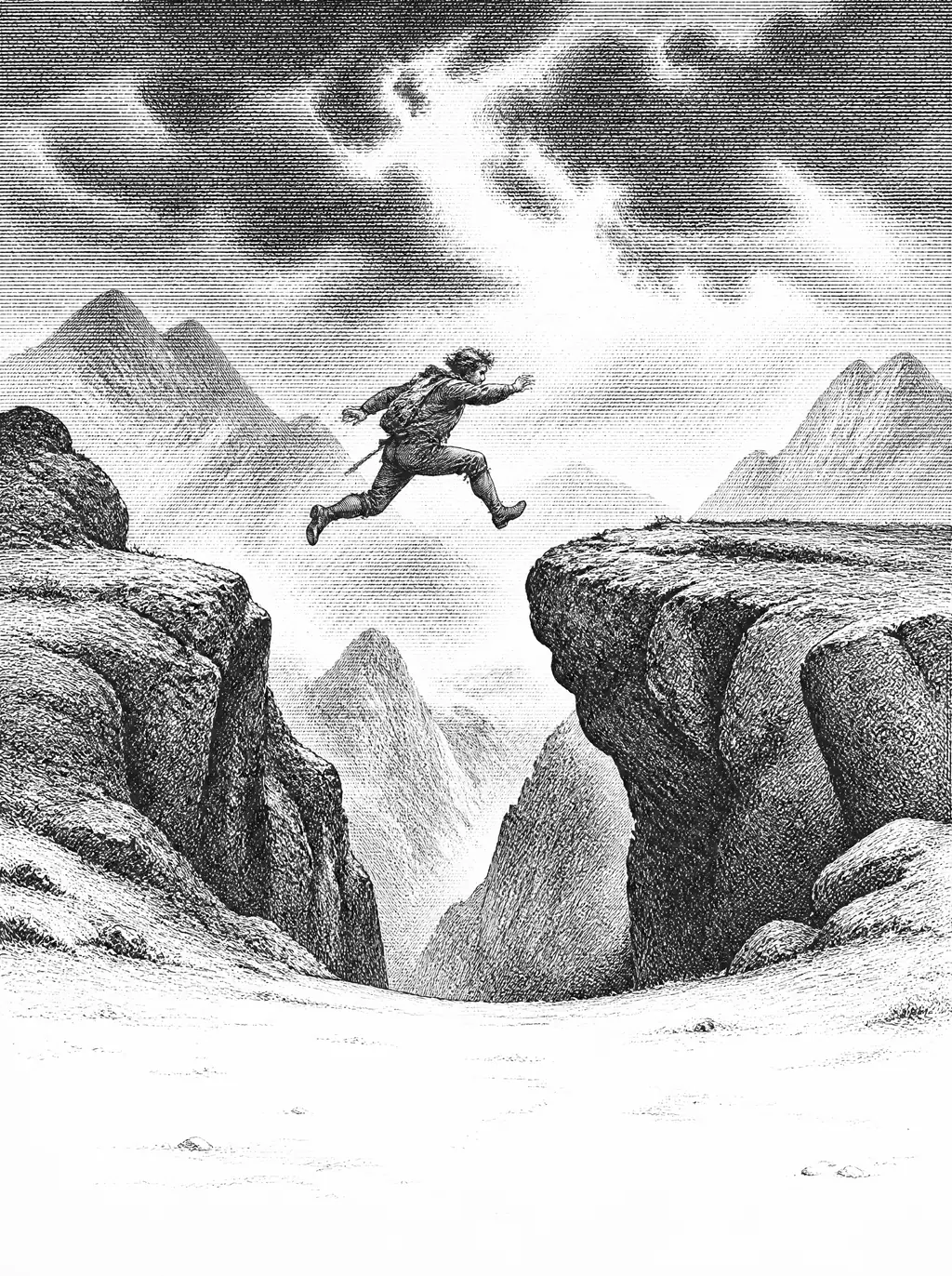
The Will to Believe
A question the evidence can't settle
Whether to trust a stranger, commit to a partner, or believe your own effort can still change an outcome: none of these questions come with enough neutral evidence to force a rational verdict either way. James noticed that refusing to decide is not actually neutral either. It is itself a choice, and often the one option guaranteed to close off the outcome you were hoping for. He said so in 1896 to a room of college students who had been taught the opposite by the most admired scientists of the age, and he expected them to be shocked.
The world it came from
James was a Harvard professor who had trained as a physician and never practiced. In his late twenties he fell into a depression so deep that he later described it, in The Varieties of Religious Experience, through the voice of an anonymous patient. What pulled him out, by his own account, was a decision: his first act of free will would be to believe in free will. That experience sits under the whole essay. The Will to Believe was a lecture to the philosophy clubs of Yale and Brown in 1896, in a culture where the defenders of Darwin, above all the mathematician W. K. Clifford, had made suspending judgment the mark of an honest mind. James thought that rule, applied everywhere, would cost people their lives.
The idea
For a special class of questions, ones that are living, forced, and momentous, where waiting for more proof is itself a kind of answer, our passional nature, hope, courage, need, is not an intruder corrupting otherwise pure reason. It is a legitimate and sometimes unavoidable factor in deciding what to believe, because pure intellect alone was never going to settle the question either way. James calls such a question a genuine option. Living means both answers are real possibilities for you. Forced means there is no third choice: to wait is to pick a side. Momentous means the stakes are high and the chance may not return. Outside that class, he says, the ordinary rules of evidence hold.
How the reasoning runs
Begin with Clifford's rule: never believe anything on insufficient evidence. Now ask what the rule requires when a question is genuine, meaning live, forced, and momentous. On such a question, suspending belief is not standing aside; it delivers the same result as believing no. So the rule does not keep you neutral. It picks a side for you, and picks it on the basis of a preference, the preference for avoiding error over gaining truth. That preference is itself passional, not evidential. James concludes that in these cases passion decides either way, so let it decide openly, in favor of the belief you can act on. One more step: some facts, like trust between two people, only come into being if someone believes first.
Seen in life
You are asked to lead a project that will fail if the team does not trust you, and they will not trust you until you act as if they already do. You could wait for proof that they are behind you. The proof will never arrive, because your hesitation is the evidence they are reading. So you walk in on Monday and speak as if the thing is already decided. Some of them follow because you did. James would say you did not cheat on the evidence. You supplied the missing piece of it. Belief came first, and the fact it needed followed. Had you waited, the fact would have quietly failed to exist.
Why it matters
This pushes back against a picture of rationality that treats every belief formed without full proof as a failure of discipline. Some beliefs, James argues, actually help create the conditions of their own truth: believing a friendship can survive a hard conversation makes the survival more likely than gloomy neutrality would. Refusing to decide, in cases like that, is not the safe option; it is a bet against yourself. The essay also draws a line most readers miss. James never says you may believe whatever you like. He confines the permission to questions the intellect cannot settle, and he admits the risk: the same permission that lets you trust a friend can let a fanatic trust a delusion.
“There are some options between opinions in which this influence must be regarded both as an inevitable and as a lawful determinant of our choice.”
From the source
James makes the claim directly in his essay: “There are some options between opinions in which this influence must be regarded both as an inevitable and as a lawful determinant of our choice.” Passion, not just evidence, rightly shapes belief in cases reason alone cannot decide. He states the thesis in one breath and then spends the rest of the lecture fencing it in. The influence he means is our passional nature: hope, fear, need, temperament. He names Clifford in the same pages and quotes him at length, calling him, with some affection, a delicious enfant terrible, before answering him point by point.
The pushback
Critics, most famously the mathematician W. K. Clifford, argued it is wrong always, everywhere, and for anyone to believe anything on insufficient evidence, since sloppy believing habits corrode the whole community's standard of truth over time. James's essay was written explicitly as a direct answer to Clifford, arguing that Clifford's rule itself cannot be followed in the exact cases that matter most. A harder objection comes later. James assumes belief is something you can decide. Try, right now, to believe the wall in front of you is blue when it is white. Belief follows what seems true, not what you want, and a will to believe looks like a will to self-deception.
The reply
To Clifford, James answers that his rule is not neutral either. It prefers avoiding error over finding truth, and that preference is a passion dressed as a principle. To the second objection, he agrees that you cannot believe the wall is blue, and says the essay never asked you to. The permission covers only questions the evidence leaves open, where believing and doubting are equally consistent with the facts. There the will does not fabricate; it tips. The answer is honest but partial. James never gives a clean test for when the evidence is truly balanced rather than merely unwelcome, and readers who want one must build it themselves. He concedes the risk of self-deception and judges it worth running.
Where it went next
The lecture became the opening move of James's pragmatism, developed in The Varieties of Religious Experience (1902) and Pragmatism (1907), where he judges religious belief by its fruits in a life. John Dewey carried the same spirit into education and democracy. Bertrand Russell attacked the essay as a license for wishful thinking, and the charge has stuck to James ever since. In the twentieth century the debate returned under new names: the ethics of belief, doxastic voluntarism, and, since the 2000s, pragmatic encroachment, the claim that what is at stake affects what counts as knowing. Self-fulfilling beliefs in psychology, from the placebo effect to trust inside a team, are the empirical footnote James would have wanted.
Where this leads
The leap of faith reaches a strikingly similar conclusion from a very different angle entirely: some commitments only become real once you have gone further than the evidence alone could ever justify on its own, with nothing but the choice to back them. Where Kierkegaard's leap is a solitary act before God, James's is a public act among other people, and he thought the two were relatives. The problem of induction sits behind both. Hume showed that even the sun's rising tomorrow is a bet, which lets James say that betting is not a scandal for reason but the ordinary condition of a mind that has to act before the evidence is in.