Symposium · Metaphysics · Pl. 5Empedocles · c. 494 – c. 434 BC
The Four Roots
Gods standing in for elements
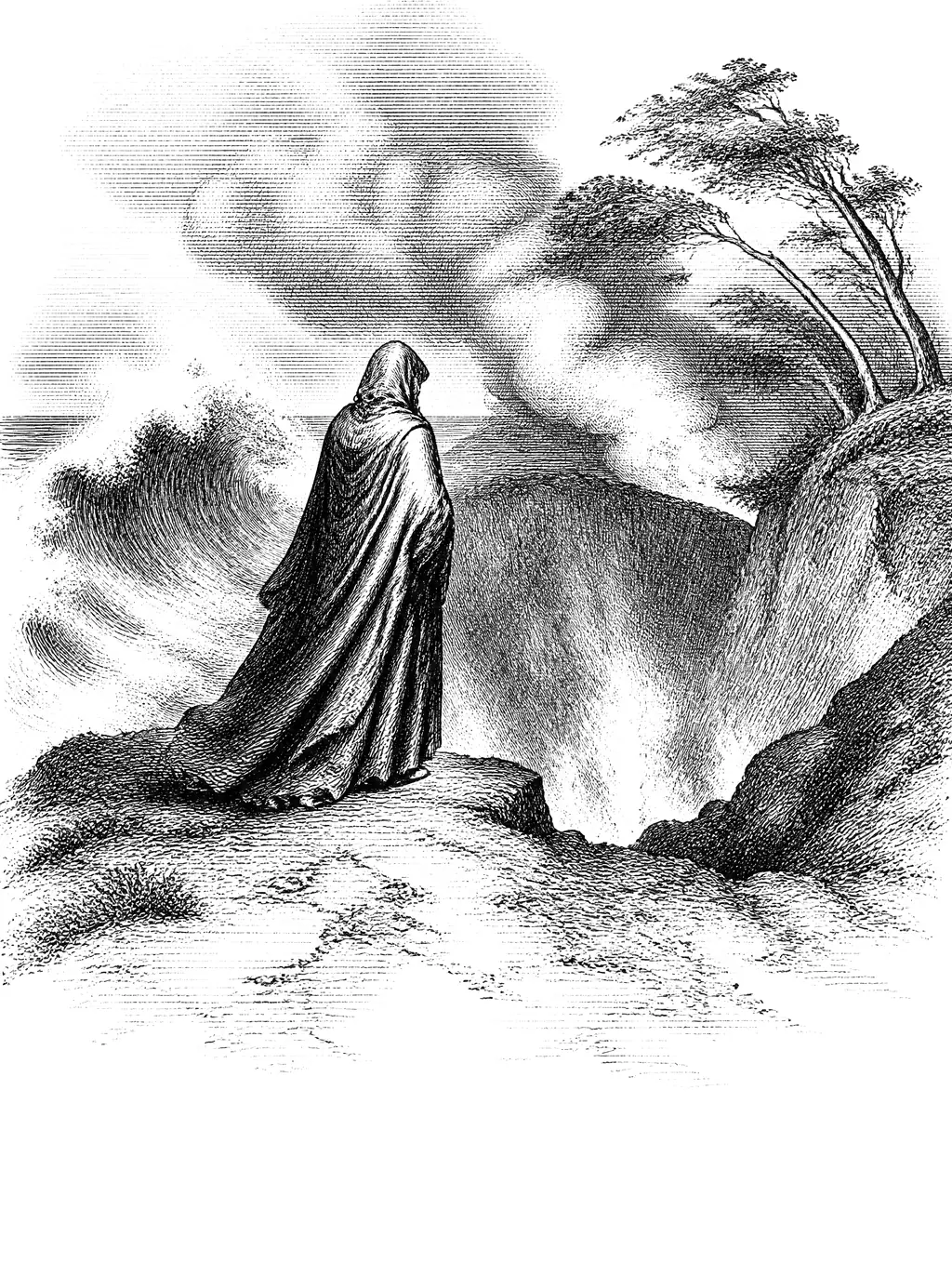
Where Parmenides had argued that true being must be one single, unchanging thing, Empedocles proposed a way out that kept plurality without abandoning permanence: not one changeless substance, but four, each individually eternal, combining and separating in endlessly different ratios to produce every object anyone has ever seen or touched. He announced it in verse, with the roots named as gods, and he walked through Sicily in a purple robe and bronze sandals claiming he could raise the dead. Later writers said he ended his life by leaping into Etna to prove he was divine, and that the volcano threw back one sandal. Under the theatre sits a working theory of matter that lasted two thousand years.
The world it came from
Empedocles lived in Acragas, a rich Greek city on the south coast of Sicily, in the middle of the fifth century BC. He was a physician, a democrat who is said to have refused a crown, a poet, and a self-described wonder-worker. Two poems are attributed to him, On Nature and Purifications, and several hundred lines survive. His philosophical problem came from Parmenides, whose argument that nothing can come from nothing had made ordinary change impossible to explain. Empedocles accepted the premise and rejected the conclusion. If nothing is created or destroyed, then birth and death must be the mixing and unmixing of things that always were. He needed permanent ingredients and a reason for them to move. The roots supplied the first, Love and Strife the second.
The idea
Hear first the four roots of all things: shining Zeus, life-bringing Hera, Aidoneus, and Nestis, standing respectively for fire, air, earth, and water. Nothing new ever truly comes into being and nothing truly perishes; the four roots themselves never change, only their mixture does, driven apart and drawn back together by two great cosmic forces, Love and Strife. Love draws unlike things together; Strife pulls them apart into their kinds. The cosmos cycles between a state of total unity under Love, a sphere in which the roots are perfectly blended, and a state of total separation under Strife. Our world exists in the passage between them. Bone, Empedocles says, is fire, water, and earth in fixed proportion. Blood is all four in equal parts.
How the reasoning runs
Premise one, from Parmenides: nothing comes from what is not, and nothing that is passes into nothing. Premise two, from the senses: things do come to be and pass away, since a child is born and an old man dies. Both premises seem true, and together they contradict each other. Empedocles's resolution: what we call birth is the coming together of ingredients that already existed, and what we call death is their parting. The ingredients obey Parmenides; the compounds obey the senses. Then a further step. Ingredients cannot combine by themselves, since matter alone has no reason to move, so there must be forces that act on it, and two are needed because there are two motions, together and apart. Hence Love and Strife.
Seen in life
Bake bread and you can watch Empedocles at work. Flour, water, yeast, and salt go in; none of them survives as itself; a loaf comes out that is a new thing to the eye and nothing new at all to the scale. Every gram in the loaf was in the bowl. What changed was the ratio and the arrangement, driven by heat and by the mixing of your hands, which is Love doing its work. Leave the loaf a week and it dries, crumbles, and moulds: Strife, separating what was joined. The modern chemist would correct the ingredients list and keep the whole shape of the story. Conservation of mass is Empedocles's first premise, still in force.
Why it matters
This is an early ancestor of a move science still makes constantly: explain the enormous variety of the visible world as different combinations of a much smaller set of stable, invisible basic ingredients. Empedocles could not test his four roots the way a modern chemist tests an element, but the underlying strategy, complexity from a few stable parts, still shapes how nature gets explained. He also introduced the idea that matter needs forces distinct from itself to move it, which is the shape physics still has. And in his account of how living things arose, with limbs and organs first wandering separately and combining at random until the fit ones survived, Aristotle saw and rejected a theory of natural selection two millennia before Darwin.
“Hear first the four roots of all things: shining Zeus, life-bringing Hera, Aidoneus, and Nestis whose tear-drops are a well-spring to mortals.”
From the source
Empedocles opens his account of the elements with an instruction to listen closely, naming each root after a familiar god: “Hear first the four roots of all things: shining Zeus, life-bringing Hera, Aidoneus, and Nestis whose tear-drops are a well-spring to mortals.” Which god stands for which element has been argued since antiquity; Nestis, a Sicilian water goddess, is the only certain one, and Burnet's identification of Zeus with fire is one reading among several. The word roots is Empedocles's own. The word element came later, from Plato and Aristotle, who took over the four and gave them the name that stuck. Empedocles's four survive as the elements in nearly every account of the ancient world.
The pushback
Why trust four roots specifically, rather than one, as Parmenides argued, or an unlimited number, as later atomists proposed? Empedocles offers no independent proof for exactly four; the number reflects an intuitive division of the sensible world into fire, air, earth, and water that later chemistry would eventually replace with a much longer, empirically derived table of actual elements. A second objection cuts at the movers. Love and Strife are named as forces, but they are described as if they were substances, occupying space and taking turns. Aristotle complained that Empedocles never explained what they were or why they alternated. If Love simply is the tendency of things to combine, it explains nothing; if it is a thing, it is a fifth root and the count is wrong.
The reply
To the first objection there is no reply from Empedocles, and the tradition offers only a defence of the method: he chose the four states of matter a Greek could observe, solid, liquid, gas, and burning, and no better observation was available. That explains the four in his time; it does not show four is right. To the second, his defenders say that Empedocles was doing something new and lacked the vocabulary for it. The idea of a force as distinct from a body did not exist yet, and he reached for the nearest available words, which were the names of gods and passions. The gap Aristotle found is real. What Empedocles saw was that matter does not move itself, and nobody before him had seen it.
Where it went next
Plato took over the four in the Timaeus and gave them geometric shapes. Aristotle kept them, added a fifth for the heavens, and built a physics on them that lasted until the seventeenth century. Galen tied the four elements to the four humours, and European medicine followed for fifteen hundred years. Alchemists worked within the scheme. Lavoisier's chemistry of the 1780s finally replaced the four with a table of elements defined by what could not be decomposed, which was Empedocles's own criterion applied with better instruments. Lucretius had already praised him as the glory of Sicily. Matthew Arnold's poem Empedocles on Etna and Hölderlin's unfinished drama kept the man alive after the physics was gone.
Where this leads
Democritus and the void answers a similar question with a starkly different picture, replacing four qualitative roots with an unlimited number of tiny, indivisible atoms moving through empty space, a rival strategy for the same underlying puzzle about what persists beneath change. Being is is the problem both of them were solving. Parmenides had made change impossible, and every physicist after him had to keep his ban on coming-from-nothing while saving the world of the senses. Empedocles kept qualities and multiplied the roots; Democritus dropped qualities and multiplied the particles. The two answers mark a fork that runs through the whole history of matter, and chemistry eventually took both roads at once.