Symposium · Metaphysics · Pl. 4Democritus · c. 460 – c. 370 BC
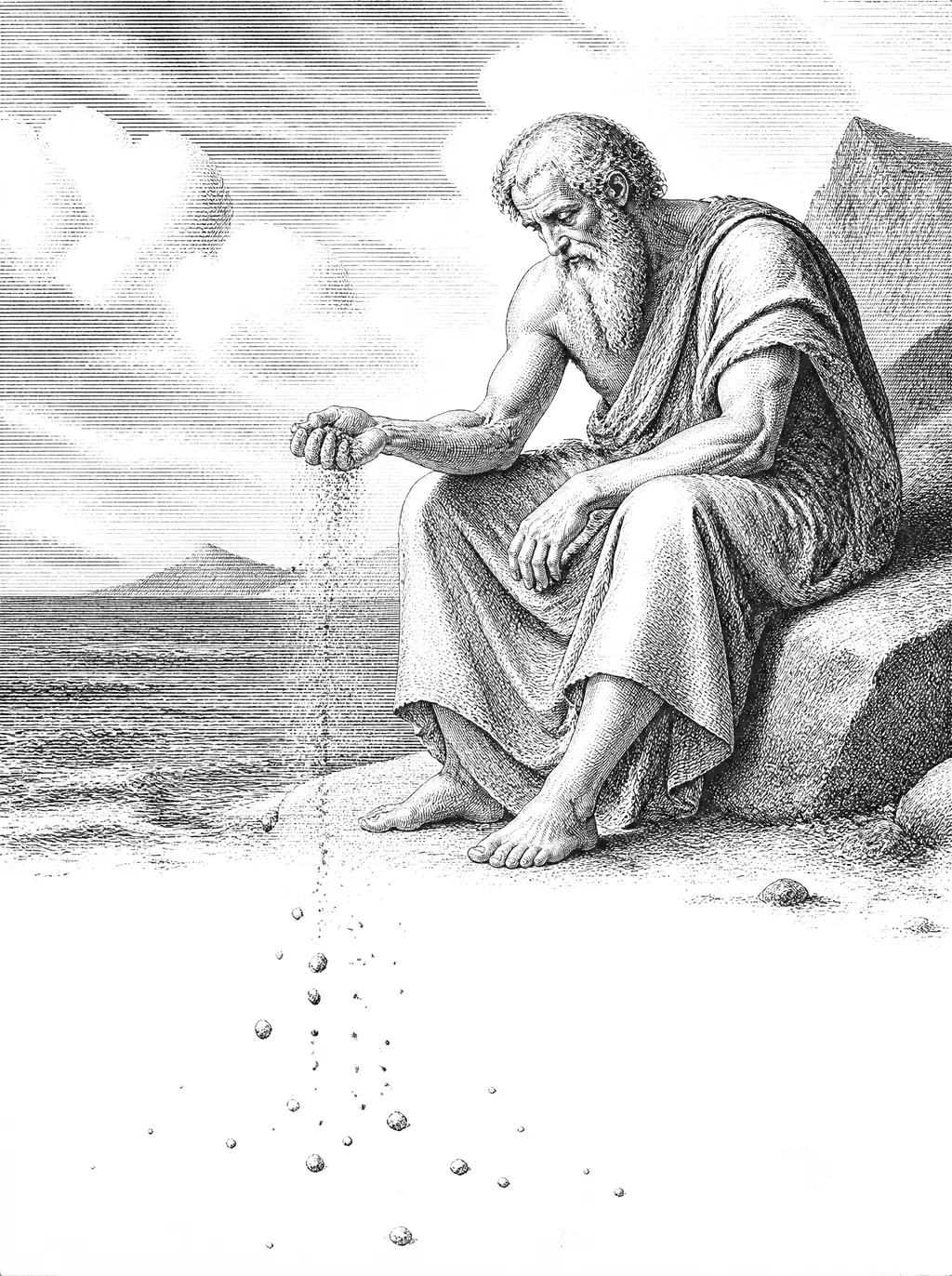
Atoms and the Void
A guess no instrument could check
Democritus and his teacher Leucippus had no microscope, no chemistry, no way to test their claim against anything smaller than the naked eye could resolve. They proposed it anyway, reasoning their way to it from first principles: matter cannot be divided forever, so there must be some smallest, indivisible piece at the bottom of everything, however far imagination has to reach to picture it. The word they chose says what they meant. Atomos is Greek for uncuttable. Below the atom there is nothing to cut, and between the atoms there is nothing at all, a genuine emptiness that earlier philosophers had said could not exist. Two ingredients, and one of them is nothing. Everything else, Democritus said, is arrangement.
The world it came from
Leucippus is a shadow; even in antiquity some doubted he existed. Democritus, born in Abdera in Thrace around 460 BC, is solid: he travelled widely, wrote on everything from ethics to mathematics, and was called the laughing philosopher for his amusement at human folly. Not one of his books survives. The problem the two were solving was Parmenides's. Being cannot come from not-being, and not-being cannot exist, so change is impossible. Melissus had added that if there were many things, each would have to be as changeless as Parmenides's one. The atomists accepted almost all of it and made a single bold move: not-being, the void, exists. Grant empty space and the Eleatic ones can multiply, move, and collide.
The idea
Leucippus's principal doctrines were that all things were infinite in number and interchanged with one another, and that the universe was a vacuum full of bodies; he was the first philosopher who spoke of atoms as principles. Democritus developed the theory further: everything that exists is either atoms, tiny, indivisible, indestructible particles, or the void, the empty space they move through. Atoms differ only in shape, arrangement, and position, like the letters of an alphabet that make different words. Sweet, bitter, hot, cold, and colour are not in the atoms at all. By convention sweet, Democritus said, by convention bitter, but in reality atoms and void. The qualities you experience are effects of shapes on your senses. The world in itself is silent, colourless, and full of motion.
How the reasoning runs
Start from Parmenides: nothing comes from nothing, and what is cannot cease to be. Now add a fact the senses insist on: things move and change. For anything to move there must be somewhere for it to move into, an empty place, so either the void exists or motion is an illusion. Democritus chose the void. Second step: if matter were divisible without limit, then dividing it completely would leave either nothing or points with no size, and neither can be reassembled into a body. So there must be smallest parts that cannot be cut. Third step: since the atoms are uncuttable, they cannot be destroyed, which satisfies Parmenides. All apparent coming-to-be is atoms combining; all passing-away is atoms parting. The shapes and arrangements do the rest.
Seen in life
Zoom in on the screen you are reading. The letters dissolve into squares of three colours, and the squares are all there is: no letter, no word, no meaning lives in any one of them. Move back and the words return, made of nothing but arrangement. Democritus saw the world this way before anyone could zoom. The taste of the coffee beside you is, he would say, a shape: atoms of a certain kind meeting your tongue, and the sweetness is in the meeting, not in the cup. It is a strange thought to sit with. Everything you find rich about the morning is, at the bottom, particles and gaps. He found the thought funny rather than sad, which is one reason they called him the laughing philosopher.
Why it matters
This strips the universe down to the barest possible ingredients, matter and empty space, and explains every visible difference, texture, color, taste, as differences in how invisible atoms of different shapes and arrangements combine. Nothing supernatural, no cosmic Mind, no divine forces, is required; complexity is just atoms arranging themselves according to their own shapes and motions. That refusal of purpose is the point where Democritus parted from nearly every other ancient thinker, and it is why Plato reportedly wanted his books burned. It also produced the first clear statement of a distinction philosophy has never let go: between how the world appears to a sensing creature and how it is in itself. Galileo and Locke restated it as the primary and secondary qualities.
“He was the first philosopher who spoke of atoms as principles.”
From the source
Diogenes Laertius records the founding claim of the school directly: “He was the first philosopher who spoke of atoms as principles.” Leucippus and Democritus held that the universe was a vacuum, and full of bodies, worlds forming as those bodies collided and became entangled with one another. Diogenes wrote in the third century AD, six hundred years after the fact, compiling from earlier sources now lost. That is the condition of everything we know about the atomists: Aristotle's discussions, a handful of quoted sentences, and a long tradition of summary. The most famous fragment, that sweetness and colour are by convention and only atoms and void are real, is preserved by the physician Galen and the sceptic Sextus Empiricus, both quoting to make their own points.
The pushback
Without any way to observe atoms directly, wasn't this simply an unverifiable guess dressed up as physics, no more provable than any rival ancient theory of matter? The comparison is fair as far as method goes; what distinguishes the guess in hindsight is how closely later, actually testable atomic theory ended up resembling the shape of this one, guessed purely from reasoning. Aristotle raised a sharper objection. If atoms have size, they have parts, and what has parts can in principle be divided. So an uncuttable body with magnitude is a contradiction. And if the qualities we experience are all mere convention, Democritus himself noticed the problem: the senses are the only evidence for the atoms, and the theory then discredits its own witnesses.
The reply
To Aristotle, the atomists could reply that uncuttable does not mean without parts; it means that nothing exists that could get between the parts to separate them, since there is no void inside an atom. Physical indivisibility, not mathematical. Epicurus later made that distinction, giving atoms minimal parts that can be counted but never separated. To the objection about the senses, Democritus left a dialogue in which the senses answer the mind: wretched mind, you take your evidence from us and then throw us down; the throw is your fall. He recorded the problem and did not solve it. The honest position is that the theory explains appearances by positing things that do not appear, a method vindicated only when the instruments caught up, two thousand years later.
Where it went next
Epicurus adopted the atoms and the void a century later, added a random swerve to make room for free will, and built an ethics on the absence of fear. Lucretius put the whole system into Latin verse in On the Nature of Things, and the rediscovery of that poem in 1417 fed the Renaissance. Gassendi revived atomism in the seventeenth century; Boyle and Newton took corpuscles for granted. John Dalton's chemical atoms of 1803 were named in Democritus's honour. Jean Perrin's measurements of Brownian motion in 1908 finally counted them. The atom turned out to be cuttable after all, but the strategy, explain the visible by invisible parts and their arrangement, is the method of every physical science.
Where this leads
The four roots proposes a rival answer to the identical underlying question from Empedocles, replacing an unlimited number of featureless atoms with a fixed four qualitative substances combined by cosmic forces, a genuine fork in how the ancient world tried to explain matter. Falsifiability is the standard by which the objection in this lesson is usually judged. Popper would say that Democritus's theory was not science in his time, because nothing could have refuted it, and became science when it began to forbid things that Dalton and Perrin could test. The atom is the best case for the idea that a bold guess can be worth making long before it can be checked, and the best warning that being right is not the same as having known.