Symposium · Metaphysics · Pl. 2Anaxagoras · c. 500 – c. 428 BC
Mind Set the Universe in Order
A different kind of first cause
Anaxagoras inherited a universe already crowded with rival explanations, one root substance, four roots, an infinite formless boundless. He proposed something that stood apart in kind from all of them: not a material substance at all, but Nous, Mind, a single unmixed principle whose only job was to set everything else in order and keep it moving. The same man who put Mind at the origin of everything also said the sun was a mass of red-hot metal larger than the Peloponnese, and Athens put him on trial for it. That combination, a cosmic intelligence and a sun made of stone, is the whole of Anaxagoras. He wanted an ordering cause and he wanted the ordinary explanations too, and he was the first to see that you could have both.
The world it came from
Anaxagoras came from Clazomenae, an Ionian city near Smyrna, and moved to Athens around 480 BC, the first philosopher to make the city his home. He became a friend and teacher of Pericles, and Athens learned to blame Pericles's friends when it could not touch Pericles. Anaxagoras was prosecuted for impiety, on the charge that he had called the sun a burning stone, and left for Lampsacus, where he died. Before him, Ionian thinkers had explained the world as transformations of one stuff, and Empedocles had offered four. Anaxagoras's problem was Parmenides's ban on coming-from-nothing, and his solution was radical: everything contains a portion of everything, and what we see is whatever predominates. Then he needed something to start the sorting, and named it Mind.
The idea
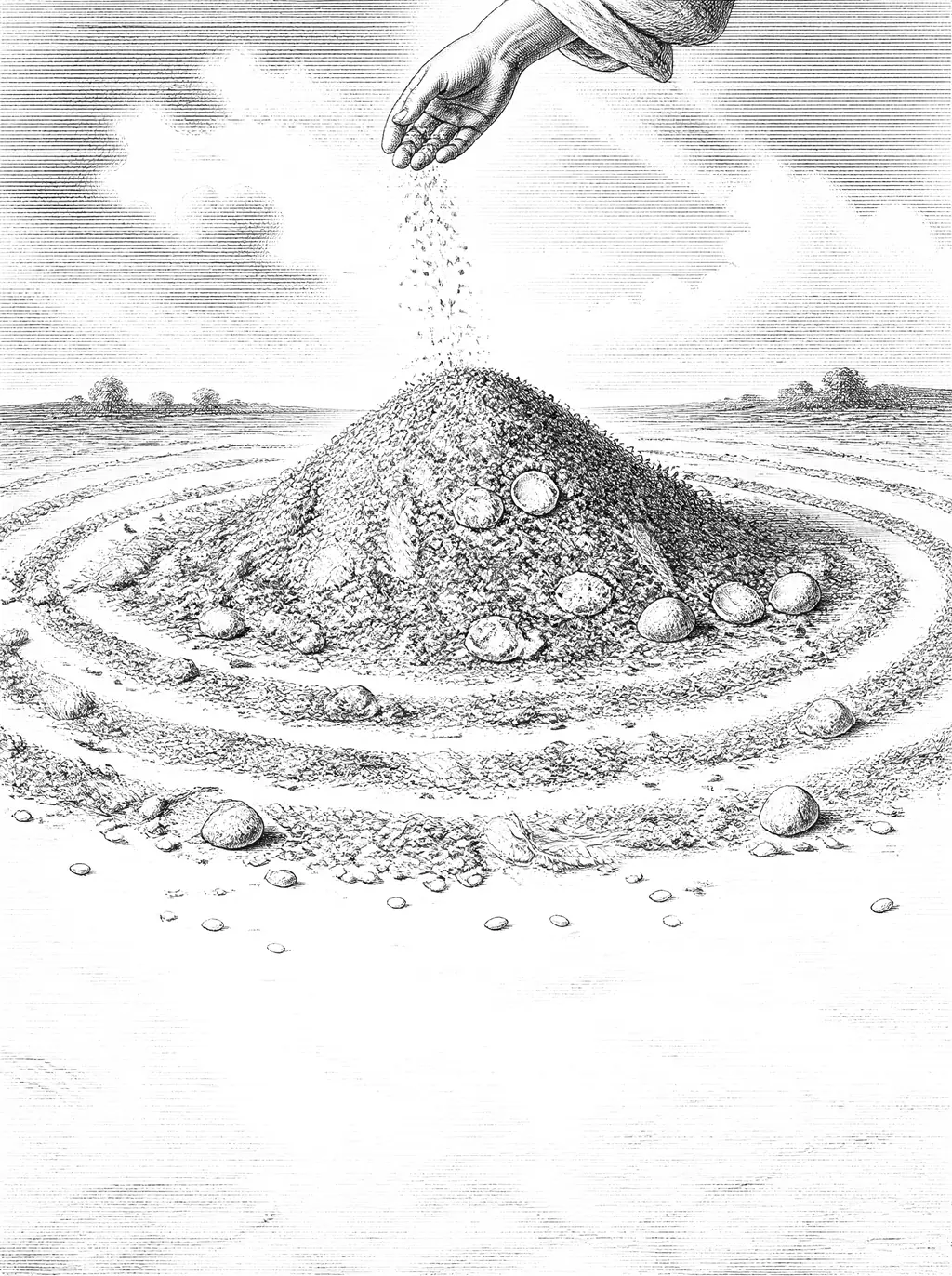
Nous is infinite and self-ruled, and is mixed with nothing, but is alone, itself by itself. Because it stays unmixed, it alone has power over all things, both greater and smaller, that have life. Nous set in order all things that were to be, and all things that were and are not now and that are, starting the great revolution that separated the cosmos out of its original mixture. In the beginning, Anaxagoras says, all things were together, so thoroughly mixed that nothing could be distinguished. Mind began a rotation at one point, and the rotation spread, separating dense from rare, cold from hot, dark from bright. Mind knows all things, has the greatest strength, and is the finest and purest of things.
How the reasoning runs
Premise one, from Parmenides: nothing comes from nothing. Premise two, from observation: hair grows from bread, flesh from water, so bread must already contain hair and water must contain flesh, in portions too small to see. Conclusion: every thing contains a portion of every thing, and the original state of the universe was a total mixture. A second argument. A mixture does not sort itself. Something must have begun the motion that separated things out, and that something cannot be part of the mixture, or it would be as inert as the rest. It must be unmixed, and it must be able to initiate rather than merely respond, which is what mind does. So there is Mind, apart from all things, and Mind set the rotation going.
Seen in life
You walk into a warehouse where a thousand deliveries have been dumped in one heap. Nothing is labelled and every box holds a bit of every order. A conveyor belt starts, and as it runs, the heap sorts itself: heavy things drift one way, light things another, until aisles and shelves appear. Anaxagoras would ask one question. Who pressed the button? The belt, the drift, and the sorting are all mechanical, and he was happy to explain them that way. But a heap does not decide to start moving. Something with knowledge of the whole, something not itself in the heap, gave the first push. That is his Nous. And note what it did not do: once the belt is running, it stands back and watches physics.
Why it matters
This introduces a genuinely new kind of explanation into philosophy: purpose and order as a cause in their own right, distinct from the raw material being ordered. Aristotle later praised Anaxagoras for finally giving the universe a reason to be arranged the way it is, rather than leaving arrangement to chance collisions of unthinking stuff. The idea also drew a line that philosophy has been arguing over ever since: between mind and everything else. Anaxagoras is the first Greek to say that mind is not a kind of matter, that it is unmixed, and that it acts on matter without being acted on. Descartes's thinking substance and every later dualism descend from that sentence, and so does the objection that a mind so separate could never touch the world.
“Nous is infinite and self-ruled, and is mixed with nothing, but is alone, itself by itself.”
From the source
Anaxagoras describes Nous directly: “Nous is infinite and self-ruled, and is mixed with nothing, but is alone, itself by itself... And Nous set in order all things that were to be, and all things that were and are not now and that are.” This is the longest surviving fragment, preserved by the commentator Simplicius in the sixth century AD, who had the book in front of him and copied out its central passages because he thought it deserved preserving. Anaxagoras wrote in prose, not verse, and the fragment shows his manner: flat, repetitive, insistent on the distinction between the one unmixed thing and everything else. Simplicius's copy is nearly all that survives of the first book of philosophy published in Athens.
The pushback
Aristotle himself, while praising the idea, complained that Anaxagoras barely used it, reaching for Mind only when other explanations ran out and falling back on ordinary material causes everywhere else, using Mind, in Aristotle's phrase, as a device rolled onstage only when nothing else would work. Socrates had made the same complaint a generation earlier, and Plato records it in the Phaedo. Socrates says he bought Anaxagoras's book expecting to learn why each thing was arranged for the best, and found instead air, ether, water, and rotation. If Mind ordered the world, it should have ordered it for a reason, and a reason should explain why the earth is where it is. Anaxagoras gave the mechanism and never the purpose. Mind starts the machine and goes home.
The reply
The best defence of Anaxagoras is that Socrates and Aristotle wanted something he had never promised. His Mind is an ordering cause, not a benevolent one. It knows all things and starts the rotation; it does not choose the best arrangement, because Anaxagoras had no concept of a best arrangement, and the rotation does the rest by physical necessity. On that reading, the reluctance to invoke Mind is not a failure but a discipline: use the special cause once, at the beginning, and explain everything else by the ordinary causes you can actually observe. That is closer to a modern cosmologist's use of initial conditions than to Plato's designer. What the defence does not answer is why Mind acted at all, or why then. Anaxagoras says only that it began.
Where it went next
Plato's Phaedo turned the disappointment with Anaxagoras into the program for teleology: Socrates wanted a Mind that arranges for the best, and Plato's Timaeus supplied a craftsman god who does exactly that. Aristotle's final cause is the same demand made systematic. Later, the unmoved mover of Aristotle's Metaphysics, which moves the world without being moved, is Anaxagoras's Nous with the mechanics worked out. Christian theology inherited the ordering Mind through both. In the other direction, Anaxagoras's naturalism about the heavens, the sun as a stone, the moon lit by the sun, eclipses explained by shadow, was vindicated in every detail, and his trial for saying so is the first recorded prosecution of a scientist.
Where this leads
The idols of the mind picks up a related thread twenty centuries later, treating the human mind not as a cosmic ordering principle but as something that has to be carefully purified of its own distortions before it can see the actual order of nature clearly. The four roots is the theory Anaxagoras was answering. Empedocles had kept Parmenides's ban on creation by positing four eternal ingredients and two forces; Anaxagoras thought four was too few, since anything can come from anything, and two forces too many, since one Mind that starts a rotation is enough. Read the two together and you can watch the earliest Greek physics argue over the question modern physics still asks: how many basic ingredients, and what makes them move.