Symposium · Metaphysics · Pl. 11Parmenides · c. 515 – c. 450 BC
Being Is
Two roads, one closed
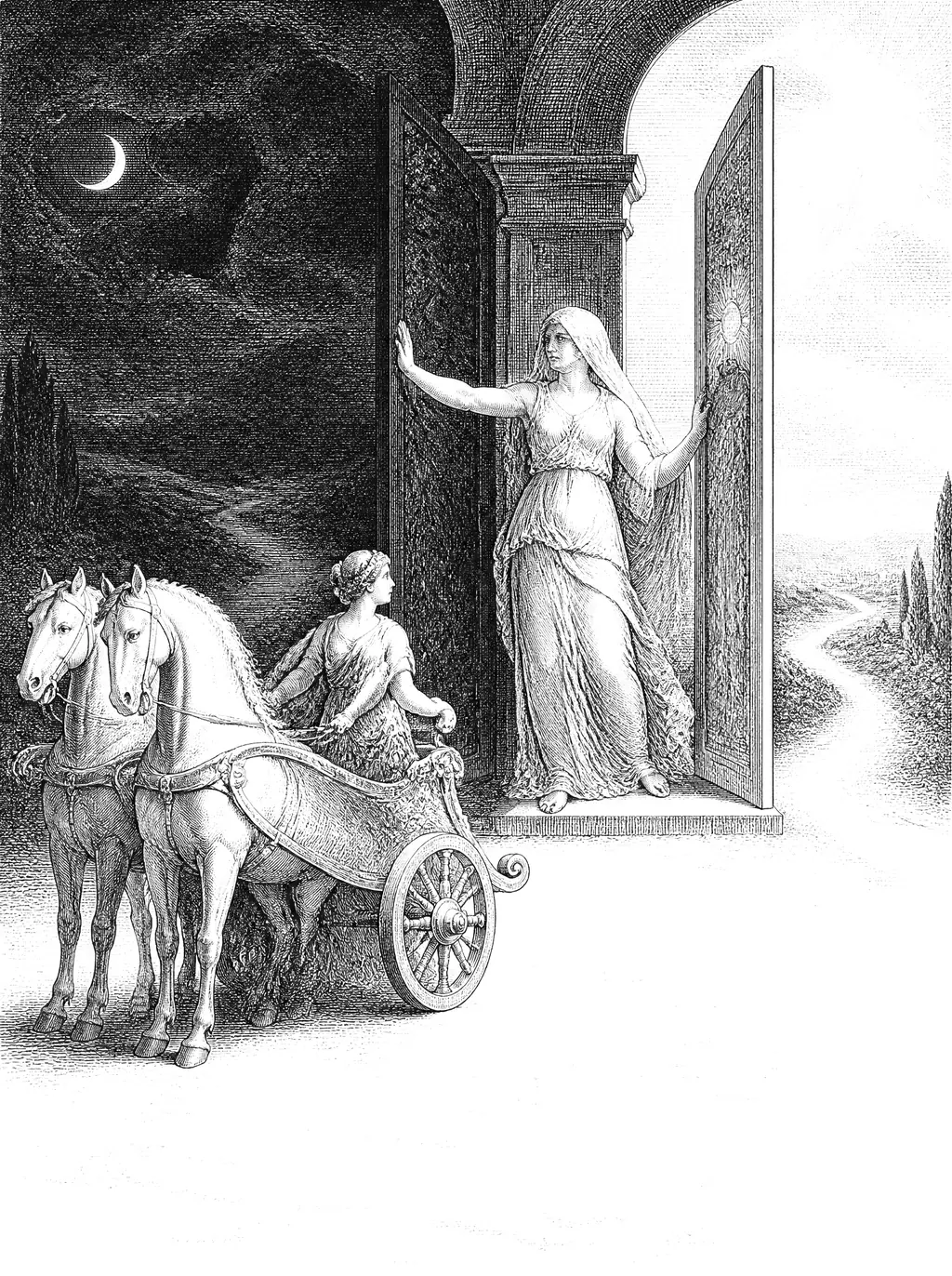
Parmenides frames his entire philosophy as a journey: a chariot carries him beyond the gates of night and day, where a goddess greets him and lays out the only two paths a mind can take. One path says that what is, is, and cannot not be. The other says that what is, is not. She closes the second road before he can even set foot on it. What she says next is the surprising part. The whole world you see, with its birth and death and movement and colour, lies on the closed road. Mortals wander there with two heads, she says, deaf and blind, mixing being and not-being in every sentence. Parmenides is about to tell you that everything you see is a mistake.
The world it came from
Parmenides came from Elea, a Greek colony on the coast of southern Italy, and is said to have written laws for the city that were still sworn to generations later. He lived in the early fifth century BC. He wrote his philosophy as a hexameter poem in the manner of Homer and Hesiod, which is why a goddess delivers it. The problem he faced was set by the Ionians before him. Thales, Anaximenes, and Heraclitus had explained the world as one stuff transforming into others. Parmenides asked what transformation would require: something that was not, coming to be. He decided that could not be said or thought, and followed the consequence wherever it led. His pupil Zeno and the Samian Melissus defended the result.
The idea
That It is, and that it is impossible for it not to be, is the way of belief, for truth is its companion. The other path, that It is not, cannot even be thought, since thinking about nothing is not thinking about anything at all. Whatever genuinely is cannot come from what is not, and cannot pass into what is not either. From that one rule Parmenides draws the whole character of what is. It is ungenerated and imperishable, since coming to be would need a prior not-being. It is whole and continuous, since any gap would be a place where it is not. It is unmoving, since movement needs empty space to move into. It is complete, like a well-rounded sphere, equal in every direction.
How the reasoning runs
Premise one: you can think and speak only of what is. What is not is nothing, and nothing is not there to be thought. Premise two: any change involves what is not. Coming to be means that earlier the thing was not; passing away means that later it will not be; motion means that the thing is not yet where it will be. Conclusion: change cannot be thought coherently, so change is not real. Apply the same rule to plurality. For there to be many things, each must be separated from the others by something that is not them, and that separation must itself be a case of not-being. So there is only one thing, unchanging and undivided. Every appearance to the contrary belongs to the way of opinion.
Seen in life
You are told that a friend has died. Try to think of the moment when they stopped existing. You picture the hospital room, the last breath, the stillness after. Each of those pictures is of something that is: a room, a breath, a body. The ceasing itself never appears. It is a word for a boundary, and the boundary has no content. Parmenides would say this is not a failure of imagination but a discovery. Non-existence is not a state a thing passes into; it is a hole in language. Grief works with what remains, and what remains is always something. His consolation, if it is one, is severe: nothing that is ever becomes nothing.
Why it matters
This is often read as the first purely logical argument in Western philosophy, reasoning about reality from the structure of thought and language alone, rather than from observation. If coherent, it implies being is single, unchanging, and eternal, since coming-to-be and passing-away would both require the unthinkable: something arising from nothing. Every philosopher who came after had to decide what to do with it. Some accepted the ban on coming-from-nothing and rebuilt the world out of eternal ingredients: Empedocles's four roots, Anaxagoras's seeds, Democritus's atoms. Plato kept Parmenides's unchanging being and moved it to the realm of Forms. The principle that nothing comes from nothing became a fixed point of physics for two thousand years. Modern conservation laws are its descendants.
“That It is, and that it is impossible for it not to be, is the way of belief, for truth is its companion.”
From the source
The goddess names two ways of inquiry. The first: “That It is, and that it is impossible for it not to be, is the way of belief, for truth is its companion.” The other, namely, that It is not, and that it must needs not be, is a path that none can learn of at all. This is the second fragment in the standard numbering, from the section of the poem now called the Way of Truth. About 150 lines of the poem survive, mostly because Simplicius, a commentator in the sixth century AD, copied out the central argument because the poem had become rare. The Way of Opinion, in which the goddess describes the deceptive world of mortals, survives only in scraps.
The pushback
If being cannot change, how does the argument explain the world of birth, motion, and decay everyone actually experiences every day? Parmenides bites the bullet completely: he calls the changing world of appearance mere opinion, not truth, a move so severe that his own student Zeno spent his career defending it with a fresh set of paradoxes about motion. A harder objection attacks the first premise. Parmenides treats is as if it had one meaning. But saying that a unicorn is not does not commit you to a thing called a unicorn with the property of not-being; it says the word has no bearer. Plato's Sophist made this point, distinguishing not-being as nothing from not-being as difference. Once is can mean is different from, plurality returns without contradiction.
The reply
The Eleatic answer to the first objection is that appearance requires no explanation of the kind demanded, because appearance is what the argument has shown to be confused. To ask how being produces the illusion of change is already to assume that being does something, and doing is change. To the second objection, the honest reply is that Parmenides had no answer, because the distinction had not yet been drawn. Plato drew it in the Sophist and called it a kind of parricide against father Parmenides. What survives the parricide is the core insight: nothing comes from nothing, and thought must have an object. What does not survive is the leap from that to a single motionless sphere. The tradition kept the premise and dropped the conclusion.
Where it went next
Zeno's paradoxes of motion were built to defend Parmenides by showing that the opposite view collapses. Melissus extended the argument. The pluralists, Empedocles, Anaxagoras, and the atomists, each accepted that nothing comes from nothing and rebuilt change as the rearrangement of eternal parts. Plato wrote a dialogue named after him and treated him with more respect than any predecessor. Aristotle's analysis of change in terms of matter, form, and privation is an answer to Parmenides's dilemma. The thought reappears in Spinoza's single substance, in Hegel's opening of the Logic with pure being, and in Heidegger, who asked why there is something rather than nothing and named Parmenides as the beginning of that question.
Where this leads
Achilles and the tortoise is Zeno's own defense of exactly this position, using several clever paradoxes about motion to show that a world of plurality and change is really no more coherent than Parmenides had already claimed it to be. The arrow paradox does the same job from inside a single instant. Read them as Parmenides's lawyers: he made the claim, and Zeno cross-examined the witnesses for the other side until they contradicted themselves. Then turn to Heraclitus, who is usually cast as his opposite. One said everything flows; the other said nothing moves. They agree on more than it seems: both distrust the senses and both find, beneath appearance, one hidden unity.