Symposium · Philosophy of Mind · Pl. 4Epicurus · 341–270 BC
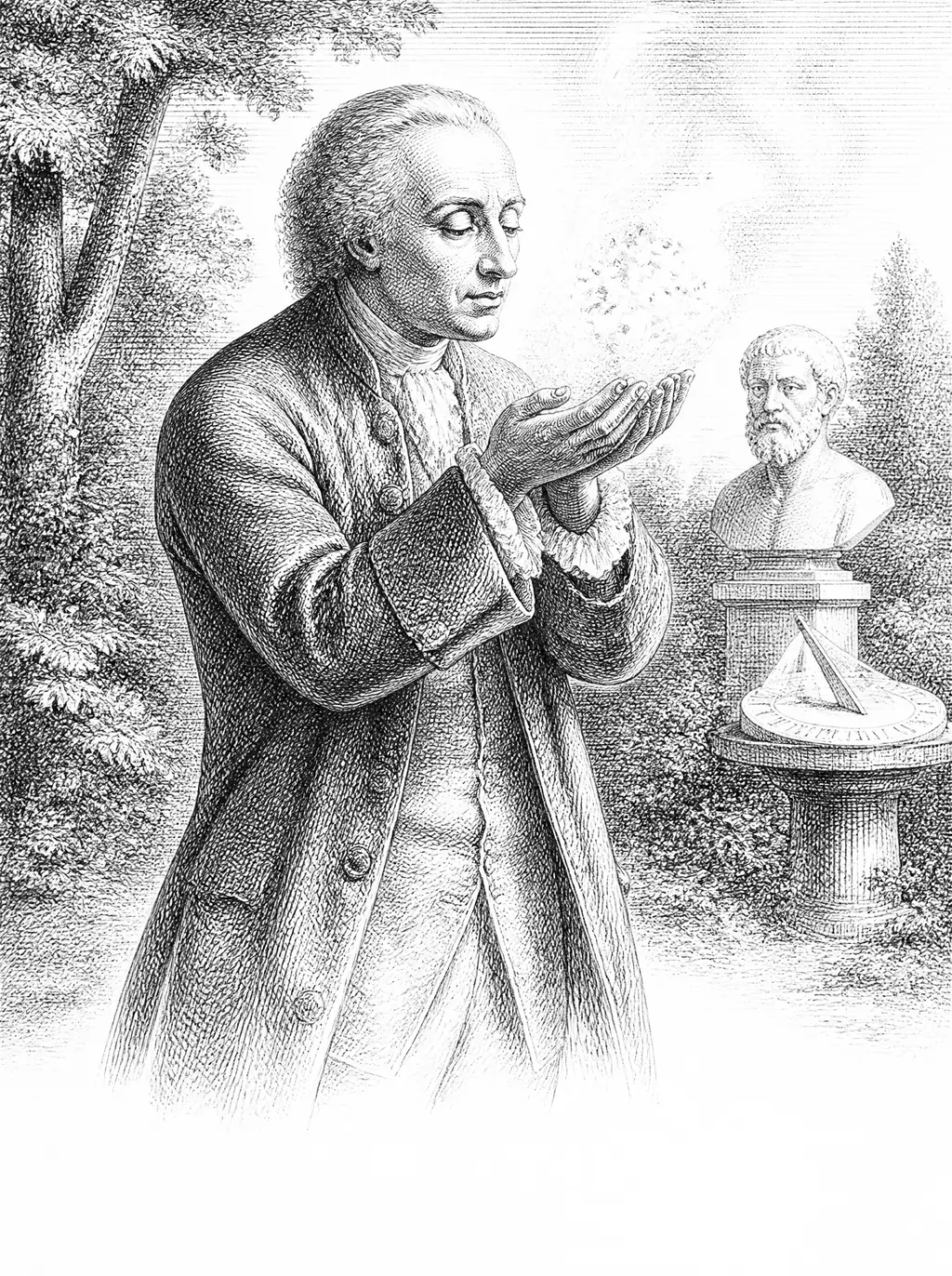
The Soul Is Made of Something
A word he refused to use
Many of Epicurus's contemporaries were comfortable calling the soul incorporeal, without body, as though that settled the matter of what it actually was. Epicurus, a strict atomist who believed everything real is made of matter moving through void, refused to let the word pass unexamined, and pushed hard on what it would actually mean for something to act, or be acted upon, while having no body at all. His answer was that it would mean nothing. Only empty space is bodiless, and empty space does nothing. A soul that moves a hand and flinches from a burn is doing a great deal. Whatever does that, he concluded, is made of something.
The world it came from
Epicurus was born on Samos in 341 BC and opened his school, the Garden, in Athens around 306. Plato's Academy and Aristotle's Lyceum were both still running, and Plato's Phaedo had made the immortal, immaterial soul the respectable view. Epicurus took his physics from Democritus: atoms and void, nothing else. His interest in the soul was not academic. The Garden taught that the two great fears, of the gods and of death, ruin a life, and that both rest on bad physics. If the soul is atoms, it scatters when the body fails, and there is nobody left to suffer. The Letter to Herodotus, which survives because Diogenes Laertius copied it five centuries later, is a summary of that physics for students.
The idea
The soul is composed of atoms of the most perfect lightness and roundness, an irrational part diffused through the whole body and a rational part seated in the chest. Those who call the soul incorporeal utter words destitute of sense, since only the void can truly be incorporeal, and the void, having no body, can neither act nor be acted upon, while the soul plainly does both constantly. Epicurus compares the soul to breath mixed with heat, plus a third, finer kind of atom with no name, responsible for sensation. Sensation belongs to neither soul nor body alone but to the two together, which is why a corpse feels nothing and why a soul without a body would feel nothing either.
How the reasoning runs
Step one: everything that exists is either body or void, because a thing either resists touch or provides the room for it. Step two: void cannot act or be acted upon. It gives bodies a place to move and does nothing else. Step three: the soul acts, since it moves the limbs, and is acted upon, since it feels pain and pleasure. Step four: so the soul is body, not void, and the word incorporeal applied to it names nothing. Step five: since the soul moves fast and spreads through the whole frame, its atoms must be the finest and roundest there are. Conclusion: at death the container breaks, the fine atoms disperse, sensation ends, and the dead are not there to be harmed.
Seen in life
You count backward from ten in the operating theater and reach seven. Then a nurse is saying your name, and it is three hours later. Nothing was experienced in between: no darkness, no waiting, no you. A few milligrams of propofol did that, a molecule that binds to receptors in the brain and turns experience off like a switch. Epicurus would ask the dualist a simple question. How does a thing with no body get knocked out by a drug? A stroke that changes someone's temper, a concussion that erases an afternoon, an anesthetic that suspends a person and gives them back: each is a case of matter acting on the soul, and Epicurus said that only shows the soul was matter all along.
Why it matters
This is an early, rigorous demand that mental language actually explain something, rather than gesture at a mystery and stop there. If the soul genuinely causes motion, feels pain, and registers pleasure, Epicurus argues, it must be made of something capable of causing and undergoing those effects, since nothing else in his universe manages to act without being some kind of body. It also ties a theory of mind to a way of living. Epicurus did not want a materialist soul for its own sake. He wanted one because a soul that scatters at death cannot be punished afterward, and a person who believes that can stop being afraid. Physics, for him, was the cure for dread.
“They who pretend that the soul is incorporeal, utter words destitute of sense; for, if it had this character, it would not be able either to do or to suffer anything.”
From the source
In his letter to Herodotus, preserved by Diogenes Laertius, Epicurus states the objection directly: “They who pretend that the soul is incorporeal, utter words destitute of sense; for, if it had this character, it would not be able either to do or to suffer anything.” He adds that, as it is, we see plainly enough that the soul is liable to both. The translation is C. D. Yonge's. The same letter describes the soul as a fine body spread through the whole frame, most like breath with a share of heat, and says the body gives the soul its share in sensation while the soul gives it back. Lucretius later expanded the whole account in the third book of On the Nature of Things.
The pushback
Doesn't reducing the soul to especially light, round atoms just relocate the mystery rather than solve it, since it is no clearer how arrangements of matter produce felt experience than how an immaterial soul would manage the very same trick? Epicurus offers a mechanism where dualists offer none, but the hardest step, matter somehow becoming experience, remains unexplained either way. A second objection came from his own contemporaries. If the soul is atoms and atoms move by necessity, then every choice was fixed before you were born, and the Garden's advice to choose wisely is empty. Epicurus's answer, a random swerve in the fall of atoms, seemed to Cicero and later critics to replace fate with a coin toss, which is not what anyone means by freedom.
The reply
To the explanatory gap Epicurus would say the demand is unfair. He never claimed that a single atom feels. Sensation is a property of the compound, as taste is a property of wine and not of any one ingredient, and a property of a compound needs the compound, not a second substance. That reply names where experience lives without saying how it arises, and honest Epicureans admit it. On freedom, the swerve was meant to show only that the chain of causes has gaps, so that what an animal does can come from itself rather than from the push behind it. Lucretius presents it that way. Whether a gap in causation amounts to a choice is a question the school never settled, and neither has anyone since.
Where it went next
Lucretius turned the physics into Latin verse in the first century BC, with twenty-odd proofs that the soul is mortal, and his poem, rediscovered in 1417, carried Epicurus into the Renaissance. Pierre Gassendi rebuilt Epicurean atomism for Christian readers in the 1640s, and Hobbes, who knew Gassendi in Paris, made the materialist soul English. La Mettrie's Man a Machine in 1747 and the French materialists took it further. Karl Marx wrote his doctoral thesis on the difference between Democritus and Epicurus, and admired the swerve. Modern physicalism about the mind makes Epicurus's bet in different vocabulary: whatever thinks is made of what everything else is made of. The objection he faced, that this leaves experience unexplained, is now called the hard problem.
Where this leads
The heart is just a spring reaches a strikingly similar materialist conclusion from Hobbes, nearly two thousand years later still, insisting that thought and life require nothing at all beyond ordinary matter arranged and set properly into motion by something else. Pleasure as the absence of pain is the other half of Epicurus's system, and the two depend on each other. A soul made of atoms cannot survive the body, so there is no afterlife to fear and no judgment to dread. Once those fears go, what remains to want is a body without pain and a mind without trouble. The physics of the soul is what makes the ethics of the Garden possible. Read them together, and neither looks arbitrary.