Symposium · Philosophy of Religion · Pl. 6Ludwig Feuerbach · 1804–1872
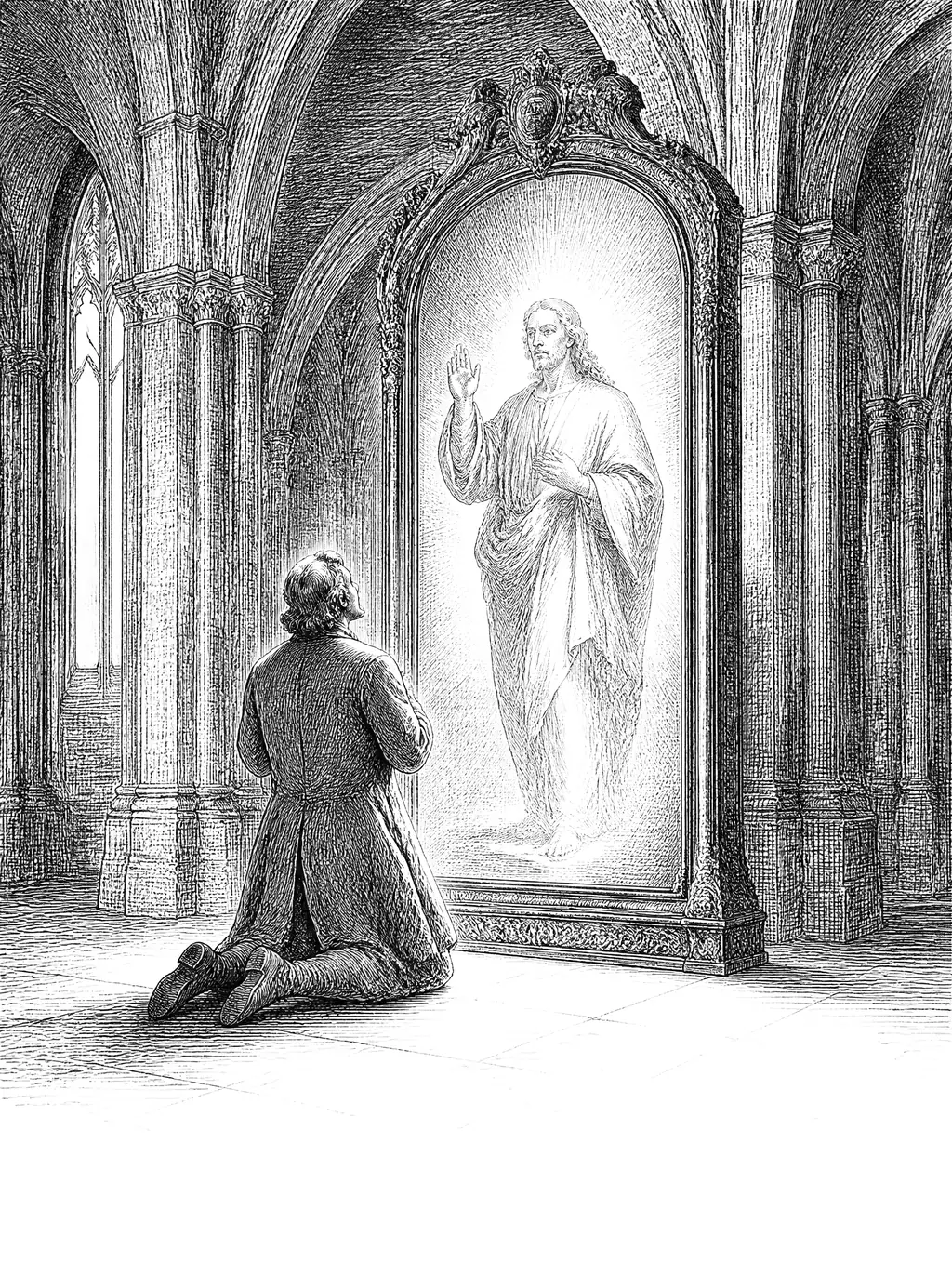
Consciousness of God Is Self-Consciousness
A mirror mistaken for a window
Feuerbach argues that theology has the whole relationship backward. Rather than God creating humanity in his image, humanity creates God in its own, taking its highest qualities, reason, love, moral will, and projecting them outward into an idealized being it then bows down to and worships as something entirely separate from itself. The Essence of Christianity appeared in 1841. Engels later recalled that on reading it his whole generation became Feuerbachians at once. The book's argument is still the first move in most modern accounts of religion as a human product.
The world it came from
Ludwig Feuerbach was born in 1804 in Bavaria, the son of a famous jurist. He studied theology at Heidelberg, then went to Berlin to hear Hegel, and turned from theology to philosophy. An anonymous early book denying personal immortality, traced back to him, ended his university career in the 1830s, and he spent the rest of his life writing on a country estate, supported by his wife's share in a porcelain factory. The Essence of Christianity, published in 1841, came out of the Young Hegelian ferment in which Strauss had just treated the Gospels as myth. Hegel had made religion a picture-language for philosophical truth. Feuerbach's move was to ask whose truth the pictures showed, and to answer: ours.
The idea
Consciousness of God is self-consciousness, knowledge of God is self-knowledge. By his God thou knowest the man, and by the man his God; the two are identical. Whatever qualities and values a culture attributes to its deity, on this account, are simply that culture's own ideals about itself, displaced outward and experienced as though they belonged to someone else entirely. The method is to take each divine attribute in turn. God's love is human love freed from limit. God's reason is human reason freed from error. The predicates are real; only the subject to whom they are attached is imaginary.
How the reasoning runs
Feuerbach's argument runs through the predicates. First, what we know of God we know through attributes: wisdom, justice, love, power. Second, each attribute is one we recognise because we possess it, in a limited form, ourselves; a being with no experience of love could not attribute love to anything. Third, the divine attribute is the human one with the limit removed. Fourth, a subject known only through predicates that are ours in idealised form is not a discovery about another being but a portrait of our own species-nature, projected outward. Fifth, this explains why each culture's God resembles that culture, and why theology changes as humanity does. Conclusion: theology is anthropology that has not yet noticed what it is talking about.
Seen in life
You watch a friend describe the god she prays to, and you notice that every quality she names, patience, unconditional acceptance, a love that does not keep score, is exactly what she wishes her parents had shown her. Feuerbach would say you have just seen his thesis in the wild: the ideal she cannot find in any human, placed where humans cannot fail it. She might answer that of course God has the qualities she most needs, because God made her to need them. Notice that both explanations fit the same facts. That is the argument's strength and its limit at once. It reads the portrait perfectly; it cannot by itself prove there is no sitter.
Why it matters
This reframed theology as a branch of anthropology, the study not of a real divine being but of what humanity secretly believes about its own nature and possibilities. It profoundly shaped Marx, who took Feuerbach's projection theory and used it to argue that religion also serves a specific social and economic function. It also changed what an atheist could say. Before Feuerbach the critic of religion mostly called it a fraud or an error. After him the critic could call it the truest thing a culture believes about itself, and still deny that anyone is listening.
“Consciousness of God is self-consciousness, knowledge of God is self-knowledge.”
From the source
Feuerbach states his central thesis without hedging: “Consciousness of God is self-consciousness, knowledge of God is self-knowledge. By his God thou knowest the man, and by the man his God; the two are identical.” Theology, on this reading, is really anthropology that has forgotten and mistaken its own true subject. He is careful to add that the religious person does not know this. To the believer, the identity is hidden; the divine feels like another being altogether. That is why religion is the first, indirect form of self-knowledge, and philosophy the second, direct one. The book's task is to translate the one into the other without loss.
The pushback
Doesn't this explanation simply assume in advance what it sets out to prove, that God is nothing but a human projection, rather than genuinely arguing for that conclusion against believers who would insist the relationship runs the other way entirely? Feuerbach's defenders reply that the pattern across so many different cultures is itself strong supporting evidence. A harder objection was raised by Marx himself. Feuerbach explains the projection but not why it is made. If humans project their essence onto a God, something about their actual life must drive them to, and Feuerbach never asks what.
The reply
Feuerbach's defenders say the circularity charge cuts both ways. The believer also assumes the direction of the relation, and Feuerbach's advantage is that his story needs no second being; the pattern across cultures, where each God wears the face of its worshippers, is data that fits his account and merely tolerates the other. On Marx's objection, the tradition mostly concedes. Feuerbach gives a mechanism and no motive, a psychology and no sociology, which is why Marx and later Freud each supplied the missing engine. Feuerbach also cannot reach the believer who says that the human attributes are the image because they are the image of God. Against that reversal his argument has nothing further to say.
Where it went next
Marx's Theses on Feuerbach (1845) accepted the projection and complained that Feuerbach had only interpreted it; the eleventh thesis says the point is to change the world. George Eliot translated the Essence in 1854, and the book fed the Victorian crisis of faith. Freud's The Future of an Illusion (1927) gave the projection a motive in infantile wish. Karl Barth took Feuerbach so seriously that he urged theologians to read him, on the grounds that any theology that starts from human experience will end in his hands. Projection theory is now standard in the psychology and sociology of religion, and any argument that starts from what gods look like has Feuerbach behind it.
Where this leads
Religion is the opium of the people shows Karl Marx, deeply influenced by Feuerbach, taking the projection theory one further step, asking not just what religion reveals about human nature in general, but what specific social and economic conditions make that particular kind of comforting illusion so genuinely necessary. God is dead is the next stage. Nietzsche accepts that God was a human creation and asks what happens to the creators once they know it. Feuerbach thought they would be liberated. Nietzsche was not so sure.