Symposium · Stoicism · Pl. 6Seneca · c. 4 BC – 65 AD
The Wise Man Cannot Be Harmed
The mob and the man
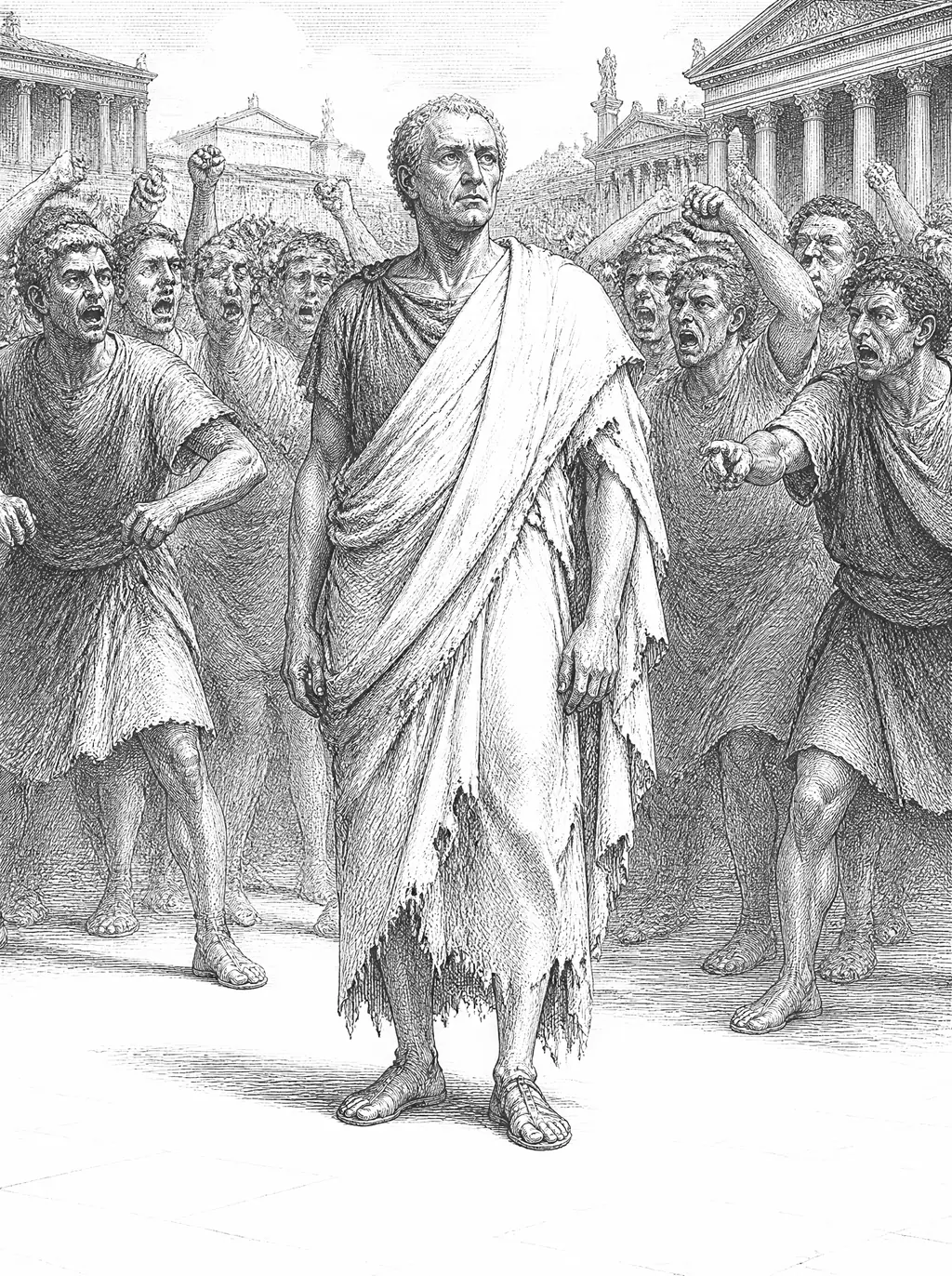
Seneca's friend Serenus is indignant on Cato's behalf: the man towered over Caesar and Pompey in character, yet his own age let a mob tear his toga off and jeer him through the streets. Seneca answers with a claim that sounds almost absurd on its face: that none of it actually harmed Cato at all. Serenus wants to know how a philosophy can look at that scene and call the man untouched. Seneca's answer takes the whole essay, and it starts by refusing to soften the claim even slightly.
The world it came from
Seneca wrote On the Firmness of the Wise Man for his friend Annaeus Serenus, a prefect of the night watch under Nero, some time in the 50s AD. Cato the Younger had been dead for a century. He had opposed Caesar to the end, been dragged from the Forum and jailed during Caesar's consulship in 59 BC, and killed himself at Utica in 46 BC rather than accept Caesar's pardon. By Seneca's day Cato was the Stoic saint of the Roman senate, a standing rebuke to every senator who had made his peace with the emperors. Seneca had made that peace; he was Nero's adviser. Writing about Cato's firmness was, among other things, a way of asking what his own compromises had cost.
The idea
A truly wise person cannot be injured or insulted, not because nothing bad happens to them, but because injury and insult require something in them capable of being damaged by outside opinion, and the wise person has stopped locating their worth there. Take away every prop of reputation and comfort, and the core the Stoics call virtue is still standing, untouched. Seneca splits the two words Serenus runs together. Injury is real damage; insult is a slight to your standing. The wise person is past the first because virtue cannot be damaged from outside, and past the second because he has stopped keeping his standing in other people's mouths.
How the reasoning runs
Seneca argues from what harm is. To be harmed is to be made worse. A person is not made worse by losing money, office, or health, since none of those is part of his character; he is made worse only by becoming less just, less brave, or less wise. Now, no one can make another person less just by force. You can take a man's toga; you cannot take his integrity without his consent. So no external act can harm the wise man in the only sense that counts. Insult follows the same path. An insult lands only if you rate the insulter's opinion above your own knowledge of yourself. The wise man does not. So the insult, like the injury, has nowhere to land.
Seen in life
The meeting ends and you learn, from a colleague who saw the email, that your manager described your work as weak in front of people you respect. Your face goes hot. Run Seneca's test. Was the work actually weak? If so, the email told you something useful and you owe it attention, not anger. If not, then a person with less information than you has said something false, in a room. Your competence is exactly where it was at nine this morning. What has been touched is your standing, and Seneca's point is that you handed him that when you decided your standing lived in his sentences. Take it back. Then fix whatever is worth fixing.
Why it matters
Most of what wounds people is not the event itself but the status it is allowed to carry: a public failure only devastates you if your sense of yourself was resting on public approval to begin with. Move that foundation somewhere the crowd cannot reach, your own judgment and conduct, and the same events lose most of their power to wound. It also gives you a reliable place to look when something stings. Ask what was actually damaged. Nine times in ten the answer is a rating, not a thing, and a rating is only as heavy as you have agreed to let it be.
“I bade you have no fears on behalf of Cato himself, because the wise man can neither receive injury nor insult.”
From the source
Defending Cato against Serenus's worry, Seneca puts the whole claim in one confident line: “I bade you have no fears on behalf of Cato himself, because the wise man can neither receive injury nor insult.” — On the Firmness of the Wise Man. He knows how it sounds. The first section of the essay is Seneca conceding that the claim seems paradoxical and refusing to soften it anyway, because the alternative, he says, is to make virtue depend on the crowd's mood. Later he compares the wise man to a rock jutting into the sea, beaten by waves for ages and showing no mark of them.
The pushback
This can sound like denial: Cato was visibly humiliated, so claiming he was not harmed looks like refusing to see plain facts. Seneca's answer distinguishes two things the mob confuses: what happened to Cato's body and reputation, which he grants was ugly, and what happened to Cato's character, which the mob never had the power to touch at all. That distinction has a cost of its own. If nothing the mob does reaches Cato's character, then a Stoic can watch an injustice done to anyone with the calm of a man watching weather. Seneca's own life invites the charge: he wrote about firmness while serving a court he later fled.
The reply
Seneca answers the denial charge by granting the facts. Cato was mocked, dragged, and jailed; the essay says so. What he denies is the inference from ugly facts to real harm, and he denies it because he thinks harm has a definition. The indifference charge is harder, and the reply is only partial. Seneca insists that the wise man defends others, punishes injustice, and gives no ground, and that he does all this without being personally wounded; firmness is what makes the defense possible. But the essay's attention is on the sage's peace, not the victim's rescue, and a reader who wants the second to come first has found a real gap. Seneca's own compromises did not close it.
Where it went next
Cato became the republican hero of the next two thousand years. Joseph Addison's play Cato, staged in London in 1713, was George Washington's favorite; he had it performed for his officers at Valley Forge in 1778, and Patrick Henry's liberty or death reworks a line from it. Seneca's definition of harm was taken up wholesale by the Christian tradition, which made the martyr the new sage: the body can be broken, the soul cannot. The playground rhyme about sticks and stones is the same claim stripped of argument. And every advice column that tells you nobody can make you feel inferior without your consent is quoting Seneca's essay, usually while crediting Eleanor Roosevelt.
Where this leads
Of providence asks why a wise universe would let its best people be tested this hard in the first place, and answers that the testing itself is exactly what proves the firmness this idea only describes from the outside, without yet explaining where it comes from. The dichotomy of control is the tool Seneca is using without naming it. The mob's hands and the mob's opinion were never in Cato's class, and the essay is a portrait of a man who had sorted them correctly long before the day of the riot, so that when the riot came there was nothing left in it for him to lose.